Written and reviewed by Bc. Petr Kučera, MSc., MBA
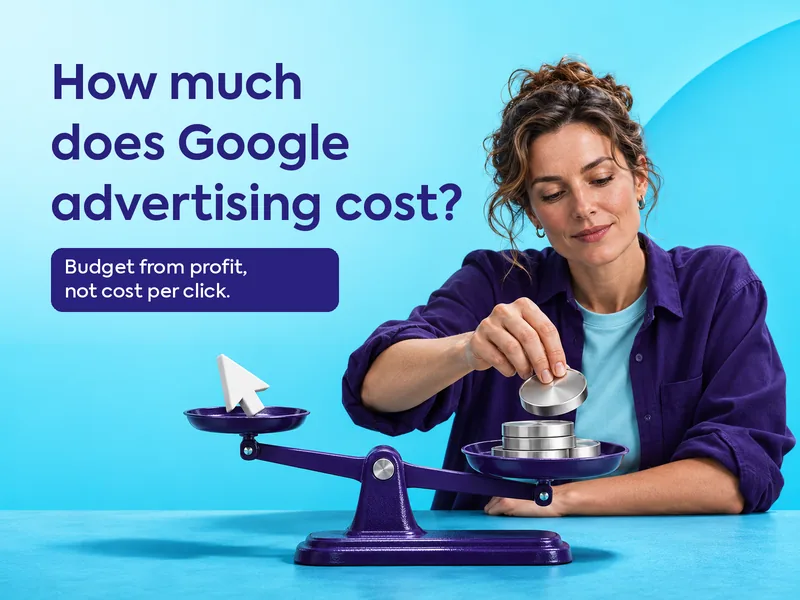
Google Ads has no general minimum spending commitment. You set and manage your own budget, as Google Ads Help explains. For a first test, we recommend estimating your budget using your expected cost per click (CPC), your expected conversion rate, and the number of conversions you need to evaluate the test. A conversion could be an order or a lead submission. This approach comes from a Czech agency budget model.
Start with what a conversion is worth to you and the margin you earn on it (Czech expert article on ad economics). Then estimate your media spend, meaning the money that goes to the ads themselves. Czech expert articles also describe costs that may come on top of media spend, depending on the project, including campaign management, conversion tracking setup, graphics, and landing pages (Czech expert article on management costs).
The figures and settings described here are current as of November 18, 2026.
First, decide what counts as a conversion, such as an order for an online store or a lead for a B2B company. To estimate your budget, you’ll need your expected cost per click (CPC), your conversion rate, and the number of conversions you’ll need to evaluate results for the period. If you base the rate on clicks, divide the number of conversions recorded from those clicks by the number of clicks for which you can track conversions. Use the same period for both counts (Google Ads Help). In this calculation, CPA means the media cost per conversion (Czech agency budget model, Google Ads Help).
To estimate the monthly budget using the Czech agency budget model, divide the number of conversions you need by your expected conversion rate, then multiply by your expected CPC. You can also calculate the budget in two steps. Enter the conversion rate as a decimal. Take every input from the same set of costs, clicks, and conversions.
| What you’re estimating | Calculation from the Czech agency budget model |
|---|---|
| Media cost per conversion | CPA = CPC ÷ conversion rate |
| Media budget | Number of conversions needed × CPA |
| Direct monthly media budget estimate | Number of conversions needed per month ÷ conversion rate × CPC |
Compare your estimated CPA with the value of a conversion and the margin you earn on it. For leads, we also recommend assessing their quality from a sales perspective. A Czech expert article on ad economics gives maximum CPA = conversion value × profit margin as a rough guide. This CPA covers media spend alone (Czech agency budget model). Assess campaign management, conversion tracking, and other costs separately.
In Keyword Planner, select the location and ad network for your new campaign to see estimates for search queries, traffic, and costs. For the selected location and Search Network settings, the low and high top-of-page bid estimates for a given keyword correspond roughly to the 20th and 80th percentiles of what advertisers historically paid when bidding for top-of-page placement. To estimate costs for a new campaign, use the forecast with your own assumptions about conversions. Google Ads Help on Keyword Planner.
According to Google Ads Help on Performance Planner, you can compare scenarios in Performance Planner for an existing eligible campaign. The tool uses data from the last 7 to 10 days, accounts for seasonality, and updates its forecasts daily. We recommend treating the forecast as an estimate and adding your own assumptions about conversions.
With CPC billing, you pay when someone clicks your ad. Google uses your bid per click in the auction, and the price you pay depends on the conditions of that auction (Google Ads Help on cost-per-click bidding). Two advertisers can therefore pay different prices for clicks on the same search query. In the search auction, Google weighs bids, competition, search context, ad and landing page quality, and thresholds for Ad Rank, which is how Google evaluates an ad in the auction (Google Ads Help on ad position and Ad Rank). Your maximum bid and diagnostic Quality Score give you only part of the picture. The actual CPC depends on the auction as a whole. Google Ads Help on actual CPC.
Target CPA (tCPA) adjusts bids based on a target cost per action. Target ROAS (tROAS) adjusts bids based on a target return on ad spend. Your billing model determines which event you pay for. With CPC billing, that’s a click on your ad. Google Ads Help on bids and CPC and Google Ads Help on billing with target CPA.
Google lets you add ad components it calls assets at no charge. It typically charges for clicks on the ad and for some interactions with assets. Clicks on reviews and seller ratings are free. Google Ads Help on asset charges. Google charges for at most two clicks per impression of an ad with assets. Google Ads Help on asset charge limits.
For most campaigns with an average daily budget, Google can bill up to 2 times that budget in a day, so spending can vary from day to day. Google Ads Help on overdelivery. For most campaigns that run for a full calendar month with the same average daily budget, the monthly spending limit is 30.4 times that budget. Exceptions apply to some campaign or budget types. Google Ads Help on spending limits.
Served costs are the costs of ads that actually ran, and they can differ from the amount you are billed. Google Ads Help on overdelivery says that when served costs exceed the applicable limit, Google covers the difference, possibly through a credit. To see how Google Ads reports both costs, consult Google Ads Help on the cost report.
Since June 1, 2026, Google has aimed for monthly spend of up to 30.4 times the average daily budget for supported campaigns with ad schedules that turn ads off for entire days. Spending may vary across active days, and the daily limit still applies. Actual monthly spend may fall below that amount. Schedules that restrict only hours within a day fall outside this change. Google Ads Help on ad schedule.
A total campaign budget caps billed spend for the entire campaign, with no separate daily limit. For supported campaign types, you can choose a total campaign budget when you create the campaign. The budget type is final once you create the campaign (Google Ads Help on total campaign budgets).
The following Czech publications show different ways to estimate costs. As of November 18, 2026, these publications do not substantiate representative CPC figures for the Czech Republic or representative monthly spend by industry. When you see an industry figure, we recommend checking what it measures, which period and country it covers, and how the publisher selected the data. Czech agency overview, Czech agency selection of offers, and Czech agency selection of estimates.
In its August 2026 sample, a Czech agency reported a range of CZK 3 to CZK 12 for typical top-of-page bids in electronics. Its sample of 70 Czech commercial keywords across industries included electronics terms. Czech agency selection of offers. In October 2026, another Czech agency estimated electronics CPC on Google Search at CZK 2.5 to CZK 3.1 for the middle half of the queries it selected. Czech agency selection of estimates. Both publishers sell paid advertising services. Their samples cover different periods and mixes of queries, and the publishers define their price ranges differently. You’d need comparable data to establish a single billed CPC for electronics or determine whether prices changed from August to October.
| Industry | Range of typical top-of-page bids from a sample of 70 Czech commercial keywords, August 2026 |
|---|---|
| Typical online store | CZK 5 to CZK 18 |
| Local services | CZK 16 to CZK 73 |
| Legal services | CZK 18 to CZK 50 |
| Finance | CZK 42 to CZK 142 |
| B2B or software | CZK 49 to CZK 130 |
The October CPC estimates on Google Search were CZK 2.0 to CZK 2.9 for fashion and footwear and CZK 59 to CZK 99 for online marketing services. Both ranges cover the middle half of the selected queries. Czech agency selection of estimates.
As of November 18, 2026, the publisher of the August bids also lists model monthly budgets it describes as cautious upper estimates. The model uses top-of-page bids, assumes a conversion rate of 1.5% for an online store and rates of 5% and 3% for services, and targets 10 to 30 conversions per month. Plug your own assumptions about CPC and conversions into the model to estimate your budget. Czech agency budget model.
| Business type | Published model monthly budget, described by the publisher as a cautious upper estimate |
|---|---|
| Smaller online store | From CZK 12,000 |
| Midsize online store | From CZK 24,000 |
| Local services | From CZK 11,000 |
| B2B | From CZK 30,000 |
| Finance | From CZK 37,000 |
smec publishes CPC figures for its European ecommerce and retail panel on two pages. The main page reports more than EUR 450 million in annual media spend and summarizes CPC for November 2026. The dedicated CPC page, updated November 16, 2026, reports medians based on EUR 650 million in European media spend. The two pages report different data volumes, and their CPC figures may differ. smec, panel overview and smec, CPC data.
| Campaign type | Median CPC from the page updated November 16, 2026 | November CPC summary on the panel’s main page as of November 18, 2026 |
|---|---|---|
| Search | EUR 0.45 | EUR 0.41 |
| Performance Max (PMax) | EUR 0.43 | EUR 0.42 |
| Shopping | EUR 0.37 | EUR 0.36 |
Channable’s publication describes a separate sample of online stores from the European Union (EU) and European Economic Area (EEA) (Channable, comparison overview). Each panel’s results apply to its own publisher’s sample (smec, CPC data). Both Channable and smec have a commercial interest in selling tools.
WordStream’s 2026 benchmark reports a median CPC of USD 5.42 and a median cost per lead (CPL) of USD 66.69. According to WordStream’s methodology, the sample includes 13,474 US search campaigns that ran on Google Ads and Microsoft Ads from April 1, 2025, to March 31, 2026. WordStream, 2026 benchmark. Adwave also identifies the sample as US-based. Adwave overview. For your own estimate, we recommend choosing figures that match your market and platform. WordStream benchmark and Secondary advertising overview.
In the same report, Cliff Sizemore, who represents an advertising services provider, warns that focusing too much on CPC can bring in cheaper clicks that don’t convert (WordStream report with the comment). The report’s publisher and the company Sizemore represents both have a commercial interest in selling advertising services.
If you’re deciding who should run the campaign, review your options for paid campaign management. A Czech advertising services provider treats media spend and ongoing campaign management as separate costs. Depending on the project, launch may also involve one-time work such as setting up conversion tracking, creating graphics, and preparing landing pages for the ads. Czech expert article on management costs.
Start with the value of a conversion and your profit margin (Czech expert article on ad economics). Before launch, set your budget and decide which actions to track, what CPA you can accept, and which margin to use. Check your payments profile and the tax rules that apply to you (Google Ads Help on billing). Also check the countries where you plan to show your ads (Google Ads Help on surcharges).
As of November 18, 2026, Google’s billing documentation mentions Google Ireland. Check your invoice to confirm which company is billing you. Google Ads Help on billing. Check your account’s billing settings to see which payment options apply (Google Ads Help on payments profile).
Under the general EU rule for cross-border services between businesses, the default place of supply is where the business customer is established (European Commission on the place of supply). You may have to report value-added tax (VAT) even if your invoice shows none. The place of supply, the customer’s status, and the specific invoice all matter. Czech VAT Act and Google Ads Help on billing.
The standard rate of 21% applies when an advertising service has its place of supply in the Czech Republic and the customer accounts for the tax (Czech Financial Administration on the Czech tax system, Czech VAT Act). The net VAT impact is zero for a VAT payer entitled to deduct the full amount. Under Section 6h of the Czech VAT Act, a business with a registered office or fixed establishment in the Czech Republic that is not a VAT payer becomes an identified person when it receives a taxable service with a place of supply in the Czech Republic from a person not established there. If an earlier payment triggers an obligation to report VAT, the business becomes an identified person at the time of that payment. An identified person cannot deduct VAT on that supply (Czech Financial Administration (on selected provisions of the VAT Act)).
If you are a non-VAT payer and receive a service from a person not established in the Czech Republic, check the conditions for identified person status in Section 6h of the Czech VAT Act. If you’re unsure how VAT applies, we recommend reviewing the invoice with an accountant or tax advisor. Google describes how billing works in Google Ads Help on VAT and billing.
Surcharges depend on where the ad actually appears. As of November 18, 2026, Google’s list of countries with surcharges excludes the Czech Republic. Google lists 5% for Austria, 2% for France, and 2.5% for Italy. It announced that the rates for France and Italy would both rise to 3% on January 1, 2027. Google Ads Help on surcharges.
Based on Google Ads Help, we recommend regularly checking billed spend (Google Ads Help on costs), along with the budget type, changes to the budget, and the campaign schedule (Google Ads Help on ad schedule). If costs jump, first find out whether the report shows served or billed costs. Then review the countries where your ads appeared (Google Ads Help on surcharges) and confirm that conversion tracking is set up correctly. For an existing eligible campaign, you can compare scenarios in Performance Planner to see how the campaign might perform (Google Ads Help on Performance Planner).
If you expect a significant change in conversion rate and your campaign type and bid strategy support seasonality adjustments, Google recommends using them, ideally for 1 to 7 days. Smart Bidding, which automates bidding, already accounts for ordinary seasonality. Google Ads Help on seasonality adjustments.
To evaluate the economics of your ads, see our articles on return on ad spend (ROAS) and PNO, the Czech cost-to-revenue ratio. After the evaluation period, compare your plan with the media spend Google billed you for (Google Ads Help on costs). According to the Czech agency budget model, CPC can fall while CPA rises if the conversion rate drops far enough. We recommend assessing CPC, CPA, conversion value or quality, and margin for the same period and campaign scope (Czech expert article on ad economics). Use those results to recalculate your budget.
If costs appear to exceed the applicable limit, compare served costs with billed costs and check the budget type, the period, and any credit. If billed costs still appear to exceed the limit after those checks, contact Google Ads support with your billing document and cost report. Google Ads Help on costs. If your conversion tracking can’t tell you which conversions have value, discuss the setup with a paid advertising or analytics specialist. Czech expert article on management costs.
Start with profit to estimate what Google advertising can cost your business. A single average figure won’t answer that question. Multiply conversion value by margin to get a rough estimate of your maximum CPA for media spend alone. Multiply that figure by your conversion rate to estimate the most you can afford per click when you count only media spend. Use industry bid and CPC tables only as a rough guide. As of November 18, 2026, none of the Czech publications cited here give a representative Czech CPC by industry. Cheaper clicks don’t guarantee results if your conversion rate falls. We recommend evaluating the first month by CPA and margin, because CPC alone doesn’t determine the outcome. For most campaigns with an average daily budget, Google can bill up to 2 times that budget in one day. For most campaigns using this budget type, the monthly spending limit is 30.4 times the average daily budget if it stays the same for the full month.
Google Ads has no general minimum spending commitment, and you control your budget. Google Ads Help. With CPC billing, you pay when someone clicks your ad. Google Ads Help on CPC. Your actual search CPC depends on the auction, including factors such as bids, competition, and the quality of your ad and landing page. Google Ads Help on Ad Rank and Google Ads Help on actual CPC.
Yes. For most campaigns with an average daily budget, Google can bill up to 2 times that budget in a single day. For those campaigns, the monthly spending limit is 30.4 times the average daily budget if the campaign runs for a full calendar month with the same budget setting. Exceptions apply to some campaign or budget types. Google Ads Help on spending limits. Google says it covers the difference if served costs exceed the applicable limit. Google Ads Help on costs.
In a search campaign with CPC billing, Google bills you for clicks. Target CPA influences how Google sets your bids in the auction. Google Ads Help on billing with target CPA. Pay for conversions is a separate option for eligible Display campaigns using target CPA. Google Ads Help on pay for conversions.
For the selected location and Search Network settings, they correspond roughly to the 20th and 80th percentiles of what advertisers historically paid when bidding for top-of-page placement for that keyword (Google Ads Help on Keyword Planner). The individual auction determines what you actually pay per click (Google Ads Help on actual CPC).
For most campaigns with an average daily budget, the daily billing limit is 2 times the budget. For most campaigns using this budget type, the monthly spending limit is 30.4 times the average daily budget if the campaign runs for a full calendar month with the same budget. Google Ads Help on spending limits. A total campaign budget caps billed spend for the entire campaign, with no separate daily limit. For supported campaign types, you can choose a total campaign budget when you create the campaign. The choice of budget type is final. Google Ads Help on total campaign budgets.
You may have to report VAT even if the invoice shows none. With cross-border services between businesses, the place of supply, your status as the customer, and the specific invoice all matter (European Commission on cross-border services). Under Section 6h of the Czech VAT Act, if your business has a registered office or fixed establishment in the Czech Republic and you are not a VAT payer, you become an identified person when you receive a taxable service with a place of supply in the Czech Republic from a person not established there. If an earlier payment triggers an obligation to report VAT, you become an identified person at the time of that payment. An identified person cannot deduct VAT on that supply (Czech Financial Administration (on selected provisions of the VAT Act)).
Surcharges depend on the country where the ad appeared. As of November 18, 2026, the Czech Republic is not on Google’s list of countries with a surcharge (Google Ads Help on surcharges).
At PPC ONE, we offer advertising services for Google Ads and Sklik. If you’d like to discuss your campaign budget or what to track at launch, get in touch with us.
Contact us
About the author
Bc. Petr Kučera, MSc., MBA
AI Systems & Marketing Strategist, founder of PPC ONE
Petr discovered the power of performance campaigns back in 2011, and they have been an inseparable part of his professional life ever since. His edge comes from working with more than a hundred companies.




 80 client reviews