PPC management makes sense for online stores and service businesses with a proven offer and a clear idea of what they can afford to pay for a new customer.
You might recognize one of these:
You spend on ads but don't know how many orders or leads they bring.
Reports show numbers but not what they mean or what to do next.
You inherited an account where tracking can't be trusted.
You want to add another platform or expand into a new market.
You want to know who is responsible and what you get for the fee.
When would you advise us to check the project's economics first?
If the offer isn't proven yet or the website doesn't work, we first work out with you whether ads can pay off at all. When people aren't searching for your product yet, search ads have little demand to work with, so we don't recommend starting with that channel. If your offer already sells, we work out how much you can pay to win a customer and whether your margin can cover it.
That tells you whether to invest in campaigns now, validate the offer first or fix the website.
Is your website or offer holding back sales?
We check whether your ads attract the right visitors and whether the site records orders or leads. If those visitors don't convert, we look at how your prices compare with competitors', how clear and fast your site is, what your reviews say and how quickly you respond to inquiries.
Before you increase your budget, we explain what we found and what's holding back sales or leads.
How does PPC differ for online stores and services?
For an online store, we track sales, revenue, margin and cost of sale (ACoS, ad spend as a share of the revenue it brings). A product feed supplies the listings for both Shopping in Google Ads and Zboží.cz, a Czech price comparison site, through Seznam's ad platform Sklik.
For services, we look at how many leads you get, what they cost, and what business they could bring. Two leads at the same price can be worth very different amounts to you, depending on the deal they could lead to. If businesses buy your services for their own operations, we allow for a longer decision process and the need for more data when evaluating results.
What we do
What PPC campaign management includes
Management is ongoing work. At the start, we agree on a business goal and check tracking. Every week, we manage and test the campaigns. Every month, we explain the results and propose next steps. We judge each change by what it does for sales and leads. Some clients have stayed with us for 7 years.
What you seeYour ads
The foundationStrategy. Data. Tracking. Optimization.
Kickoff
Tracking and structure check
We start with your goal: revenue, margin, customer acquisition cost or lead quality. Cost of sale is one metric, and we build the strategy around your goal.
We check whether the reported conversions match that goal, and review account structure, budget split and settings.
We write the ad copy. Visuals come from you or can be ordered from us separately. Either way, we recommend formats and evaluate how the creatives perform.
Weekly
Manage and test campaigns
We review search terms and negative keywords, adjust budgets and bids, test ads and respond to swings in performance.
For an online store, we judge changes by the sales they generate and at what cost. For services, we look at what leads cost and what they're worth. Clicks alone are not enough.
Monthly
Results, explained
Your report explains how results changed, what they mean and what we recommend for the next month.
Ad platforms
Ad platforms and international campaigns
How we choose: goal, budget, data
Facebook Ads is Meta's proven advertising platform, with broad reach and a strong price-to-performance ratio. It is ideal for promoting products and services people are not actively searching for, or for projects in their early stages. With attractive, original creative, Facebook advertising can even outperform search campaigns on Google.
from €1,590 per month
Instagram Ads is Meta's proven advertising platform, with broad reach and a strong price-to-performance ratio. It is ideal for promoting products and services people are not actively searching for, or for projects in their early stages. With attractive, original creative, Instagram advertising can even outperform search campaigns on Google.
from €1,590 per month
Google Ads is the original PPC advertising platform and a cornerstone of any strategy for promoting products and services. By targeting users precisely while they are searching, one of the most important moments in the marketing mix, it delivers an excellent conversion rate. Google Ads performs best alongside Google Analytics.
from €1,590 per month
YouTube is the world's second-largest search engine, with precise targeting that sets it apart from traditional TV advertising. Advanced options let us target customers by keywords, demographics, location, interests or past behaviour, maximizing the chance of reaching the right people.
from €1,590 per month
TikTok can be compared to Facebook in its early days: low advertising costs and a rare window of opportunity to build large, successful accounts. TikTok is ideal for brands that want to reach a new audience while their existing customers are already active on other channels.
from €1,590 per month
LinkedIn Ads is an advertising platform with precise targeting by job title, company size, seniority and industry, making it an ideal tool for B2B marketing. Because costs are higher, it is better suited to specialized campaigns aimed at specific professional segments, where targeting quality matters more than volume.
from €1,590 per month
Microsoft Ads (formerly Bing Ads) has regained momentum thanks to technological innovation, integration with the Microsoft ecosystem and AI. In the Czech Republic, its share is in the low single-digit percentages, but in international markets it reaches 4–20% depending on the segment. With lower competition, it usually offers a cheaper alternative to Google Ads.
from €1,590 per month
Seznam Sklik today works more like a media house than a classic search engine. It offers broad advertising options in attractive media spaces, where your banners can run in high-impact formats such as branding or native advertising. These formats deliver greater visibility and stronger brand perception.
from €1,590 per month
How do you choose the platforms for a project?
Which channel to use depends on your business goal, the budget available and the data you'll have to evaluate results. If people already search for what you offer, search ads are worth considering. If your product isn't something people usually search for, Facebook or Instagram can introduce it. For services aimed at professionals, LinkedIn Ads can target by job title or industry, for example.
We limit the number of platforms so your budget can generate enough data on each to tell whether it's paying off.
What kind of international campaigns have you run?
We worked on global campaigns for the startup Rankacy and for ArtMaster, a music education project. We also manage campaigns for the Polish company Chroma that target the Czech market.
Where your company is based and which market you target are separate questions. In the form, describe your offer, who you want to reach and whether it's one market or several. That's what we use for the first assessment.
What does the platform automate, and what do you handle?
The platforms adjust auction bids, match ads to search queries and assemble ads from the assets you provide. Together with you, our team sets the business goal, checks conversion data, sets budgets and keeps watch over your brand and the queries your ads appear for.
In Google Ads, we use AI Max for Search and Demand Gen for our clients. In Sklik, we work with Chytrá kampaň (Smart campaign) and Maximalizace konverzí (Maximize conversions). We judge each feature by its results in your account.
Case study #1
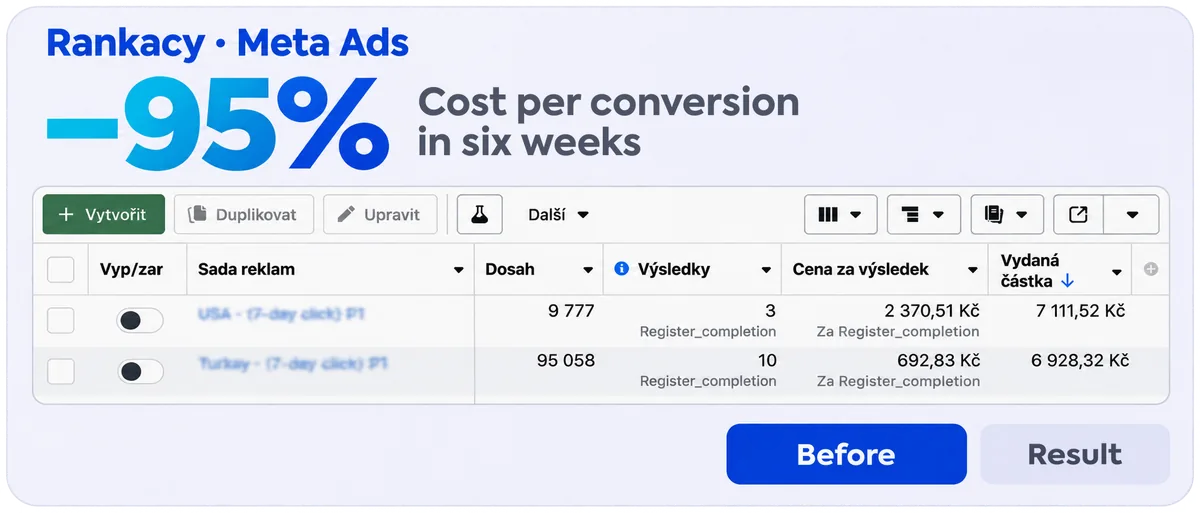
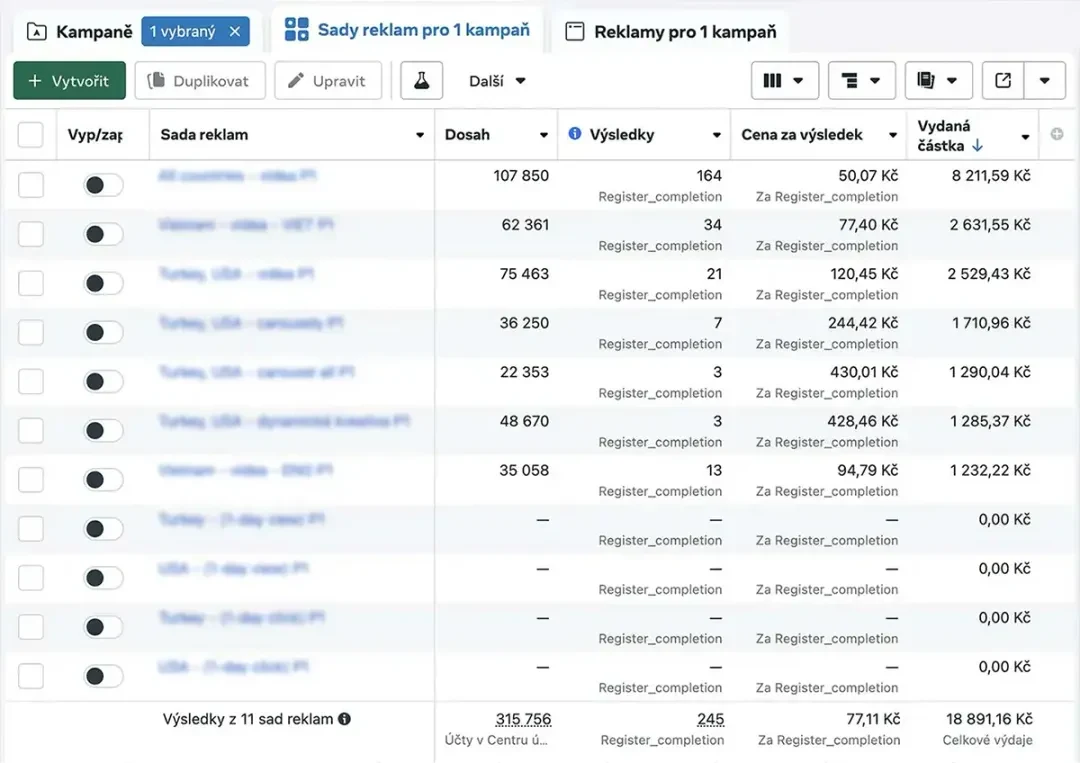
Cost per conversion down 95% on Meta. We don't pause, we scale fast
Server-side tracking recovers part of the conversions the browser loses.
+474% more conversions from the winning ad platform
+483% more conversions from strategic video creative
Results:Cost per conversion reduced by 95% in six weeks.
Case study #2
Alenka, Škola Stylu
"The product was so unconventional, I was convinced no one could pull it off."
Server-side tracking recovers part of the conversions the browser loses.
Tracking set up via Google Tag Manager
Optimizing against the client's real sales data
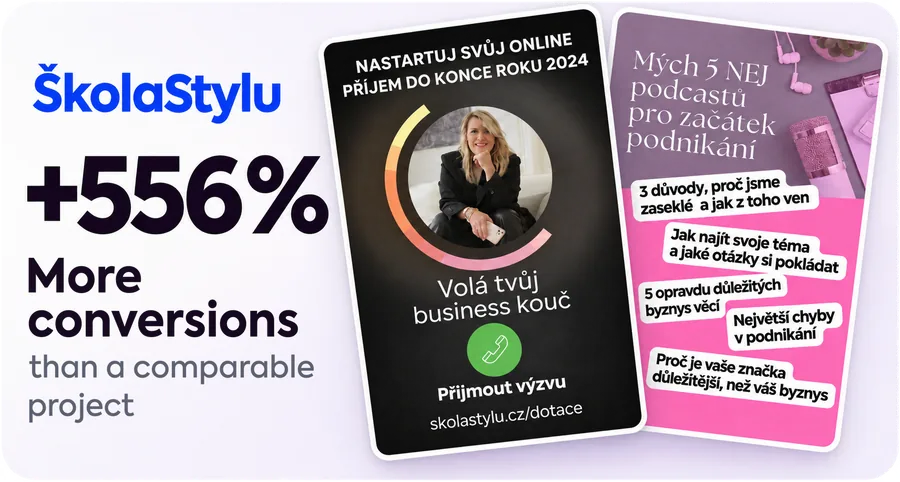
Results:Conversions 556% better than on a comparable project.
Case study #3
Cheap clicks, CPM, or sales? Choose wisely.
Your ads have a much higher CPM than the previous agency's.
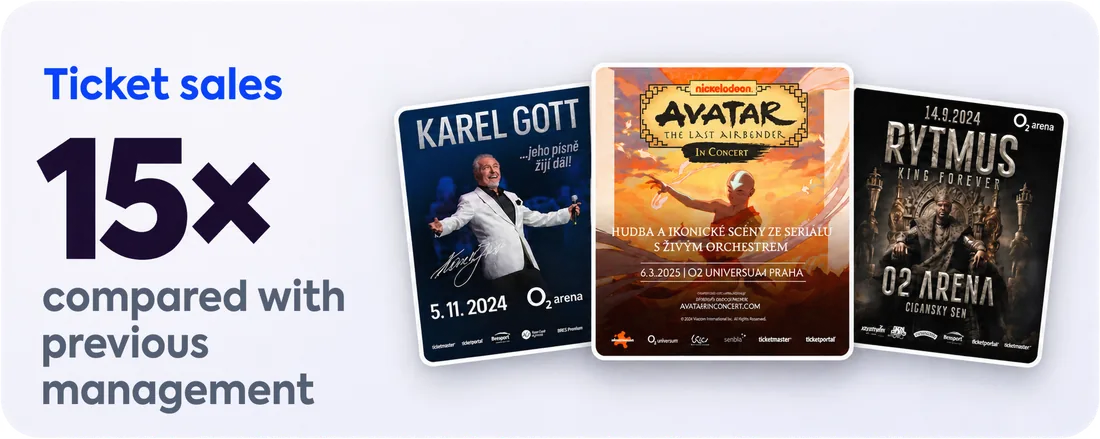
True, but revenue is 15x higher. Do we want cheap CPM, or sales?
Sales, of course. Thank you.
Server-side tracking recovers part of the conversions the browser loses.
Switching optimization to conversions and deploying the Pixel
Optimizing with the right attribution (1 or 7-day click)
Results:15x more ticket sales than under the previous management.
How can you verify the ratings and badges?
The Prověřená společnost (Verified Company) badge and our Meta Certified Media Planning Professional certification are in the footer.
On Google, we have a 5.0/5 rating from 30 reviews (as of November 12, 2026). On Firmy.cz, we rank 3rd out of 1,826 advertising agencies in the Czech Republic.
We've managed PPC campaigns since 2011. More than 100 companies have trusted us with their campaigns.
An overall score is only part of the picture, so read individual reviews too. You'll find them on our references page. If you have a specific type of project in mind, look at case studies that show the starting point and what we changed.
How long do clients stay with you?
Some clients have worked with us for 7 years. As of November 2026, roughly half of our current clients have been with us for more than a year.
We count only active clients whose length of engagement is documented by invoices or reports in our archive. One-off projects are not included.
How should you read these numbers?
Each result has its own baseline. We compare performance with the previous management, with the same campaign before we made changes, or with a comparable project. Look at each figure alongside the metric, the baseline, and what changed.
Treat the figures from one case study as separate comparisons. When a study shows several results, adding them together won't give you the campaign's overall effect. It's more useful to look at which metric we track and how its movement relates to the change we describe.
What people say about us on platforms we cannot influence
Alenka Š. ŠkolaStylu
I worked with Petr Kučera from the PPC ONE team on a sales campaign for one of my online products. The product was so unconventional that I was convinced no one could make it work. Petr did, and keeps doing it, with total confidence and amazing results!
Lukáš Rosulek Svoboda & Williams
A genuinely interesting alternative to large performance agencies. Dozens of campaigns behind them, with their own approach and models for setup and data analysis.
Adéla Vedralová Opero Prague
A very pleasant and effective collaboration. Petr from PPC ONE set up our LinkedIn ads brilliantly, and the results were excellent. Thank you, highly recommended 😊
Nicola L. Moser Glass
They were always genuinely willing to meet us halfway and find solutions within the constraints we faced, both financial and industry-specific. Everyone on the team who worked with our in-house team was deeply human, professional and dependable, with a remarkable feel for the brand's DNA and needs.
Zuzana Krejčíková Bestsport, O2 arena
We've worked together for several years, and it's a real pleasure that they don't just execute the brief, they actively bring new ideas and opportunities.
Michal Příhoda National Theatre
A reliable approach and excellent communication, 5/5.
Team
A senior team on your account
Petr Kučera & Pavla Rýznarová
Petr Kučera, founder. Running performance campaigns since 2011: 15 years, thousands of campaigns and more than 10,000 hours of hands-on work.
PR
Pavla Rýznarová (Pája), CEO and project manager. She coordinates the team, budgets and task delivery, drawing on more than 12 years of leading people and running online projects.
Conversions also counted store visits and clicks on the phone number. In January 2026, the account reported 733 conversions from 11,574 clicks, while purchases and bookings were not tracked correctly.
2Purchase recorded before payment was confirmed
The purchase event fired as soon as someone reached the payment gateway. Automated bidding could therefore optimize for an event other than a completed sale.
3The same purchase tracked twice
A follow-up check found the same business event tracked twice and no native Google Ads website conversion.
4Internal log: about four months without real work
The budget stayed the same the whole time. A steady budget or few manual changes don't prove much on their own. You also need to look at results and how automation was handled.
We look at how Performance Max treats your own brand and how it relates to a separate brand campaign, if you have one. For brand searches, we check exclusions and how impressions are split between campaigns.
We look at the searches that actually triggered your ads and review the negative keywords. We identify specific irrelevant queries. The findings show how well the account filters searches. A count of exclusions alone tells us little.
Why start with tracking?
In a Google Ads account we took over, we found a setting that recorded a purchase as soon as someone reached the payment gateway. On top of that, 2 imported conversion actions tracked the same purchase. One purchase could therefore be counted more than once in the totals, and reaching the gateway didn't yet prove payment.
We check when the business event actually happens and when tracking records it. Then we look for duplicates and check which signal the bidding strategy uses. That signal should reflect the action you actually want customers to take.
What signals it's time to change managers?
The first test is whether your manager can explain business results. If the account spends money and the report doesn't show how many orders or leads it brought, you should get an interpretation and a concrete next step. The steps proposed should match the goal you agreed on.
Judge results together with how automation is being used. An unchanged budget or few manual changes don't mean much without more context. If the evidence isn't clear, have the account reviewed.
How it works
From your brief to ongoing management
1
Fill in the form
Describe the project and your goals for advertising.
2
Internal review
If the project's a fit for us, we'll invite you to an online meeting.
3
Needs and goals
We agree on the brief and scope.
4
Access and tracking
We work in your existing accounts or set up the ones you need.
5
Preparation and launch
The first invoice is issued when work begins.
6
Ongoing management
Weekly work on the campaigns and a monthly review of results.
Pája coordinates communication and requests. We usually reply within 24 hours. We log requests in HelpScout so no email goes unanswered.
How do I give you access to my accounts?
The account is in your name, or we work in one you already have. Access is granted through the platform's own features, so you never share a password, and you can remove it at any time.
Step-by-step guides and permission levels for each platform are on our access page. You stay in control of access for the entire engagement.
What does linking to your MCC manager account mean for us?
Our Google Ads agency manager account (MCC) links to your account so we can manage campaigns. You own the data and keep administrator rights. You can unlink our MCC from your own account.
You keep your own Google Ads login and can manage the account yourself. You can unlink our manager account and switch providers while keeping access to your own data in Google Ads.
What do you need from us once we're running?
At the start, we need access to your ad accounts and analytics, your business goal and what you can afford to pay for an order or lead. We need this to manage campaigns around business results.
Visuals, unless you order them from us, and a heads-up on changes to prices, products, promotions or capacity that affect the campaigns. Pája coordinates everything, and we usually reply within 24 hours.
Reporting
Live performance data and a monthly explanation
Your report in Data Studio is available any time. Setting it up, worth €500 to €1,250, is included. Each month, we add commentary and recommendations.
We start with business results:
You can judge the work on the account from the change history together with the commentary in our report. The number of manual changes alone doesn't give the full picture, because automation makes some of the adjustments.
From business goal to ad
1
Business resultsRevenue, margin, leads
2
EfficiencyCost of sale and cost per conversion
3
Ad deliveryCTR (click-through rate) and CPC (cost per click)
How do you account for a bidding strategy's learning period?
With automated bidding in Google Ads, we factor in the strategy's learning period and the length of your conversion cycle. For the learning status it describes, Google states up to 7 days. Adapting to a new goal usually takes 1 to 2 conversion cycles. A cycle is the time from contact with an ad to the action you want.
When customers need more time to decide, we expect some results to show up later. We also base our conclusions on the number of conversions recorded.
How do you handle visitor consent for tracking?
We implement Consent Mode v2 for our clients. For user data from the European Economic Area, Google requires appropriate consent and the related signals for measurement, personalization and remarketing. The implementation passes each visitor's choice on to Google.
In the Czech Republic, non-essential cookies have required active consent since January 1, 2022, under Section 89(3) of Act No. 127/2005 Coll.
Server-side tracking costs €239 per month excluding VAT and is included in the Medium plan and above.
We start with the business metric that matches your goal: revenue, margin or leads. Then we look at cost of sale or cost per conversion to see what it costs to get those results.
Click-through rate helps us diagnose how ads perform in the auction, and cost per click tells us what a visit costs. If cheap visits bring in few or no orders or leads, we go back to the business metrics to judge performance.
Pricing
Price depends on ad budget and number of platforms
Management starts at €1,590 per month. The management fee is separate from the ad budget you pay to the platforms.
What monthly budget are you planning?
€20,000
"A top-tier online marketing team for the price of one receptionist"
Radek, Digitag s.r.o.
Ad budgetMinimum campaign budgets are €400 per month per ad system.
Ad platformsFacebook and Instagram count as a single ad platform; the same goes for Google and YouTube.
Campaign setup
Senior PPC specialist
Project manager
Senior strategist15 years of experience in online marketing.
Facebook and Instagram count as 1 platform because both run under Meta Ads. Google and YouTube sit in one system, Google Ads. Google Ads and Sklik are 2 separate platforms.
When comparing options, look at the ad systems the campaigns will run in. For example, Facebook plus Instagram counts differently toward your plan than Google plus Sklik. We use the number of platforms counted this way, together with your budget range, to choose your plan.
How billing works
Item
How it's billed
Ongoing management
Flat monthly fee by plan
Campaign and analytics setup
€1,000 deducted from the next invoice after month 3
Data Studio setup and monthly report
Included
Server-side tracking
€239 per month, included from Medium
Ad budget
Separate from the management fee
Ad banners
From €790 for 12 concepts, of which we produce 6 to 8 banners in the required sizes
Website design
From €11,990, with the option to add branding work
Targeted LinkedIn messages
From €1,090 per month, with a minimum ad budget of €300 per month
Your landing page affects PPC performance. We offer website development as a separate service.
Why does the amount of data matter when planning?
We recommend at least €400 per month in ad spend for each ad system. Which strategy we choose depends on how much data that budget will generate. In Sklik, for example, the Maximalizace konverzí (Maximize conversions) strategy needs at least 30 conversions in the past 30 days. That's why we also watch how many results are recorded when choosing a strategy.
When we monitor spend, we take each system's rules into account. In Google Ads, spend on a single day can reach up to 2× your average daily budget. Google states a monthly limit of 30.4× that average daily budget.
How to plan your ad budget
Basic calculation for an online store
Target revenue from adswhat you expect ads to bring in
Start costs €1,590 per month and covers the work of a senior PPC specialist, a project manager and a senior strategist, with reporting included. For campaign and analytics setup, we deduct €1,000 from the invoice that follows your third month. The ad budget is separate.
“I'll lose control of my accounts.”
The accounts are in your name, and you can ask for them to be handed over at any time. You see performance in Data Studio around the clock. Access works without sharing a password, and you can revoke it.
“We already work with someone.”
Have the account reviewed independently. An audit starts at €1,390 excluding VAT, with 50% off if we then start working together. You get specific findings to inform your next decision.
“PPC didn't work for us before.”
We check tracking, setup and the business goal. The website, price or offer can also hold results back. We don't promise results, because online marketing can influence at most 20% of a product's or service's success. We use campaign data to decide on the next steps.
“I don't want a long commitment.”
No minimum term and no notice period.
An online team is a growth engine for your business. Why?
"A genuinely compelling alternative to big agencies."
Illustrative comparison based on 15 years of industry experience
Illustrative comparison based on 15 years of industry experience
Choosing a provider
Agency, freelancer or in-house specialist?
Decide based on the people, the scope of work, the price and how results are evaluated. The same service name can cover a different scope of responsibility.
Five questions to ask every provider
Who owns the accounts?
With us, accounts are set up in your name, or we work in accounts you already own. You decide who else gets access.
Check this before you start. For a new account, ask whose name it's in and who can grant or remove access.
Who manages the campaigns day to day?
Jakub and Jana, our senior PPC specialists. Every week they review search terms, adjust budgets and bidding strategies, and test ads.
With other offers, find out who actually works in your account.
What does the monthly fee cover?
Campaign management, strategy, project management, ad copy and reporting. At the start, we agree on the business goal. During management, we change settings and run tests. In the report, we interpret the results and recommend what to do next.
Two offers with the same service name can include very different amounts of work. Ask what is actually delivered, who is responsible for proposing the approach, and whether you'll be told why each change was made.
Does the fee depend on ad spend?
No, it's a fixed monthly fee. Your plan depends on your budget range and number of platforms. As long as both stay the same, swings in spend don't change the fee.
If the scope changes, for example you add another system or move into a new budget range, we reassess the plan. When comparing offers, check how many systems and how much ad budget each one covers.
What happens if the goal isn't met?
We go back to the agreed goal and check tracking, settings and performance. Depending on what we find, we take a closer look at your offer, price and landing page.
Based on the data, we may adjust the campaigns or recommend investigating an issue with the website or offer. The report explains what the numbers mean and what we'll focus on next.
How do you compare an agency, a freelancer and an in-house specialist?
Compare specific offers by who will do the work, how much capacity you get and what they'll be accountable for. With an agency, find out who leads strategy, which work the monthly fee covers, and how you'll submit requests. With a freelancer, check the experience and availability of the person doing the work and confirm what you're paying them to do. For an in-house specialist, look at what it costs to fill the role and how much time that person will have for campaigns alongside other duties. Also check whether they'll need support from other specialists. The table below helps you compare specific offers.
Criterion
PPC agency
Freelancer
In-house specialist
Expertise
Account manager and strategist
Experience of the person doing the work
Candidate's experience plus other skills you'll need
Price
Flat fee and actual scope
Rate and time booked
Full cost of the role plus services you'll need
Speed
Response time and task handoff
Available capacity and agreed response time
Time for campaigns alongside internal tasks
In a 2025 US survey by Setup and CMO Institute, reasons for changing agencies included dissatisfaction with delivery (61%), dissatisfaction with value (61%) and a lack of understanding of the client's business (44%).
What does management cost, and how does it relate to the ad budget?
Management starts at €1,590 per month with the Start plan. That's what you pay us for the work. The ad budget is a separate amount that goes to the platforms to show your ads.
Plan for both amounts from the start. In the form, enter what you want to spend on the ads themselves, so we can assess it against your goal and the scope. All plans are listed on our pricing page.
What is the minimum ad budget?
For planning, count on at least €400 per month in ad spend for each system you use. Management is billed separately. We recommend setting aside ad funds for at least 3 months, so there's enough to evaluate.
If you split the budget across several systems, each one needs enough to produce usable data. How many systems we use depends on your goal, your budget and what can be evaluated. Enter your planned ad budget in the form.
Can you audit our account without us changing managers?
Yes. An audit starts at €1,390 excluding VAT. A senior specialist checks tracking, structure, search terms and brand handling, and explains the findings.
Based on the findings, you decide whether to keep your current management or change it. If you then start working with us, we deduct 50% of the audit price from your first monthly management fee.
Who owns the accounts, and what happens if we part ways?
The account is in your name. Throughout the engagement, you control the access you've granted and can remove ours at any time.
The accounts and campaigns stay with you. Depending on the project, we hand over analytics and the other materials we used, which may include tracking, the product feed, audiences, ad copy, creatives and the report. A new manager can pick up from your existing accounts and materials.
How does the setup deduction work?
Campaign and analytics setup costs €1,000. After your third month with us, we deduct that amount from the following invoice. Allow for the setup cost in your initial budget, since the credit comes later.
At kickoff, we clarify your business goal, review tracking and account structure, allocate the budget, and configure the campaigns.
When will I see results?
The first performance data comes in after launch. For orders or leads, it depends on how many get recorded and how long your customers usually take to decide. The longer the decision, the more time you need.
We draw conclusions based on how much data is available. The report shows how performance is developing, what it means so far and what we'll monitor or adjust next.
How often do we get reports, and how can we see what changed?
You can see live data in Data Studio at any time. Every month you get a report with explanations and recommendations. We work on the campaigns every week.
To see what's happening in the account, read the change history together with our commentary on the results. The history shows the recorded changes, and the commentary explains how performance moved and what we'll focus on next. When you look at the number of manual changes, keep in mind that automation makes some of the adjustments.
Who creates the ad copy and visuals?
Ad copy is part of management. Visuals come from you, or you can order them from us as a separate service. Either way, we recommend formats and evaluate how the creatives perform.
When we agree on scope, tell us what materials you have and what needs to be created. Before we prepare the campaigns, we agree on who supplies the visuals and what work is needed.
Do you promise results?
We don't promise a specific number of orders, leads or business results. Results also depend on your offer, price, website, market and customer service. For leads, that includes how fast you respond after someone submits a form.
We agree on the business goal at the start and manage your campaigns toward it. Our reports explain how performance is changing, what the data means and what changes we recommend.
When does it make sense to increase the ad budget?
When the data shows that more spend will bring orders or leads at a cost your margin can carry. Typically, that's when campaigns hit their budget limit or when we want to expand the campaign structure or run more tests. If the website, price or offer is holding things back, we deal with that first.
Our fee is fixed within your plan's budget range, so spending more within the same range doesn't raise the management fee.
Do you manage campaigns abroad?
Yes, we have experience with campaigns in the US, Europe and Asia. In your brief, include the countries you're considering, your offer, your goal and information about any existing campaigns.
We choose platforms based on your goal, budget and what's needed to evaluate results. We'll go through these inputs and the scope at the first meeting.
Have you worked in my industry?
Our published references include ŠkolaStylu, Svoboda & Williams, Bestsport, Národní divadlo (the Czech National Theatre), Moser Glass and Opero Prague. For a specific industry or campaign, tell us about your offer, your audience and the result you need, and we'll assess how relevant our previous experience is.
Read the references with your own project's goal in mind. Our case studies show the starting point and the changes we made.
How do we get started?
Fill in the form using the Submit your project button. Tell us about your offer, audience, advertising goal, website and planned budget. We review your brief and invite you to an online meeting if the project's a fit for us.
At the meeting, we go through your needs, business goals and scope. Next come access, a tracking check and campaign preparation. The first invoice is issued when work begins. Your brief gives us a starting point for the meeting.












 from €1,590 per month









 3.5

 4.5