Written and reviewed by Bc. Petr Kučera, MSc., MBA
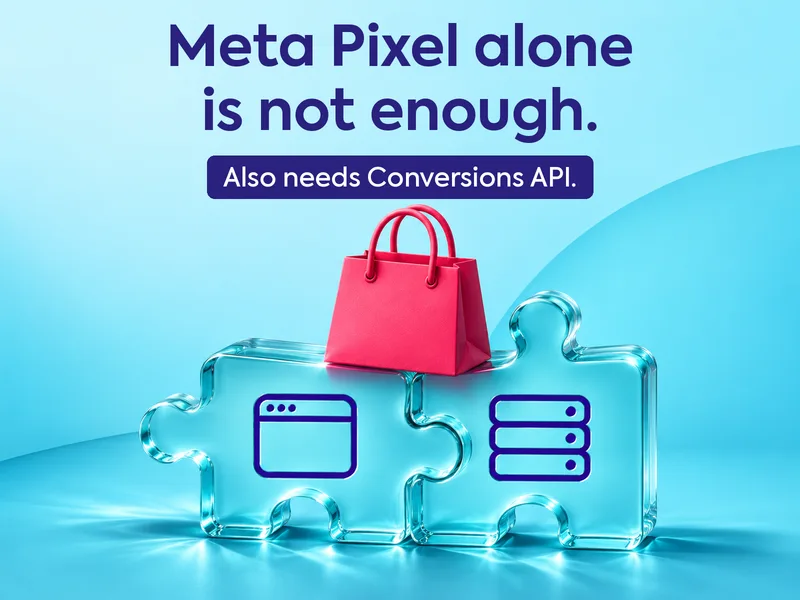
Meta Pixel and Conversions API: why the pixel alone is not enough
See how Meta Pixel and Conversions API work together, check event deduplication, matching and coverage, and understand differences in reported purchases.
meta-pixel-conversions-api
According to PPC Land’s explanation of attribution, Ads Manager reports purchases attributed to advertising. Meta’s rules differ from those used by Google Analytics, for example.
Purchase values first. Compare the numbers with your orders separately from attribution.The data and settings in this article are current as of November 10, 2026.
The Meta Pixel sends web events from the visitor’s browser. The Conversions API (CAPI) is an interface for sending events to Meta from a server (direct integration course, using the API).
According to Meta, CAPI is less affected than the pixel by loading errors, connection problems and blockers (study).
Meta recommends sending the same business event through both routes and deduplicating it correctly, so that the copies are recognized as one action.
Our conclusion from Meta’s recommendations and the study is conditional: a server copy can supply a signal lost along the browser route, provided the server actually obtains and sends the event. That mechanism explains a potential benefit.
In some implementations, the browser passes an event to a tagging server, which processes measurement events (Google’s introduction). In others, the event can be created directly in the backend, for example while an order is being processed, without any trigger from the browser. How exactly the event is passed to Meta depends on the implementation (sending data).
Before choosing an integration, we ask: Where does this solution obtain the event it sends? As Google’s documentation shows, calling a setup server-side does not answer that question. Our article on server-side conversion tracking principles explores the broader context.
PageView events even without third-party cookies, and some US Safari visitors were matched to Meta accounts. Matching reach ranged from 0 to 51% across experiments.Drawing on Meta’s documentation and attribution rules, we use three questions to distinguish the stages. Each question addresses a different part of the process.
| Stage | Question to check |
|---|---|
| Delivery | Did Meta receive the event that was sent? |
| Event matching | Was the event linked to a Meta account? |
| Attribution | Was the purchase credited to an ad? |
An event can reach Meta without being successfully matched or attributed. That is the practical implication of separating data quality from attribution. CAPI therefore guarantees neither complete conversion tracking nor agreement between attributed purchases and the orders recorded by your store.
Meta Blueprint treats event matching and event deduplication as separate mechanisms. Matching connects an event with a user. Deduplication concerns whether two copies of the same action are counted once. We check both independently.
According to PPC Land, attribution rules decide whether a purchase is credited to an ad. Correctly configured pixel and CAPI implementations cannot, on their own, make Meta’s count equal your order count.
We recommend checking the actual attribution settings in the ad set. 2026 explanations of attribution settings for web conversions describe a default of 7-day click, 1-day view and 1-day engagement. According to AdExchanger and the settings explanation, a March change expanded and renamed the former engaged-view category.
Pair the technical check with an assessment of what marketing actually brings the business. How campaign results differ between Facebook and Instagram is covered in Facebook vs. Instagram.
For the ID-based method described by Meta, browser and server copies of the same purchase must share an event name and event ID to be merged into one action. Separate actions need separate IDs.
According to Meta’s documentation, copies of the same action share the event name and the ID. The pixel uses eventID, while CAPI uses event_id. The event name goes in event_name. Both copies point to the same Pixel ID, which identifies the target pixel (official code).
Meta’s documentation for ID-based deduplication requires both the name and the ID to match (deduplication). We recommend keeping both values identical on both paths. A different or missing ID can prevent deduplication (official code).
A secondary account of Meta’s rules describes a 48-hour deduplication window. That window concerns the reconciliation of copies under the described rules. It is neither a recommended sending delay nor a data retention period. The event name and destination pixel also matter.
According to the same secondary account, every distinct action gets its own ID. If another action arrives with the same pixel, name and ID within that window, it can be discarded.
The secondary account also describes an alternative method using the same event name with fbp or external_id. In general, this method requires a preceding browser event within the last 48 hours. According to that source, it does not remove repetitions within the browser source alone or within the server source alone. Those restrictions belong to this alternative method. They should not be carried over to the recommended method based on an event ID.
In an archived PPC ONE record for one online store, we found the Meta Pixel installed both in the page code and through Google Tag Manager (GTM). A single page view produced two PageView events with different event_id values. For that store, we recommended removing the pixel from GTM and retaining the installation in the page code.
IDs that do not match, or senders that are unclear, are a reason to review the implementation (official code). On their own, they are not a reason to change a campaign automatically.
According to Meta’s materials, EMQ assesses the information used to match server events, and Event coverage is the seven-day average share of pixel events also received through CAPI with the same deduplication key (EMQ factsheet, data quality documentation).
In Meta’s materials, Event Match Quality (EMQ) evaluates the customer information accompanying server events for matching to Meta accounts. It assesses the inputs available for event matching.
Documentation and guides list email, phone number, the external identifier external_id, the parameters fbp and fbc, IP address and browser information in user agent (customer information parameters). Their use must fit the specific integration and comply with the applicable legal framework.
Based on our reading of Meta’s materials, deduplication, revenue, order values and campaign performance require separate checks (Meta Blueprint, data quality documentation).
Meta’s technical materials specify different handling for different data types. Normalization standardizes a value’s format before hashing. Hashing then transforms that value using the specified algorithm.
| Data | Handling specified by Meta |
|---|---|
| Email and phone | Normalize, then hash with SHA-256, as described in the technical guidance. |
fbp | Do not hash; see customer information parameters. |
fbc | Do not hash; see customer information parameters. |
| IP address | Do not hash; see customer information parameters. |
user agent | Do not hash; see customer information parameters. |
Table source: customer information parameters.
Meta’s technical guidance calls for normalizing email and phone values and hashing them with SHA-256. That technical treatment does not settle the legal question. Under the EU General Data Protection Regulation (GDPR), hashing alone does not remove the need for a legal basis for processing personal data for advertising.
The metric appears in the interface as Event coverage. It is the seven-day average share of pixel events that Meta also received through CAPI with a matching deduplication key (Meta). It is not the share of all your orders that Meta captured.
Our archived record for the same store showed Event coverage from 34 to 51% and an EMQ of 6.1/10.
We proposed adding email and phone for logged-in users to the matching parameters. That was a proposal only. Any transfer of this data must comply with the legal framework for the specific data flow.
We compare integration routes by where their events originate and how much developer work they require.
| Path | What the sources document |
|---|---|
| Direct integration | According to Meta Blueprint, your own server-side solution that requires developer work |
| Partner integration | A supported connection through a platform, for example Shoptet (Shoptet Support) |
| Conversions API Gateway | According to Meta Blueprint, a self-service deployment |
| Server-side Google Tag Manager | A documented route for sending CAPI events (server-side GTM guide) |
| Meta-enabled Conversions API | On April 27, 2026, PPC Land reported it as available in Events Manager. The report describes a free one-click web setup that automatically mirrors the pixel’s events and parameters. |
According to a PPC Land report from that time, Meta announced the one-click CAPI on April 15, 2026. The announcement date does not tell you when all accounts first got access.
Shoptet Support gives the Czech navigation path as Propojení → Sociální sítě → Facebook. The setup takes a Pixel ID and an access token, which acts as a credential for the connection. Shoptet recommends using the pixel with CAPI and highlights the store operator’s legal obligations.
The description of Shoptet’s setup reflects the wording of its help page as of the article’s verification date.
In one archived PPC ONE case, we considered replacing an existing server integration with native CAPI from Meta. Before turning off the original solution, we wanted to find out how the new path works and test it.
In specific Conversions API Gateway deployments, we needed to configure a CNAME DNS record. For several clients, the process was delayed when the request was passed to a DNS administrator who was different from the website administrator.
We start by separating delivery, event matching and attribution. Then we inspect Purchase, its copies, its value and event deduplication.
From PPC Land’s distinction between orders and attributed purchases, we derive a practical first step: set the comparison period and define each system’s metric. Keep three questions separate: whether an order exists, whether Meta received an event and whether advertising received credit for the purchase.
Purchase event and its copiesBased on the areas covered in Meta’s materials, we recommend using Events Manager (Meta’s event management tool) to work through these questions.
After any change to the implementation, we recommend checking again, in line with the deduplication principles, that copies of the same purchase are reconciled and that new duplicates have not appeared (official code). Based on the distinction between event transmission and attribution, a rise in reported events alone does not prove a rise in actual sales.
Fewer purchases in Meta than in your store do not, on their own, tell you whether the problem lies in delivery, event matching or attribution (attribution). More events after adding CAPI can mean that transmission changed, so check deduplication. When Meta reports more purchases, deduplication is one of the areas to check (official code).
Posts on Stack Overflow and Reddit from 2020 to 2025 describe uncertainty about whether server events were delivered and where to verify them (delivery, Reddit experience). They also describe deduplication problems. One example is a plugin that sent repeated event_id values for add-to-cart events (AddToCart) (repeated IDs). In another, only page view (PageView) and content view (ViewContent) events arrived from the server.
A Stack Overflow respondent reported that a blocker prevented the Facebook script from loading in their test, even with Conversions API Gateway on a custom subdomain.
We recommend using these Stack Overflow and Reddit reports as prompts for technical investigation.
Before using a performance figure, we check who published it, which outcome it describes and where it was observed. Platform communications, an agency’s own results and academic experiments represent different kinds of evidence.
Source: PoPETs.
The cited evidence consists of platform material, a media report and an academic study.
The sources measured different populations and outcomes from those tracked by a Czech online store (PoPETs, Meta Blueprint).
Deploy CAPI. Meta itself reports a 13% improvement in CPA and a 17.8% reduction in cost per result. The real reason is that a server copy delivers the purchase when the browser path fails. That holds only if the server actually receives the event and sends it on.
We reject deploying CAPI without a deduplication check. A second source that nobody has checked destroys confidence in what the reports mean. After launch, check deduplication and the Purchase values first. Compare the numbers with your orders separately from attribution. Only then work on EMQ.
In the Czech Republic, Section 89(3) of Act No. 127/2005 Coll., on Electronic Communications governs storing information on a device or accessing information there. It requires prior, demonstrable consent, subject to specified technical exceptions. According to the Czech Office for Personal Data Protection (ÚOOÚ), nontechnical cookies have required opt-in consent since January 1, 2022. This article uses the statutory wording effective from November 1, 2026.
Under the GDPR (the EU General Data Protection Regulation), neither server-side transfer nor hashing removes the need for a legal basis when personal data is processed for advertising (GDPR). Purely server-side processing does not necessarily fall under Section 89 by itself (European Data Protection Board (EDPB)). It still needs a legal basis under the GDPR. The specific data flow determines the requirements.
From this legal distinction, we derive a conservative recommendation. For a typical Czech online store, do not send marketing CAPI events after the visitor has refused marketing consent, unless a legal assessment of that specific data flow has been documented separately (the act, ÚOOÚ). Another legal basis under the GDPR does not replace the consent required for accessing data on the device (EDPB). This is our recommendation, not a blanket ban on every purely server-side transfer.
The European Data Protection Board (EDPB) adopted the final version 2.0 of Guidelines 2/2023 on October 7, 2024 (final guidelines). The publication page is dated October 16, 2024 (publication page).
Where a transmission’s status is uncertain, we recommend an individual legal assessment of the data flow. Our article on consent and advertising tracking and ÚOOÚ’s guidance provide related context.
Yes. The Meta Pixel sends web events from the visitor’s browser. CAPI makes it possible to send events to Meta from a server (Meta Blueprint, using the API).
Yes. Some implementations start when the browser passes the event to a tagging server (Google’s introduction). In others, the event can be created in the backend, for example while an order is being processed, without any trigger from the browser. How the event reaches Meta depends on the implementation (sending data).
No. ATT governs permission in supported apps for tracking across other companies’ apps and websites (Apple, App Tracking Transparency). On its own, it does not block JavaScript or the Meta Pixel in Safari in general.
It is a seven-day average of the share of pixel events that Meta also received through CAPI with a matching deduplication key (Meta).
Shoptet Support gives the Czech path as Propojení → Sociální sítě → Facebook, where the operator enters the Pixel ID and access token. It recommends combining the pixel with CAPI and flags the operator’s legal obligations. This description reflects the wording of Shoptet’s help page as of the article’s verification date.
No. The definition works with pixel events and their matching CAPI events (Meta). It does not express the share of all your orders that Meta captured.
We can discuss your store’s conversion tracking and analytics with you. Contact PPC ONE to talk through your situation. Our services include server-side conversion tracking and cookies, as listed on the PPC ONE services page.
Contact us
About the author
Bc. Petr Kučera, MSc., MBA
AI Systems & Marketing Strategist, founder of PPC ONE
Petr discovered the power of performance campaigns back in 2011, and they have been an inseparable part of his professional life ever since. His edge comes from working with more than a hundred companies.
Data verified as of 10/11/2026.


 80 client reviews