 June 9, 2025
 Facebook vs. Instagram 2025: Where are campaigns making more money right now?
Article contents
- How does advertising on Facebook and Instagram differ in 2025?
- Which platform generates more leads and conversions?
- Where is it better to build brand awareness?
- Do advertising costs differ on Facebook and Instagram?
- ROI calculator: Where will advertising pay off more?
- Frequently asked questions: Facebook vs. Instagram advertising (FAQ)
- Where do campaigns make more money?
How does advertising on Facebook and Instagram differ in 2025?
Facebook and Instagram both belong to Meta, but they attract different audiences and drive very different user behavior. In 2025, both channels are still growing, although at different speeds. Facebook remains the world’s largest social network, with around 3.07 billion monthly users. Instagram has recently passed 2 billion users and is especially popular with younger age groups, particularly people aged 18-34. For context, almost 72% of teenagers (13-17) and 64% of young adults (18-29) use Instagram, while Facebook reaches a broader demographic mix, including older audiences.
The content and culture of the two platforms also differ. Facebook is a multifunctional space for news, groups, events and community content. Users share personal updates, discuss topics in groups and, for example, spend time reading longer posts. Instagram, by contrast, is a mobile-first visual gallery built around scrolling through polished photos, short Reels and Stories. The advertising style follows that distinction. Facebook Ads can include more text, links and, for example, a Messenger button for direct contact, while Instagram Ads need to fit naturally into a visual format without interrupting the browsing experience.
In 2025, new trends are also shaping the wider online marketing landscape. Google has rolled out Helpful Content System 2.0 and, in March 2024, incorporated its “helpful content” directly into the core algorithm. Organic reach therefore depends increasingly on quality, and companies may find it harder to get in front of audiences naturally. With the arrival of AI Answers (Google SGE), some users will not even click through to a website, because they get the answer directly in search. What does that mean for you? Companies need other ways to generate leads and stay visible to customers. This is exactly where paid social media campaigns come in. Facebook and Instagram both work as performance channels that can cover every stage of the marketing funnel, from awareness to conversion, and they are less exposed to search engine algorithm changes.
Meta is not standing still either. In response to market developments, it is deploying AI tools for better targeting and ad automation. One example is Meta Advantage+, which uses machine learning to optimize placements and budget across Facebook, Instagram and Audience Network. The result is lower CPM, higher CTR and stronger conversion rates, because the system prioritizes the best-performing placements itself. Advertisers are therefore increasingly managing Facebook and Instagram campaigns together, inside one Meta campaign, and letting the algorithm decide where ads appear. If you are building a strategy for individual networks, however, you still need to understand how they differ.
Bottom line: Facebook offers broader reach and more detailed user data, while Instagram delivers stronger engagement and a visual “wow effect”. When weighing Facebook advertising against Instagram advertising, ask yourself: Who do I want to reach? What type of content do I have? What is the campaign goal? The answers will point you toward the right platform, or toward a strategy that uses the strengths of both.
Which platform generates more leads and conversions?
If your goal is lead generation, meaning acquiring contacts or enquiries, Facebook Ads generally has the edge over Instagram. There are several reasons:
- Higher click-through rate (CTR): For Facebook ads, the average is around 1.5-2%, while on Instagram it is only 0.8-1.5%. Facebook has more ad placements (Feed, Marketplace, right column, etc.) and its users are used to clicking on links and offers. Instagram audiences often consume content more passively. They like the visual, but are less likely to leave the app. The data confirms this: Instagram achieves high engagement through likes and comments, but users click ad links less often.
- Better conversion rate: Among people who click an ad, a higher percentage on Facebook complete the desired action, the conversion. Analyses show Facebook Ads conversion rates around 2.5-4% across industries, while Instagram Ads sit at roughly 1.85-3.5%. Facebook ads benefit from advanced targeting and retargeting, which means content reaches people who are more likely to convert. Instagram leans more toward inspiration and visual experience, and not every interested viewer immediately becomes a lead.
- Lower cost per click and lead: Facebook advertising typically achieves a lower CPC than Instagram. According to available data, the global average CPC is roughly $0.59 on Facebook vs. $1.19 on Instagram, meaning Instagram can cost twice as much for each click. That directly affects cost per lead. When we combine all factors (CTR, CPC, conversion rate), Facebook can generate leads more cheaply than Instagram. For example, in an illustrative calculation: from 1,000 ad impressions you get about 15 clicks on Facebook (CTR around 1.5%) and around 0.5 conversions from those (CVR around 3%). With CPM around $10, those 1,000 impressions cost $10, so the cost per lead comes out to about $20. On Instagram, from 1,000 impressions you might get only 10 clicks (CTR around 1%) and 0.25 leads (CVR around 2.5%). Even with a lower CPM of $7, the lead costs about $28, or around 40% more. Of course, real results vary by industry, creative and offer, but the trend is clear. Facebook advertising typically brings in more contacts or conversions for the same budget than Instagram. 📉
- Advanced ad formats for lead capture: Facebook offers formats such as Lead Ads, where a user fills out a form with one click, with Facebook pre-filling details from the profile. These Lead Ads also work on Instagram, but Facebook users respond to them at higher rates. They are used to entering competitions, subscribing to newsletters and taking similar actions. Facebook also makes it easy to connect with Messenger or WhatsApp, where the lead can be qualified right away, for example when a bot sends follow-up questions. Instagram does not offer these communication integrations quite as strongly, although contact can also happen through Direct messages.
- Greater trust among older audiences: For higher-priced services or campaigns aimed at B2B and older decision-making roles, credibility matters. Facebook advertising can feel more serious to audiences aged 35+, who may not use Instagram at all. These people are used to responding to job offers through Facebook, filling out forms, or visiting a website and sending an enquiry. Instagram, by contrast, is the domain of Millennials and Gen Z. They will also fill out a form, but they often prefer quick interaction (swipe-up, emoji response) and may postpone the conversion. So if you target B2B directors, technically oriented professions or audiences aged 40+ in general, Facebook is usually the safer lead gen choice.
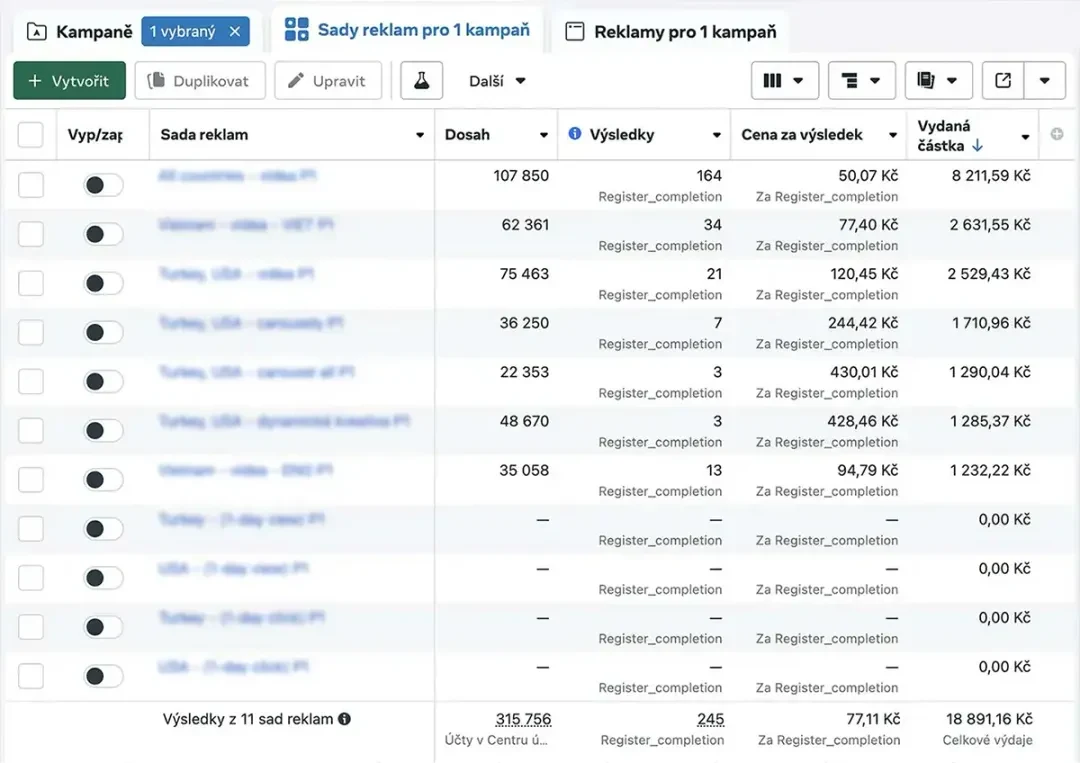
Below is a comparison of the key metrics for lead generation campaigns on both platforms:
Comparison - Lead Generation: Facebook vs. Instagram
| Metric / Factor | Facebook Ads (Lead Gen) | Instagram Ads (Lead Gen) |
|---|---|---|
| Reach and audience | ~3bn users, broad age spectrum. A large share of the Czech audience. | ~2bn users, younger audience (18-34). Strong engagement growth. |
| CTR (click-through rate) | ~1.5-2.0% (higher willingness to click) | ~0.8-1.5% (visual browsing without clicking) |
| CPC (cost per click) | ~$0.50-0.60 (lower) | ~$1.00-1.20 (higher) |
| Conversion rate (CVR) | ~2.5-4% (better targeting = more leads) | ~1.8-3.5% (fewer actions from visuals) |
| Indicative CPL (cost per lead) | ~$20 (cheaper lead)*average across industries * | ~$30-40 (more expensive lead)*estimate, 1.5-2x higher than FB |
| Lead gen formats | Lead Ads (instant form), Messenger bot, website remarketing. | Lead Ads (form in IG), link in bio, Swipe-up (Stories). |
| Best use cases | B2B and services with a longer cycle (consulting, software). Broad interest-based targeting and remarketing. | Lifestyle services for younger audiences (courses, events). Good for competitions and visually attractive offers. |
Data proof: Facebook has long delivered the highest ROI among social networks for marketers. For example, according to HubSpot 2024, more marketers named Facebook as the platform with the best return on investment than any other. Facebook Lead Ads performance is also improving year over year. In the second half of 2024, the average conversion rate for lead campaigns increased, while average cost per lead fell. Average CPL on Facebook is around $21.98 across industries, compared with around $66 for Google Ads, so social networks can bring in contacts more cheaply than search engines. That applies especially when you choose the right platform and targeting. In short: Facebook leads on the numbers, with a higher chance of clicks, more conversions and lower lead costs.
Instagram is not out of the game, though. Its lead gen strength can lie in visual appeal that grabs attention where a text-heavy FB ad might disappear. Some segments, such as fashion, design and travel, can generate a solid number of enquiries on Instagram too, because a compelling image or video persuades users to act. Instagram also offers Stories and Reels ad formats that can bring in leads through less traditional routes, for example interactive polls (“Interested in an offer? Yes/No”). These techniques may not generate a contact directly, but they increase interest, and users can then be reached through retargeting on Facebook.
Where is it better to build brand awareness?
Alongside direct conversions, you often also need to build brand awareness: how many people discover your brand, how well they remember it and how they perceive its image. In this respect, Instagram has the reputation of being “the beautiful one”, while Facebook is “the omnipresent one”. But which is more effective for brand building?
1. Reach and frequency vs. attention and recall: Thanks to its user base, Facebook offers the largest possible reach across demographics. You can easily reach hundreds of thousands or millions of people if you have the budget. CPM (cost per mille), the cost per thousand ad impressions, does not differ dramatically between platforms (Facebook roughly $8-12, Instagram $5-8). Instagram can therefore be slightly cheaper per unit of reach. In pure impression terms, Instagram may win by a small margin for the same spend. However, reach is not everything. What matters is how many of those people notice you and remember you. And here Instagram has an ace up its sleeve: engagement rate is many times higher. The average Instagram post reaches a smaller audience, but gets around 1.2% interactions from followers, while a Facebook post gets only around 0.18%. For ads, this is not a perfectly direct comparison, but the trend is similar. Instagram users are more likely to like, comment on and share brand content. Higher engagement means higher memorability. A person who interacted with you, gave a heart or answered a Stories poll is more likely to keep your brand in mind than someone who only glanced at a sponsored post in the FB feed.
2. Visual storytelling vs. community content: Instagram advertising is ideal for visually strong stories. Brands can use formats such as Stories and Reels to bring the life of the brand closer in an authentic way, for example through short behind-the-scenes videos, influencer collaborations or interactive visuals. Instagram users are in discovery and inspiration mode. Brand awareness campaigns in that environment can create an emotional connection. A beautiful photo, catchy music in a video and a consistent style make an impression. Facebook, by contrast, supports other types of content too: longer videos, for example a webinar recording or TV spot, articles through shared links and community building through groups and events. If your goal is to position the brand as an expert or community leader, Facebook gives you tools to do that, including fan groups, live broadcasts with discussion, event creation and more. Instagram does not have community functions this deep, although there are “Close Friends” circles and live broadcasts, for example, but they are not as widespread. In short: Instagram builds awareness through the power of beautiful content and trends; Facebook through a combination of ubiquity and community involvement.
3. Virality and sharing: When we talk about brand awareness, we also need to mention viral potential, meaning whether users spread your content spontaneously. Here, it is almost fifty-fifty. Facebook has a Share function, so a satisfied fan can send your post to friends or a group with one click. Instagram does not have a classic “share post publicly” button. It can only be shared to your own Story or via Direct. Even so, viral trends often emerge precisely on Instagram, especially through Reels, short videos in the style of TikTok. These trends spread more within the platform through algorithmic recommendations than through direct user sharing. For a brand, that means: on Facebook, you are more likely to achieve virality with controversial or valuable content that people deliberately share, for example an article with useful tips, a funny video or a community challenge. On Instagram, virality is about hitting a trend, such as a popular music clip, challenge or hashtag, when the algorithm picks up your Reel and shows it at scale to people who do not follow you. Both can massively increase brand reach, but neither can be relied on. When planning brand campaigns, it is better to count on paid reach and treat any viral effect as a welcome bonus.
4. Brand demographics: It depends what image your company has and whom you want as a fan. Instagram is excellent for brands that want to be “cool” among younger audiences, such as fashion, sportswear, healthy lifestyle, travel, cosmetics and so on. There, awareness built through IG is key. People often say that if it is not on IG, it might as well not exist. Facebook is essential if you are targeting older generations or the broader public as well. For example, a local service, say a car repair shop, bank or even a municipal library, will gain broader awareness through an FB campaign, because it will also reach people aged 40+ and seniors who may not have Instagram at all. Facebook is also still used by more than 5 million people in the Czech Republic, so for general campaigns too, including state awareness, recruitment and well-known brands, it is a mainstream channel.
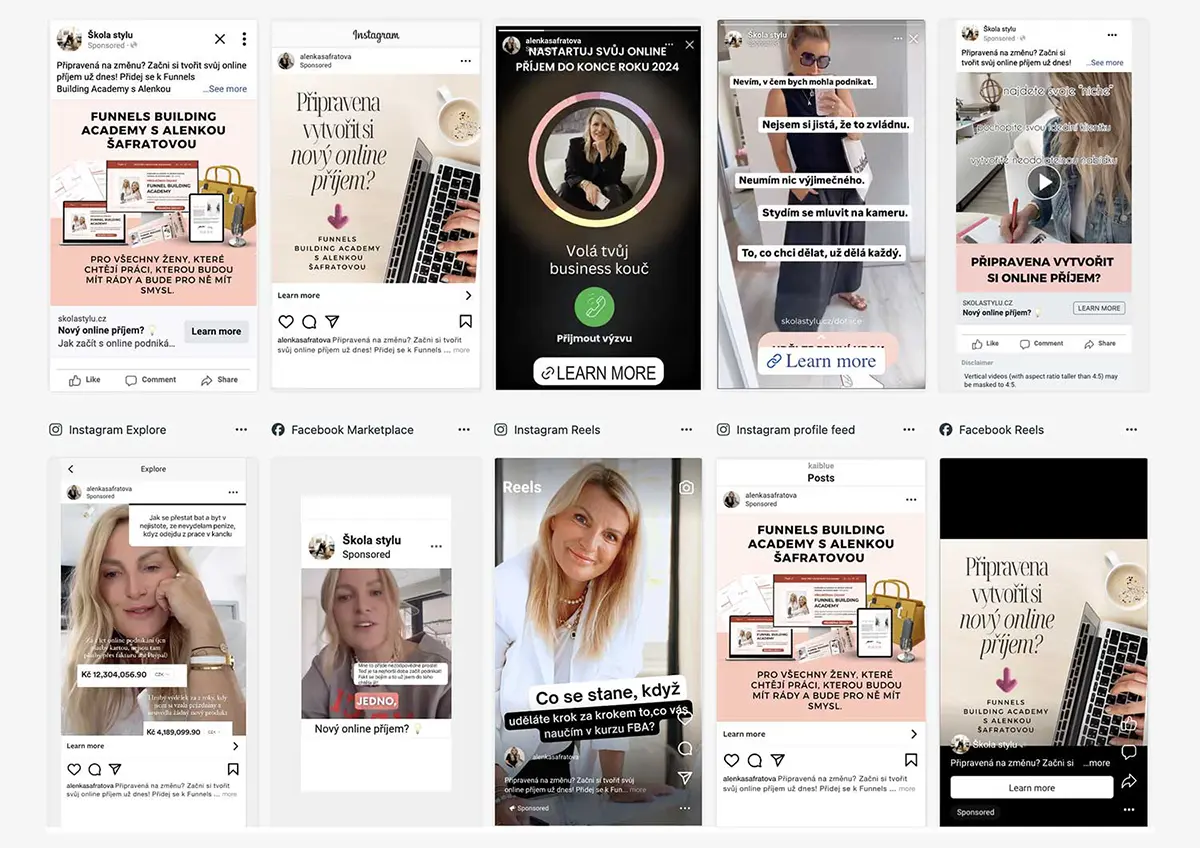
Below is an overview of factors for brand awareness campaigns:
Comparison - Brand Awareness: Facebook vs. Instagram
| Aspect (Brand) | Facebook (brand awareness) | Instagram (brand awareness) |
|---|---|---|
| CPM (cost per 1k views) | ~$10 (medium, stable) | ~$6-7 (often lower) |
| Engagement rate | ~0.2% (lower audience engagement) | ~1.2% (high engagement, active community) |
| Suitable formats | Video (longer), articles, links, groups, Facebook Live | Stories, Reels (short videos), images, Instagram Live |
| Emotional impact | Medium - mix of visuals and text (suitable for education, community). | High - visually engaging, aspirational content (inspiration). |
| Community | Strong - option to build FB groups, events, discussion threads. | Limited - followers and comments, but no robust groups. |
| Viral potential | Based on user sharing (direct share button). | Based on trends and the algorithm (appears on Explore/Reels). |
| Brand image | "Accessible to everyone" (mass brand, trustworthy, serious). | "Trendy & inspirational" (stylish brand, close to younger audiences). |
Tip: For maximum brand reach, we recommend using both channels in parallel. Facebook covers volume and older audiences; Instagram delivers engagement intensity and reaches younger people. By combining formats, for example the same slogan in an image spot on Facebook and in a short Reel on Instagram, you create a consistent message and a stronger effect. According to Meta studies, combining Feed + Stories increases brand recall metrics compared with using only one channel.
Real-world example: A beauty brand launched a video spot campaign on Facebook, broadly targeting women aged 25-50 in the Czech Republic, and at the same time ran a series of Instagram Reels with tips from an influencer for a younger audience. The result: Facebook ensured that more than 1 million female users saw the campaign at least once, while Instagram generated tens of thousands of interactions, including comments, saves and replies in Stories. The combination put the brand into people’s minds both broadly and deeply. After the campaign, spontaneous awareness grew by 15% and IG fanbase engagement by 40%. That shows the strength of an integrated approach.
Do advertising costs differ on Facebook and Instagram?
One common question is: “How much does advertising on Facebook vs. Instagram cost?” Budget is often the deciding factor, and it helps to know whether you are overpaying for one platform. Because both networks are managed through the same advertising system, Meta Ads Manager, the billing and auction mechanics are practically identical. Even so, there are differences in some cost levels:
- CPM (Cost per Mille): As mentioned, the cost per thousand impressions can differ by a few dollars. Instagram CPM tends to be slightly lower, around $5-8 on a global average, while Facebook CPM is $8-12. That is because Instagram has fewer placements (essentially Feed, Stories, Explore, Reels) and is shown to a narrower audience, so advertisers often pay less for the same volume of views. Facebook, by contrast, also covers less attractive surfaces, such as the desktop right column, which increase overall reach but can lift the average cost per thousand.
- CPC (Cost per Click): Facebook advertising tends to have cheaper clicks. According to data, average CPC on Facebook is around $0.60 vs. around $1.20 on Instagram. Again, this is connected to users' willingness to click (higher on FB) and to the fact that Instagram impressions convert into clicks less often, so more impressions per click are needed. On average, the advertiser therefore pays twice as much to get one visitor from IG compared with FB. For performance campaigns, where you pay for clicks or conversions, this means Facebook can bring traffic more cheaply.
- Cost per engagement: Interestingly, the cost per engagement (CPE), such as one like or comment, is similar or even slightly lower on Instagram. For example, studies cite CPE of around $0.06 on IG vs $0.07 on FB. That makes sense, because Instagram generates many interactions, such as likes, even without a link click. So if you optimize campaigns for interactions (engagement), Instagram can deliver more of them for a given budget. But be careful, likes alone usually do not pay the bills. They are more of a secondary metric.
- Competition and saturation: In highly competitive segments, such as fashion and cosmetics, Instagram ad space is crowded with both influencers and brands. The target audience spends a lot of time on IG, so brands compete for it, and that can push prices up. Competition on Facebook is also high, but the ad inventory is broader, with more different placements plus older audiences who are not on IG. In addition, Facebook Ads are stagnating in advertiser numbers, while IG is still growing to some extent. That is why in some cases you may see that, for the same segment, you pay more for IG ads, outbidding stylish competitors in the auction, whereas FB works out better thanks to the broader base. In any case, Meta's auction algorithm typically allocates budgets efficiently. If it finds conversions are expensive on IG, it will send more impressions to FB by itself, if you use Advantage+ or combined campaigns.
- Optimization and relevance score: The price you pay also depends on ad quality. Meta evaluates relevance, today called quality ranking, based on user engagement and response. People react more on Instagram, so even an average ad there may get a relatively good score, which can push the price down slightly. On Facebook, by contrast, people ignore many ads, can easily hide an ad if it is annoying, and so on. Poorly targeted or boring advertising can therefore become expensive on FB, because the system is less willing to show it, so you have to pay more for delivery. That is why you should always think about creative quality and precise targeting. Ideally, your ad should prompt positive interactions. That gives it priority in the auction and cheaper impressions. This applies on both platforms.
In practical terms, if you have a fixed budget, you will usually achieve a similar number of impressions on Facebook and Instagram. Meta will make sure the money is spent. The difference is in what you “extract” from those impressions, and that is what we covered above: Facebook tends to deliver clicks and conversions, Instagram tends to deliver engagement and visual reach.
Cost summary: Facebook is cheaper for clicks and often for conversions too, while Instagram is cheaper for reaching a thousand people and gaining interactions. The final choice depends on whether a website visitor or lead is more valuable to you, in which case you should prioritize budget into Facebook, or whether audience and awareness building matters more, in which case you should invest heavily in compelling Instagram content.
ROI calculator: Where will advertising pay off more?
Whether you prefer Facebook or Instagram, the end goal of every advertising investment is return. ROI (Return on Investment) tells you how much CZK you earn from every CZK 1 invested in the campaign. But how do you find out which platform will make you more money? Calculate ROI separately for Facebook and Instagram campaigns. It may happen that a more expensive lead from Instagram brings in a larger deal, or conversely, cheap clicks from Facebook do not lead to real business. To calculate it, proceed as follows:
- Set the conversion value: First determine what the outcome of your campaign is and what value it has. For example, if you collect leads, estimate the probability of closing a deal from one lead and the average order value. Example: From 10 leads, you close 2 deals (20% close rate) and the average order is CZK 50,000. One lead therefore has an expected value for you of 0.2 * 50,000 = CZK 10,000.
- Measure costs and number of results: Look in the ad account at the amount spent and the number of conversions/leads from Facebook and Instagram. It is important to measure them separately, for example through separate ad sets, UTM parameters, or at least by placement. Let us say you spent CZK 30,000 on Facebook and got 150 leads. On Instagram, you spent CZK 20,000 and got 80 leads.
- Calculate Cost per Lead (CPL): Divide costs by the number of leads acquired. In our example: Facebook CPL = 30,000 / 150 = CZK 200/lead, Instagram CPL = 20,000 / 80 = CZK 250/lead. Facebook costs you less per contact.
- Estimate campaign revenue: Multiply the number of leads acquired by their value (from step 1). Facebook revenue = 150 * 10,000 = CZK 1,500,000 (expected value of future deals from FB leads). Instagram revenue = 80 * 10,000 = CZK 800,000.
- Calculate ROI: Subtract costs from revenue and divide by costs, then multiply the result by 100% for percentage ROI. Facebook ROI = ((1,500,000 - 30,000) / 30,000) * 100% ≈ +4900% (that is, CZK 49 profit for every CZK 1 invested, an excellent campaign 🎉). Instagram ROI = ((800,000 - 20,000) / 20,000) * 100% = +3900%. Instagram campaigns also made money, but somewhat less. In absolute numbers, Facebook brought in around CZK 1.47 million net, Instagram CZK 780,000.
- Compare and evaluate: In our hypothetical case, the ROI of Facebook campaigns is higher. That means that, under the same assumptions, Facebook made more money from contacts than Instagram. A marketer could conclude from this that it is worth giving Facebook a larger share of the budget next time. But be careful: you also need to consider other factors, such as lead quality (are IG leads perhaps less qualified?), brand impact (IG may have increased awareness in the meantime, which will turn into sales later), or differences in campaign creative.
ROI (Return on Investment) = (Total campaign revenue - Campaign costs) / Campaign costs.
For example, ROI = (revenue CZK 100,000 - costs CZK 20,000) / CZK 20,000 = 4 (that is, 400%). Every CZK 1 invested returned fourfold.
What should you do if ROI is not positive? If, for example, Instagram comes out with ROI of only +50% (that is, CZK 1.50 profit for every CZK 1 invested) and Facebook +200%, it is worth considering whether to optimize the Instagram campaign or put less money into it. Sometimes, however, campaigns with lower immediate ROI make sense, for example because they build an audience that will buy later. You always need to look at the bigger picture: combined ROI across the whole marketing mix is king. If Facebook “subsidizes” Instagram, meaning overall your investment returns very well, you can accept that. But if you are burning budget and neither channel is paying back, it is time to change strategy or channel.
ROI and current trends: One more perspective. In 2025, the influence of artificial intelligence in marketing is growing. This also affects ROI optimization. For example, Google offers direct answers within SGE, so users may click through to websites less often. Organic ROI therefore falls, and companies need to invest in paid channels to maintain customer inflow. At the same time, Meta and others are introducing AI assistants for campaign creation. Easier creative production could reduce the cost of ad production and indirectly increase ROI, when you spend less on designers and copywriters thanks to AI generators. For you, this means keeping pace: watch how campaign efficiency develops quarter by quarter. For example, Meta states that advertising costs have remained fairly stable since 2021, while Google Ads are becoming more expensive, which plays into the hands of ROI on social networks. In other words, well-optimized campaigns on Facebook and Instagram can be a gold mine in 2025 if you know how to calculate and improve their return. 💰
Frequently asked questions: Facebook vs. Instagram advertising (FAQ)
- Is it better to advertise on Facebook or Instagram?
-
There is no universal answer. It depends on your target audience and campaign goals. Facebook generally has greater reach across age groups and works better for acquiring conversions, such as leads or sales, at a lower cost. Instagram excels with younger audiences and in building engagement and brand awareness, although conversions can be more expensive. The ideal approach is often to combine both: Facebook for performance, including performance campaigns and remarketing, and Instagram for inspiration and branding. If you have to choose, consider: Where do your customers spend more time? and What do you sell? For example, B2B services are promoted better on Facebook (and LinkedIn), while a fashion e-shop for teenagers is more likely to succeed on Instagram.
- How much does Facebook advertising for contacts (lead gen) cost?
-
The price differs by industry, targeting and campaign quality. The average cost per lead (CPL) on Facebook is around $21.98 (about CZK 500) across industries. In many cases, however, you can achieve much lower prices, commonly CZK 50-200 per lead in the Czech Republic with well-optimized campaigns. Facebook Lead Ads tend to have a much lower CPL than Google Ads, where the average is around $67 per lead. So Facebook advertising is fairly cost-effective for acquiring contacts. In any case, we recommend calculating your own CPL: take the budget spent and divide it by the number of leads acquired. That tells you how much one contact cost you. Then compare it with the value that lead has for you. See the ROI calculator above.
- Is Instagram advertising worth it for B2B companies?
-
Instagram is not typically the first choice for B2B, but it can pay off as a supporting channel. It depends on whether you can reach decision-makers or influencers in the companies you target on Instagram. In general, LinkedIn and Facebook are more effective for B2B, because they offer targeting by job roles, companies and business-relevant interests. However, Instagram advertising can work in B2B in industries where the visual side is important, for example design, architecture or events, or when you target younger professionals. Instagram helps build employer brand awareness and can engage future clients through less formal, more human communication. Direct leads, such as filling out a product demo form, from Instagram in B2B will probably be more of an exception. Consider Instagram as brand and remarketing support, for example targeting users who have already visited your website and showing them the "human face" of the company through IG Stories. Summary: Put the primary B2B budget into LinkedIn/Facebook, where you acquire contacts, and use Instagram secondarily for image and relationships.
- What are the current trends in performance marketing on Facebook and Instagram?
-
2024/2025 trends include automation and, above all, the use of AI. Meta is pushing Advantage+ campaigns, which automatically optimize creatives, targeting and placements using machine learning. Advertisers report higher performance and time savings thanks to these automations. There is also growing emphasis on video formats. Reels, Stories and short videos in general get priority in distribution, as Meta favors its TikTok competition. Ad personalization is becoming increasingly sophisticated: thanks to an advanced algorithm, two users may see different variants of the same ad (dynamic creative), optimized to their preferences. Privacy changes (iOS14+) have made targeting harder, but Meta is introducing solutions such as Conversions API and conversion modeling to cover the loss of data. For advertisers, the trend is therefore to implement server-side measurement (Facebook CAPI) for more accurate data. And last but not least, content needs to be more authentic and valuable. In connection with the Google Helpful Content update and overall content saturation, quality is prized. Ads too should educate, entertain or engage, not just push sales. Brands invest in creatives that look user-generated (UGC), work with micro-influencers for credibility and test interactive elements, such as polls, AR filters in ads and so on. Performance marketing on Facebook and Instagram is simply becoming more and more about technology + creativity working hand in hand.
- What is performance marketing and how is it related to Facebook/Instagram advertising?
-
Performance marketing is an approach where you measure and optimize marketing toward specific outcomes, typically number of conversions, cost per action, ROI and so on. Facebook and Instagram ads belong in this category because you can precisely track how many people completed the desired action, such as a click, purchase or form submission, and how much it cost you. Facebook advertising and Instagram advertising are among the main performance marketing tools in paid media. They allow detailed targeting, flexible budgets and, above all, continuous optimization. You can see which campaign has better results and direct money accordingly to where it earns more. In practice, that means, for example, launching several versions of an ad, monitoring metrics (CTR, CPA, ROAS), switching off the weaker ones and supporting the successful ones. A performance marketing approach differs from classic "brand marketing" in that every CZK 1 should be invested efficiently and with a clear measurable benefit. Facebook and Instagram today offer robust analytics and the ability to adjust campaigns quickly, which makes them an ideal environment for a performance approach.
- What metrics should you track for Facebook and Instagram campaigns?
-
The basic metrics include CTR (click-through rate), which indicates how attractive your ad is; CPC (cost per click), how much you pay for one visitor; Conversion rate (CVR), what percentage of visitors complete the desired action, on the website or in a form; CPA (cost per acquisition), how much one conversion/lead costs; ROAS/ROI, the return, meaning how much you earn from money spent. It is also useful to track Frequency, how many times the average user has seen your ad. For brand campaigns you want at least 3-5x, while for performance campaigns you should beware of too high a frequency, which can annoy people. Engagement (engagement rate), the number of likes, comments and shares, matters more on Instagram and shows content relevance for the audience. For video campaigns, track Video Views / completion rate; for e-commerce, for example, Add to Cart rates. Last but not least, pay attention to Quality Ranking / Facebook score, which tells you whether your ad is evaluated as lower quality compared with competitors. In that case, improve targeting or creative. Overall, Facebook and Instagram Ads generate a huge amount of data. The key is to choose metrics tied to your goal. For lead gen, that is CPL and number of leads; for brand, reach and frequency; for an e-shop, ROAS, and so on.
- How quickly will I see results from Facebook/Instagram ads?
-
Very quickly. You collect the first data almost immediately after launching the campaign. Facebook and Instagram Ads start displaying ads within minutes to hours of launch, after approval review. Over 1-3 days, the algorithm usually "learns" the ad, the so-called learning phase, so results may fluctuate in these first days. Nevertheless, after just a few days you should see the first trend, such as how many people click, whether conversions are coming in and so on. As for tangible business results: lead gen campaigns can bring contacts the same day, depending on the offer, and e-commerce sales through FB/IG can happen within hours of launch, if the offer and targeting are good. Brand awareness is different. There, the "result" is awareness, which you measure through surveys or only through subsequent effects, for example growth in organic traffic or brand searches. But metrics such as reach and impressions are visible immediately. Summary: Within a week of launching a campaign, you should clearly know whether the campaign is working or whether it needs optimization. The advantage of social campaigns is precisely that immediate response, compared with SEO, for example, where you wait months.
- When should you choose Instagram advertising instead of Facebook?
-
Choose Instagram Ads if your target audience is significantly younger (13-30) and spends a lot of time on Instagram, or ignores Facebook. Also choose it if you sell a highly visual product/service, such as fashion, food, design or travel. That is where Instagram shines, and ads integrate beautifully into the feed among organic content. A third factor is that Instagram offers specific formats Facebook does not have, such as AR filters in Stories ads, influencer collaboration through Brand Collabs, and so on. If you want to use the power of influencer marketing, Instagram is often the primary platform. In simple terms: prioritize Instagram advertising for "lifestyle" marketing, visual branding and reaching Generation Z. Choose Facebook advertising for broader reach, detailed targeting, for example by interests and behavioral data, and older audiences. Of course, the two platforms are connected, so you do not have to choose only one. But you can divide budget and energy with emphasis on the one that resonates better with your audience.
Where do campaigns make more money?
Brief summary: In 2025, Facebook advertising usually makes more money on direct campaigns. It brings cheaper leads and conversions thanks to a higher click-through rate and lower cost per click. Instagram advertising excels at brand building and fan engagement. For a similar budget, it can reach a younger audience with greater enthusiasm, meaning more likes and comments, which translates into brand awareness. Campaign ROI depends on your business: Facebook often comes out better, with higher direct profit, but Instagram adds brand value that can pay off over the long term. The best strategy is to use the strengths of both platforms, focusing the performance part of the budget where results are cheaper, usually Facebook, while investing in creative Instagram content that keeps your brand attractive and visible. Monitor data continuously and optimize: move money to where you see better performance marketing metrics, but do not forget the long-term brand effect. The winner of Facebook vs. Instagram can differ from campaign to campaign. With our guide and data, you are ready to make the decision that earns your company the most. ✅
💡 Bonus tip: Let the algorithms work for you. Try combined campaigns and let Meta distribute the budget. You will often find that the most profitable strategy is a synergistic one: Facebook brings in contacts, Instagram tells the brand story and indirectly increases conversions. That way, you avoid the “FB vs IG” dilemma and get the best of both worlds.
Related Articles
- PPC campaigns from A to Z: how they work and what to expect
- PPC specialist: the key to a successful campaign and maximum ROI
CEO & Performance Strategist


 Fast
Fast  Effective
  Nonstop