Written and reviewed by Bc. Petr Kučera, MSc., MBA
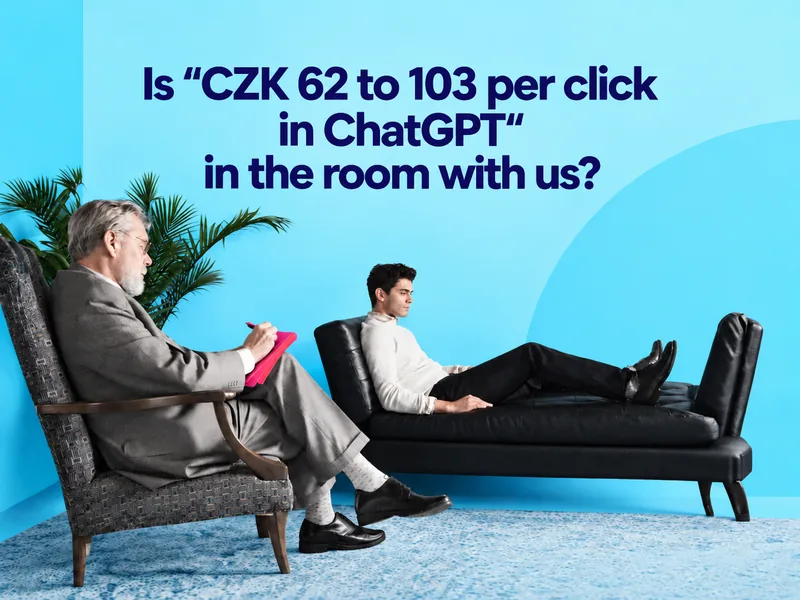
Czech businesses have been able to buy ChatGPT ads directly since 31 August 2026. In September, the first numbers came in from agencies, consultants and businesses. The results differ, and some of the data is not Czech at all. For every figure, we note who measured what, when and on what sample. We separate OpenAI’s official rules from practice.
For the general principles of paid advertising, see our separate article on how PPC campaigns work.
We start with the official framework. We cover account setup step by step in a separate guide.
OpenAI announced that from 31 August 2026, advertisers in 31 European markets can buy ads self-serve through Ads Manager. The announcement does not name the Czech Republic, but the OpenAI help center lists it as Available. Your company must be based in one of the listed countries. According to RUJZL, ads had already been showing in the Czech Republic since roughly 24 August 2026, at that time through OpenAI partners.
Ads are shown to Free and Go users, including logged-out ones. Plus, Pro, Business, Enterprise and Edu users see no ads, and neither do accounts of people under 18, according to Ads in ChatGPT. In the EEA and Switzerland, ads are not personalized yet. Ads are selected based on the current conversation and basic context, meaning approximate location and language.
The daily campaign minimum is CZK 350 for an account in Czech crowns, EUR 15 for a euro account and USD 25 for a dollar account, according to OpenAI’s campaign setup guide. The first Czech articles in early September reported that crowns were not available and billing was in euros (RUJZL). Conviu already runs its own account in crowns.
The daily budget works as an average over seven days. On one day, spend can reach up to twice that, and over seven days at most seven times the daily budget. The budget week runs Sunday to Saturday in the account’s time zone. With the CZK 350 minimum, that means up to CZK 700 in one day, at most CZK 2,450 in seven days, and roughly CZK 10,500 for the smallest 30-day test.
You pay for impressions through CPM, the cost per thousand impressions, or clicks through CPC, the cost per click. Conversion optimization is available through oCPC and, for eligible advertisers, oCPM. You do not pay for the conversion itself. See OpenAI’s billing guidance.
You cannot change the campaign objective after campaign creation or the account’s country, currency and time zone after account creation. A different objective requires a new campaign. OpenAI recommends starting with a maximum CPC of USD 3 to 5. That guidance is geared to the US and does not distinguish regions, so it is not a Czech price. The auction is a relevance-weighted second-price auction, according to Ads in ChatGPT: the basics.
After you add a card, your bank may place a temporary authorization hold. It is not a payment. The expected amount is shown on the settings page, and the hold can stay visible for 8 days or longer, according to OpenAI’s help article Fakturace a platby (billing and payments). Proficio and Jakub Kaplan reported USD 100, but that is not a general rule. Company verification and account setup take days: Proficio reports 5 to 7 days. The OpenAI help center says the company review can take up to 7 business days.
The first text campaigns by Czech authors ran in September 2026, and the PLACEMENT figures include accounts from Slovakia. In sources reporting in crowns, a paid click cost roughly CZK 1.5 to 39, and up to CZK 43 on individual days on one account. Sources reporting in euros mostly show EUR 0.5 to 1.3, about CZK 12 to 32 at CZK 24.35 to the euro. Barbora Nemravová’s managed accounts went up to EUR 2. The table includes only Czech authors’ own data.
| Author | Period | Impressions | Clicks | CTR | CPC | Conversions |
|---|---|---|---|---|---|---|
| PLACEMENT, Jakub Herrmann (5 accounts in the Czech Republic and Slovakia) | 1 to 15 September 2026 | 106,000 | 1,844 | 1.74% overall, 0.7 to 4.7% | CZK 3 to 39 | 15 (0.81% of clicks) |
| PLACEMENT, two published campaigns | 1 to 17 September 2026 | no data | 802 | over 4.5% | average CZK 3.05 | 8, at CZK 280 to 314 each |
| Jiří Navrátil (own campaign) | 1 to 9 September 2026 | 5,394 | 69 | 1.28% | EUR 1.29 | 0 |
| RUJZL | first days | 3,525 | 40 | 1.13% | EUR 0.70 | no data |
| Jindřich Fáborský (2 accounts) | September 2026 | no data | no data | around 1% | averages of CZK 9 and CZK 24 | no data |
| FAPI (SaaS) | first 3 days | no data | no data | no data | no data | 1 sign-up at roughly EUR 140 |
| Petra Vetrovská (travel website) | first 6 days | no data | no data | 8.2% | CZK 1.49 | link click |
“No data” means the author did not publish the figure or it is missing from the verified source. The overall PLACEMENT CTR and the RUJZL CTR are our calculations.
PLACEMENT, Jakub Herrmann has the largest published sample. The cost per conversion for services was CZK 148 to 300, and an e-shop order came to around CZK 1,250. The author himself writes: “Observations, not statistics.” PLACEMENT sells advertising in ChatGPT and is holding a webinar on the topic on 8 October 2026 (PLACEMENT).
Jiří Navrátil bid EUR 2.50, paid EUR 1.29 on average and spent EUR 89.20 in total. He does not treat the numbers as a reliable pricing benchmark (jirinavra.cz). RUJZL also published results for a single day: 1,671 impressions, 23 clicks, a paid CPC of EUR 0.72 and a CTR of 1.4%.
Jindřich Fáborský saw daily CPCs of CZK 3 to 43 and says there is almost no analytics data yet. He also sells a course on the topic. Source: AI First.
Barbora Nemravová reports a CPC of EUR 0.5 to 2 and a CPM of EUR 5 to 20 on the accounts she manages. In her test of three optimization goals, reach was the cheapest per click, per visit and per conversion, while the conversion campaign was the most expensive. She calls this an “early read” (barboranemravova.cz).
Lucie Thiemlová of Srovname.cz considers a CPC of EUR 0.5 to 1 relatively high. She reports that maximizing conversions spends the minimum budget every day and sees the channel as closer to consideration than purchase. Her advice: “Test, yes. But with realistic expectations and as an experiment.” Source: LinkedIn.
Advisio cites a CPC of CZK 15 to 30 and DigiChef around EUR 1; neither publishes a sample (sources: Advisio, DigiChef). FAPI launched its ads before it had finished setting up conversion tracking, and sums up the result: “Nothing to write home about.” (FAPI).
Petra Vetrovská compared the first six days with her own Google Ads results. She explicitly calls the comparison unfair. The figures were published only as an image. Source: LinkedIn.
| Metric | ChatGPT Ads | Google Ads |
|---|---|---|
| CTR | 8.2% | 16.3% |
| CPC | CZK 1.49 | CZK 0.27 |
| Active time | 11 s | 86 s |
| Bounce | 68.4% | 34.6% |
In sources reporting in crowns, a click cost anything from a few crowns to roughly CZK 40. The largest sample with a published average price, 802 clicks across two PLACEMENT campaigns, came to CZK 3. These small samples cover the first weeks and different industries, so they do not establish an average or a benchmark. A CZK 1.49 click on a travel website says nothing about an e-shop or a B2B business.
Watch out for the CZK 62 to 103 per click circulating on Czech blogs. Filip Farník points out that the figure was not confirmed at its source and differs from the measured samples (filipfarnik.cz).
RUJZL ran eight ad groups with a EUR 0.10 bid and got not a single impression all day. Delivery started at around EUR 1.5. The agency sums it up: “With manual CPC, the bid is a ceiling, not the price,” and recommends bidding above EUR 1. Jiří Navrátil got a low-bid warning at EUR 0.50. Proficio puts a competitive CPC above EUR 1.95.
According to OpenAI, the bid_too_low warning is “guidance, not a serving restriction.” It also does not appear for 24 hours after you edit an ad group, so the absence of the warning does not prove your bid is competitive (OpenAI troubleshooting).
There is no universal minimum bid. In France, a bid of around EUR 0.10 was enough, according to Alexandre Bougra of Kalyvox in Journal du Net. The UK account of Andy Brice also got delivery with bids of GBP 0.07 to 0.15.
In Sklik, Seznam’s ad platform, a low bid mostly means less volume. In ChatGPT, it meant zero delivery for RUJZL. Jakub Kaplan counts it among three “silent killers” of a campaign, alongside a blocked OAI-AdsBot and an unverified company (jakubkaplan.online).
As of 24 September 2026, product ads from a feed were not delivering in the Czech Republic. RUJZL had been uploading a feed of more than 40,000 products since 4 September and got not a single impression in three weeks, while a control text campaign on the same account was running. On 24 September, OpenAI support confirmed that the feed was fine, with 43,000 products in the index, and that the issue was a country restriction.
According to Shoptet, the Czech e-shop platform, many e-shops still have an empty feed or only a few products while they wait for OpenAI to fully open product matching in Europe. MarkMedia and Conviu say product ads cannot be launched in the Czech Republic. Marketing Makers say they rarely manage to get feeds running. OpenAI’s official documentation mentions no Czech restriction and has not published a list of countries for product ads.
Once product ads open, keep in mind that feed items expire after two weeks. The feed needs automatic refreshes via URL or SFTP, according to OpenAI’s guide to campaigns from product feeds.
OpenAI recommends avoiding custom audiences in the EEA and Switzerland until personalization is available. Audience inclusion requires at least 25,000 matched users. For Czech campaigns, leave custom audiences out of the plan for now.
Advertisers cannot see the specific queries or conversations in which their ad appeared. OpenAI does not share chats or queries, only aggregated metrics: impressions, clicks, spend, CTR, CPC, CPM and conversions. Seven Czech authors confirm this.
Context hints are topic cues you add to an ad, and they do not replace a query report. According to OpenAI, they are not keywords, do not guarantee impressions and cannot be used to exclude topics.
OpenAI’s Ad Policies apply in version 1.6, dated 10 September 2026. In this initial phase, ads are “primarily limited to consumer segments.” The policies distinguish only between the US and “outside the US,” and the Czech Republic falls into the second group.
Outside the US, ads for health and financial services are “generally prohibited”, and ads for legal services are “currently prohibited”. Both the creative and the landing page must fall into an allowed category.
A Czech dental clinic cannot advertise in ChatGPT today, even though the policies allow dentistry case by case in the US. For a pharmacy e-shop, RUJZL was told that “the industry does not meet the requirements.”
Even in an allowed category, ads do not appear in conversations about mental or personal health, in emotionally dependent or other sensitive situations, or in topics such as politics, weapons and self-harm (19 categories in total). Since version 1.6, OpenAI also reserves the right to reject an ad because of its own “business interests or competitive position.”
Policies have changed six times since March 2026 (v1.0 to v1.6). This section is accurate as of the article date; check the current version before planning.
In the Czech Republic, advertising in ChatGPT is a test for selected offers, not a new performance channel.
We see the first positive signals in the segments OpenAI’s policies target: consumer segments such as lifestyle, household and local services. The most concrete Czech evidence is PLACEMENT’s services data, with a cost per conversion of CZK 148 to 300, from an agency that sells advertising in ChatGPT. Michal Blažek of Marketing Makers saw a similar share of relevant B2B clicks as in Google Ads. Lucie Thiemlová places the channel in the consideration phase.
Test it if your offer is something people work through and compare in a conversation, and if you have budget to spare outside the channels that already work. If you have no reserve, stay with Google Ads and Sklik.
Michal Smetana offers a hypothesis, not a measurement: B2B decision-makers on paid plans other than Go do not see ads. He sums it up: “A cheap click does not mean a cheap customer.” In his view, a benchmark makes no sense yet (smetanartb.cz).
Sklik and Bing: PLACEMENT says ChatGPT came out cheaper than Sklik and Bing on some accounts, but has not published numbers. It adds that ChatGPT does not yet match Google or Meta in volume or conversion reliability. PLACEMENT promises a comparison at its webinar on 8 October 2026.
Meta: Marketing Makers saw single-digit B2C conversions, more expensive than on Facebook.
Google Ads: the only Czech comparison with published numbers comes from Petra Vetrovská, and she flags it as unfair herself. Abroad, Andy Brice saw a paid-click conversion rate of 0.46% in ChatGPT versus 5.3% in Google Ads. John Horn of StubGroup measured 0.21% in ChatGPT versus 3.71% in Google Ads on the same website, and StubGroup sells advertising in ChatGPT (MarTech). Falia reports 0.9% versus 5.95% for the same client over the same period (Falia). We cover results from abroad in a separate article.
Ads versus unpaid recommendations: abroad, Andy Brice saw a conversion rate of 0.46% from paid clicks and 4.2% from unpaid visits from ChatGPT. At Octolens, Charlotte Schmitt counted 0 sign-ups from ads and 10 from unpaid ChatGPT recommendations. Octolens sells a mention-tracking tool that also covers AI visibility (LinkedIn).
In all four cases from abroad, ChatGPT’s click conversion rate trailed Google’s by a factor of roughly 6.6 to 17.7: 0.46% versus 5.3%, 0.21% versus 3.71%, 0.9% versus 5.95% and 0.8% versus 6.64%. Four cases, two of them from StubGroup, are not a market sample. This does not surprise us. Google captures demand that already exists. ChatGPT reaches people earlier, while they are still figuring out what they want. That is why we recommend funding your first ChatGPT test from a testing budget, not from Google. We see more value in a place within the answer than in an ad beside it. In Andy Brice’s data, an unpaid visit from ChatGPT converted at 4.2% and a paid click at 0.46%. We explain how to earn that place in a separate article. For how Google Ads and Sklik fit into the mix, read about PPC advertising in 2025.
The steps combine the documentation with what the first Czech advertisers learned.
For an overview of what PPC ONE does, see our PPC services.
Yes. OpenAI opened self-serve ad buying in Europe on 31 August 2026. The Czech Republic is listed as Available, and your company must be based in a listed country.
CZK 350 for an account in Czech crowns, EUR 15 for a euro account. The first Czech accounts in early September ran in euros, so check the currency at setup; you cannot change it later.
In the first campaigns of September 2026, sources reporting in crowns saw roughly CZK 1.5 to 39 per click, up to CZK 43 on individual days on one account. Sources reporting in euros mostly saw EUR 0.5 to 1.3; Barbora Nemravová’s managed accounts reached up to EUR 2. The largest sample with a published average, 802 clicks in two PLACEMENT campaigns, came to CZK 3. These early results are not a reliable pricing benchmark.
As of 24 September 2026, agencies and OpenAI support said they were not delivering. Support told RUJZL of a country restriction; official documentation mentions no Czech restriction.
Not in the Czech Republic. Outside the US, ads for health and financial services are generally prohibited. Case-by-case approval for dentistry or mortgages applies only in the US.
No. OpenAI does not share chats or queries, only aggregated metrics such as impressions, clicks, spend and conversions.
Wondering whether a ChatGPT ads test makes sense for your business? Contact us and we will go through it together before you launch.
Contact us
About the author
Bc. Petr Kučera, MSc., MBA
CEO & Performance Strategist, PPC ONE
Petr discovered the power of performance campaigns back in 2011, and they have been an inseparable part of his professional life ever since. His edge comes from working with more than a hundred companies.
Data verified as of 29/09/2026.





 80 client reviews