

 November 5, 2025
 How to Manage PPC: the marketing tool that saves money and drives revenue
Article Contents
- How to Manage PPC: The Marketing Tool That Saves Money and Drives Revenue
- What Is PPC Management and Why Does It Matter?
- B2B vs. B2C: How PPC Strategies Differ for Business and Consumer Services
- The Main PPC Advertising Platforms and Formats
- How to Measure and Improve PPC Campaign ROI
- Case Study: How Expert PPC Management Increased Performance by 50%
- Key Components of Successful PPC Campaign Management
- Common Questions About PPC Management (FAQ)
- In Closing: What to Do Tomorrow for Better PPC
How to Manage PPC: The Marketing Tool That Saves Money and Drives Revenue
- PPC campaign management is what turns PPC advertising from a simple cost into a profitable investment. With the right optimization, campaigns can achieve returns of 200% and more.
- Without expert oversight, a significant share of the budget is wasted. The average small business spends up to 25% of its PPC budget unnecessarily, and accounts without negative keywords can waste as much as ~76% of their investment.
- For both B2B and B2C services, PPC advertising generates qualified leads. LinkedIn is usually more expensive, but lead-to-deal conversion can be almost twice as high as on Google.
- In the Czech market, it pays to cover both Google and Seznam. Google Ads controls ~81% of search, while Seznam (Sklik) has ~13%. In some sectors, even that share can represent thousands of potential clients.
- Modern management uses automation and AI (smart bidding, Performance Max) to improve targeting and scale performance. The right setup can increase campaign ROI by tens of percent.
- Rigorous measurement is essential. Connecting CRM and advanced conversions adds ~8% more recorded conversions, giving campaigns better data and stronger performance.
Managing PPC (pay-per-click) is like having a focused performance coach for your online campaigns, making sure every CZK 1 invested in advertising works as hard as possible. Imagine doubling the number of enquiries or orders without increasing your budget. That is exactly what can happen when campaigns are managed professionally. When ads are left to run on their own, money can disappear into clicks that deliver nothing, and it becomes difficult to see why.
Why keep reading? This article walks you through proven management practices step by step. We will show how smart optimization can save tens of percent in costs, increase return on investment (ROI), and generate more high-quality leads from both B2B and B2C markets. You will also learn when it makes sense to bring in an experienced agency and how to set up campaigns so they genuinely save money and make money.
What Is PPC Management and Why Does It Matter?
PPC management means continuously managing and optimizing your ads, from keyword and budget selection to creative development and ongoing evaluation. The goal is simple: maximum campaign performance from every CZK 1 invested. When campaigns are left to “run by themselves”, a large share of the budget can drain away unnecessarily. Common mistakes are usually to blame, including poor targeting, weak ads, or overlooked negative keyword terms. Accounts without solid negative keyword work can spend up to ~76% of their budget on irrelevant clicks.
By contrast, well-run management can cut costs and increase profit at the same time. With the right negative keywords and stronger ads, you can significantly reduce cost per conversion within a few weeks and focus the budget where it actually produces results.
B2B vs. B2C: How PPC Strategies Differ for Business and Consumer Services
In B2B (longer sales cycle, smaller audience), the focus is on lead quality and reaching decision-makers (Google Search, LinkedIn). LinkedIn costs more per lead, but those contacts are more likely to turn into business. In B2C (larger audience, often a direct order), a channel mix works well: search (Google, Seznam), social networks (Meta), display campaigns, and remarketing. Ideally, companies combine channels across the buying journey and manage them through one unified strategy.
The Main PPC Advertising Platforms and Formats
Every platform has its strengths. Search engines (Google, Seznam) are essential for capturing active demand, while social networks and display campaigns can create demand. LinkedIn delivers fewer contacts, but often higher-quality ones. Here is a quick comparison:
| Platform/channel | Ad type | When to use it (goals) | Benefits | Risks/limits | Key KPIs |
|---|---|---|---|---|---|
| Google Ads - Search | Text ads in Google results | Active demand, "ready-to-buy" prospects | High intent, scalability, precise measurement | Competition means higher CPC; ongoing management is needed | CTR, CPC, conversion rate, CPL, ROI |
| Sklik - Search | Text ads on Seznam.cz | Additional reach in the Czech Republic, older or local audiences | Often lower competition; strong Czech coverage | Lower volume than Google; fewer advanced features | CTR, CPC, conversion rate, CPL, ROI |
| Display network (GDN/Sklik Content) | Banner/responsive ads | Branding, remarketing, broader reach | Huge reach, interest/context-based targeting | Lower CTR (~0.5-1%), fewer direct conversions | Impressions, CTR, frequency, CPM, assisted conversions |
| Meta Ads (Facebook/Instagram) | Images/video, carousel, feeds | Demand building, B2C services, retargeting | Large reach, precise interest targeting | Weaker purchase intent, stronger dependence on creative | Reach, CTR, CPC, conversions, CPA |
| LinkedIn Ads | Sponsored posts, InMail | B2B targeting by profession/company | Lead quality, work mindset | Higher costs, smaller audience | CPL, MQL, lead-to-opportunity conversion, CAC |
| YouTube Ads | Video before/beside content | Branding, storytelling, remarketing | Strong emotional reach, payment per view | More demanding video production, harder to measure indirect value | Views, completion rate, CPV, brand lift |
How to Measure and Improve PPC Campaign ROI
ROI formula: ROI = ((Revenue from campaign - costs) / costs) x 100%.
How can you improve ROI in practice?
- Limit waste: Audit search queries, exclude irrelevant phrases, and clean up geo and display placements. Saving 10-20% of the budget is not unusual.
- Increase conversion rate: Improve the relevance of ads and landing pages. Dedicated landing pages often deliver 3-5x higher conversion than the homepage.
- Smart bidding: Deploy tCPA/tROAS and Performance Max only once you have enough conversions and accurate measurement.
- Better measurement: Connect Ads, web analytics, and CRM. Use enhanced/offline conversions, which usually add ~8% more recorded conversions.
- Ongoing optimization: Evaluate the cost/performance ratio by campaign every month and scale what makes money.
Case Study: How Expert PPC Management Increased Performance by 50%
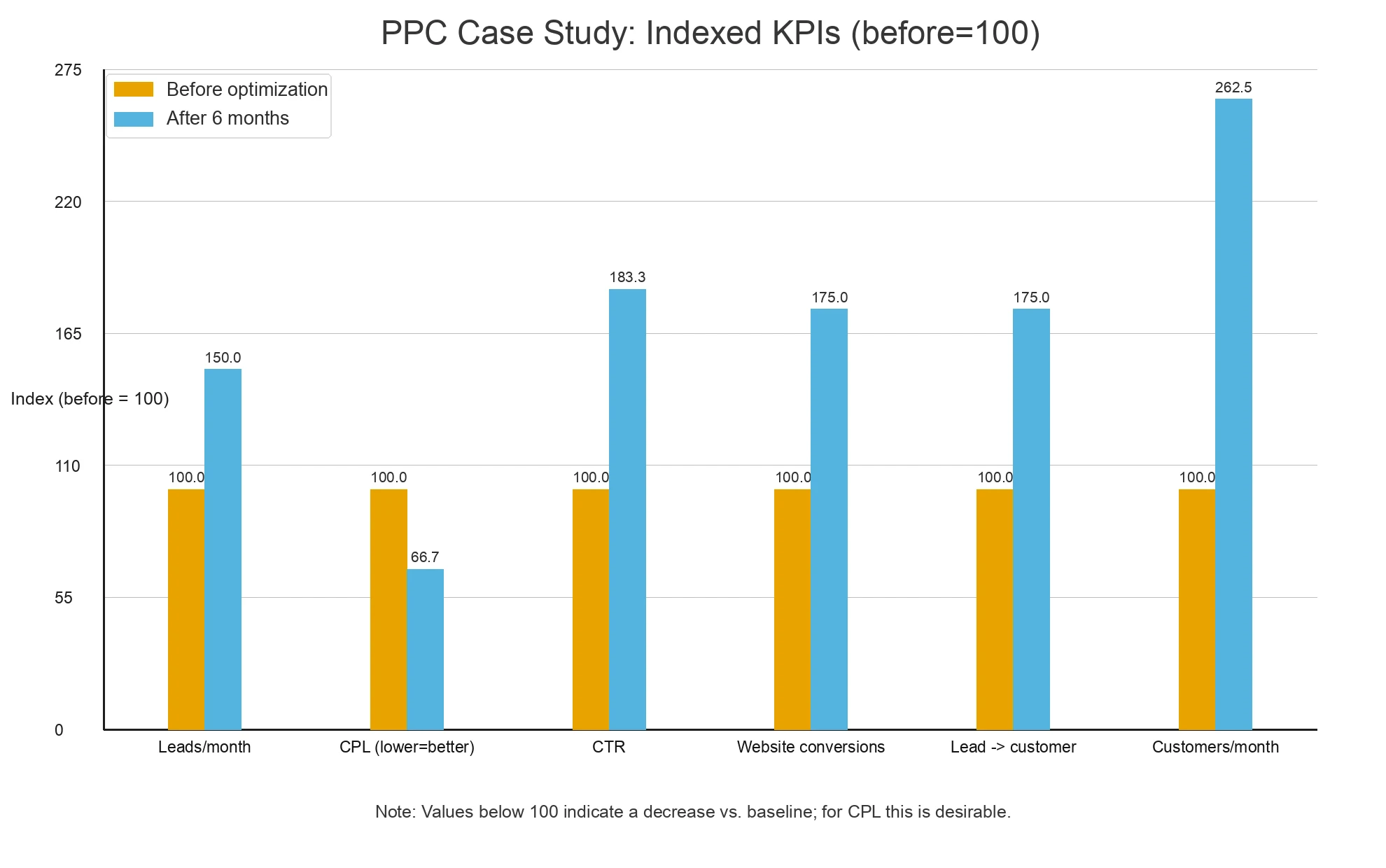
Our client offered corporate training, with a budget of CZK 100,000/month. Before optimization: 40 leads/month, CPL CZK 2,500, website conversion ~2%, lead-to-customer rate 20%.
Actions taken: campaign restructuring, dozens of negative keywords, new ads for different personas, LinkedIn for decision-makers, phone call tracking, a new landing page, and CPA targeting after enough data had been collected.
Result after 6 months: 60 leads/month (+50%) with the same budget, CPL CZK 1,667 (-33%), CTR 3% -> 5.5%, website conversion 3.5%, share of leads converted into business 35%. Number of customers ~21 vs. the original ~8. ROI increased significantly.
Key Components of Successful PPC Campaign Management
- Keyword research and structure: Logical ad groups and ongoing work with negative keywords.
- Compelling ads: Relevance to the query, a clear call to action, and variant testing.
- Optimized landing page: Clear offer, credibility, fast loading, and minimal distractions.
- Search query control: Regular exclusion of irrelevant traffic and clean display placements.
- Conversion and value measurement: Track forms, calls, and offline closes in CRM; assign values and optimize for ROAS.
- Monitoring the cost/performance ratio: PNO/ROI by campaign, with budget moved according to results.
- Testing and innovation: New keywords, creatives, channels (PMax, Demand Gen), and adaptation to trends.
Specialist’s view: “The biggest mistake is launching campaigns and then leaving them untouched for weeks. PPC is not a set-and-forget channel. It needs weekly care, deeper monthly optimization, and properly configured measurement. Without that, you are flying blind.”
Common Questions About PPC Management (FAQ)
- What is PPC management and what does it involve?
-
Complete setup and ongoing campaign optimization (keywords, targeting, ads, budgets, measurement), with the goal of maximizing results for the given cost.
- Why is PPC campaign management so important?
-
The market is dynamic: competition, prices, and user behavior all change. Ongoing optimization prevents waste and maintains ROI.
- Which main metrics should you track?
-
CTR, CPC, conversions and conversion rate, CPL/CPA, ROI/ROAS; for branding, reach, frequency, and engagement.
- How much does PPC campaign management cost?
-
Usually a retainer or a percentage of the budget. For small and mid-sized accounts, this typically means thousands to tens of thousands of CZK per month, depending on scope.
- How long before we see results?
-
The first data appears immediately, while performance usually stabilizes within 2-3 months of ongoing optimization.
- I have a small business. Is it worth investing?
-
Yes, with a sensible budget and clear goals. Start locally, target carefully, measure properly, and scale what works.
- How do you choose a specialist or agency?
-
Look for references and case studies, open communication, realistic expectations, a clear scope of services, and transparent reporting.
- What if campaigns are not working?
-
Audit data and measurement, review the offer and website, make quick fixes (negative keywords, ads), test a new landing page, and keep tracking the trend.
- Is PPC better than SEO?
-
No. They complement each other. PPC delivers results immediately, while SEO builds long-term organic visibility. The ideal approach is to combine them.
In Closing: What to Do Tomorrow for Better PPC
- Check metrics (CPC, CPA, conversions) and look for anomalies.
- Review search queries and add at least 5 new negative keywords.
- Compare ad copy and the landing page. Do they deliver exactly what they promise?
- Set goals/KPIs (number of leads, target CPL/ROAS) and reporting.
- Consider a consultation or audit with an experienced specialist for quick wins.
Related Articles
CEO & Performance Strategist




 Fast
Fast  Effective
  Nonstop