

 June 9, 2025
 YouTube Ads Without a Video Camera? How to Launch Video Campaigns with Only Images and Text
Worried you are missing out on potential customers on YouTube simply because you do not have a professional video ad ready? You are not alone. Many companies hesitate to try video advertising because they expect high costs and a complicated production process. But what if you could launch a fully fledged YouTube ad using only the images and copy you already have in a folder? In 2025, the technology is advanced enough for you to reach thousands, or even millions, of viewers with an engaging video, without ever picking up a camera. This article shows you how, and may change the way you think about online marketing and performance PPC campaigns for good.
Article Contents
- Why pay attention to YouTube ads without shooting a video?
- How YouTube ads fit into your PPC strategy
- How to launch a YouTube video campaign without your own video
- Tip: creativity beats technology
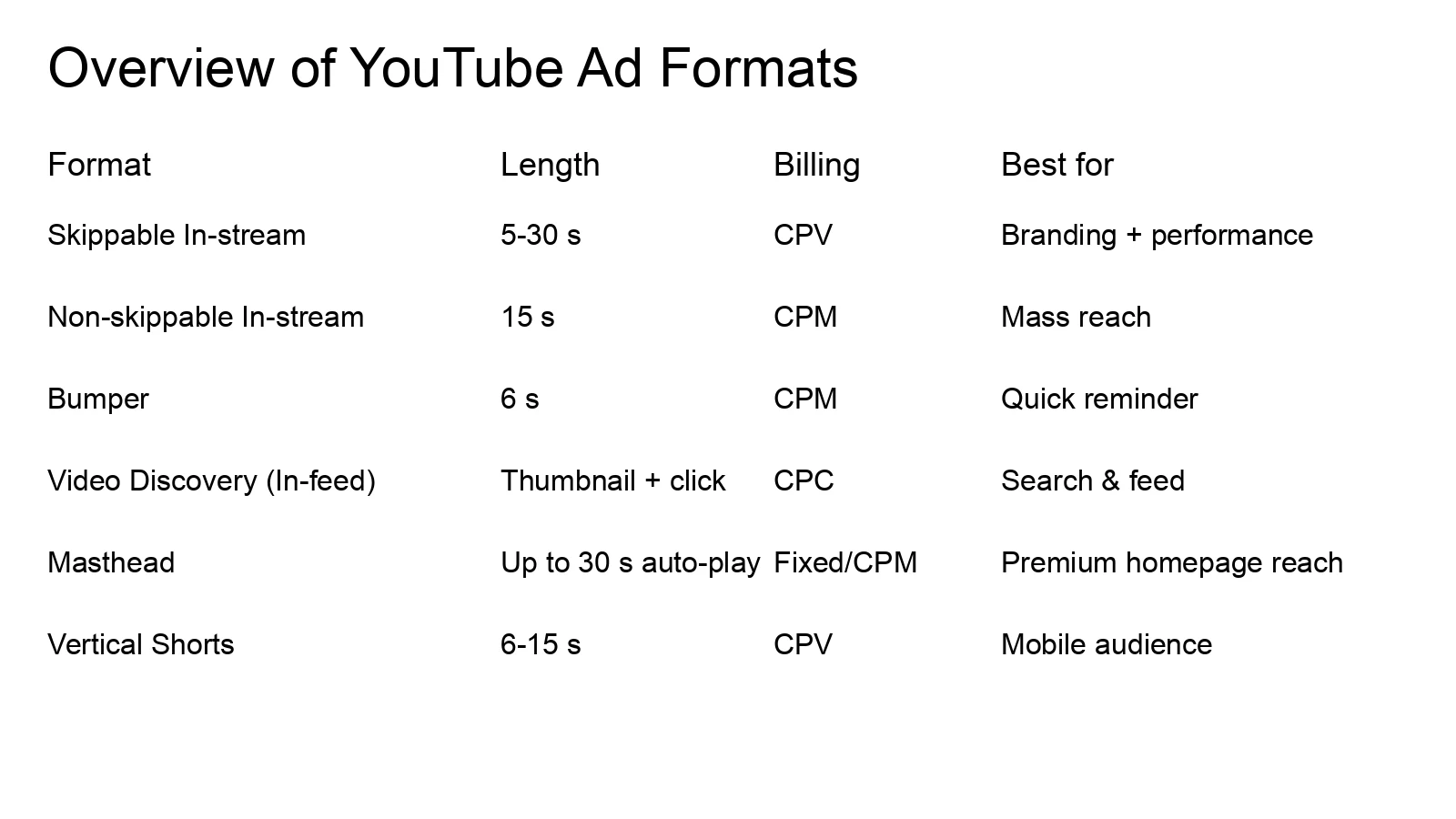
- Which YouTube ad formats can you use?
- Does it work? A real-world case study
- ROI calculator: is video advertising worth it for you?
- YouTube vs. Display vs. LinkedIn: comparison
- Frequently asked questions (FAQ) about YouTube without video
- In closing: try video advertising even without a camera
Why pay attention to YouTube ads without shooting a video?
YouTube remains the second-largest search engine in the world, and video content dominates the internet. Video ads can capture attention and create emotion in a way that a static image or text ad simply cannot. A few numbers make the case:
- Users remember 95% of a message from video, compared with just 10% from text. In short, video communicates your story and offer more effectively.
- Social networks report that videos are shared 1200% more often than posts with text and images combined, because people like to share engaging visual content.
- It is estimated that by 2025, video will account for up to 82% of all consumer internet traffic. In other words, most of your audience already consumes content in video form.
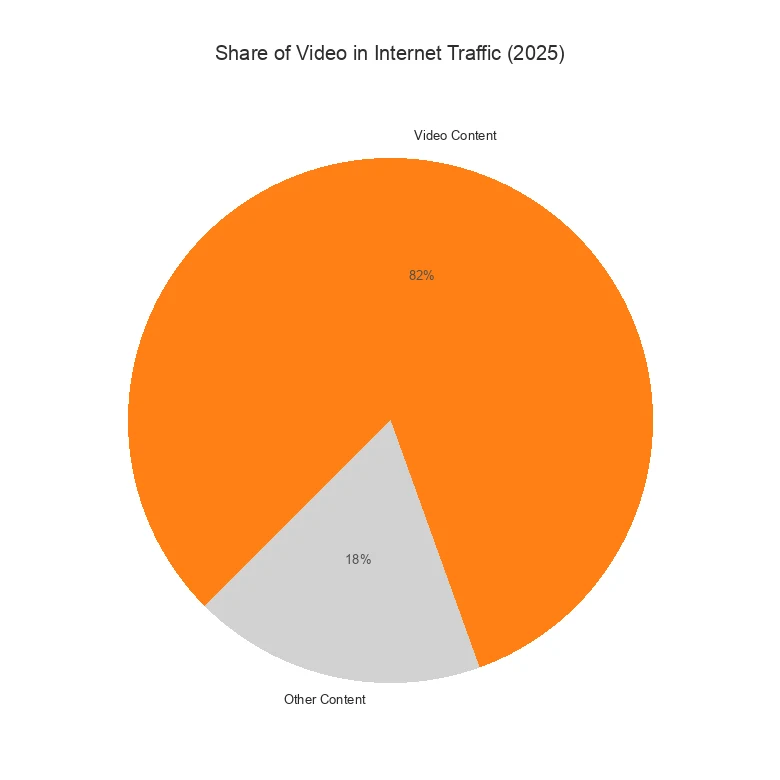
Video dominates the online environment. Estimates suggest that in 2025, up to 82% of internet traffic will be video content, shown by the orange section of the chart.
Adding YouTube ads to your marketing mix therefore makes sense for B2B companies and service providers as well. If you do not have a filmed ad, that is not a barrier. It is an opportunity to create a video from existing assets and start benefiting from video marketing quickly. Video ads also tend to deliver stronger metrics. For example, on mobile platforms, video ads can have up to a 7.5x higher click-through rate than classic banners. That means more interested visitors, and potentially more conversions.
How YouTube ads fit into your PPC strategy
You may be wondering whether, as a service-focused business, it is worth investing time in video. The answer is yes, and it does not have to be difficult. YouTube advertising can complement your existing PPC campaigns in search and the display network very effectively. Search ads reach users with existing intent, because they are already looking for your product or service. Display banners build awareness. Video advertising combines both:
- It can reach a broad audience visually, supporting brand building, while bringing qualified visitors to your website for performance marketing.
- It explains a complex service more clearly. In 15 seconds, you can show a story, results or the benefits of your offer.
- In remarketing, video can re-engage hesitant prospects in a more compelling format than a static banner.
Including YouTube video campaigns can therefore increase the overall effectiveness of your online marketing. In an environment where Google is placing ever more emphasis on content quality (after the March 2024 Core Update, Helpful Content System 2.0 was integrated directly into the core algorithm), creative and useful content is essential. Video ads help you deliver a valuable message in an engaging way, which both Google and users will appreciate.
How to launch a YouTube video campaign when you do not have your own video
Now to the practical part: what should you do if you want to create a video ad using only images and text? The good news is that Google and other platforms offer tools that make the process as simple as possible. Here is a proven step-by-step approach:
- Prepare your assets: Choose several high-quality images, such as product photos, service illustrations or infographics, and write short, punchy copy. Ideally, you need 3-5 landscape or square images and a few sentences to use in the video as captions or slogans. Do not forget your logo and call to action.
- Use Google tools: Video Builder, a tool for creating videos from assets, is available directly in Google Ads. It lets you choose a template, upload images, enter copy, and select a font and background music. Google can also automatically create a video within Performance Max if you do not provide your own.
- Alternative solutions: Canva, Animoto, InVideo and Adobe Express offer templates for creating videos from photos. You upload images, arrange the scenes, and add captions and effects.
- Upload the video to YouTube: Upload the finished video to your channel. Unlisted is fine. Then use the URL in the ad.
- Set up the campaign in Google Ads: Choose the Video campaign type, set your budget and targeting, insert the video URL, and write the headline and description.
- Check and launch: Check text readability and the first 5 seconds. Many people watch with the sound off, so make sure the message also works visually.
After launch, monitor performance, view rate, CTR, CPV and conversions, then optimize.
Tip: creativity beats technology
- Grab attention within 5 seconds: put the most important message right at the start.
- Story and emotion: problem, solution, call to action.
- Readability and branding: large type, strong contrast, logo and brand colors.
- Call to action: include a clear CTA in the video and in the ad frame.
Which YouTube ad formats can you use?
- In-stream (skippable/non-skippable) - 6-20 s and longer.
- Video discovery (In-feed) - a preview with text in results and next to videos.
- Masthead - a premium auto-play banner on the homepage.
- Shorts (vertical) - 9:16 for short vertical videos.
Does it work? A real-world case study
The theory sounds good, but you may be wondering whether this kind of video substitute can actually deliver results. One company whose campaigns we manage offers corporate training. Until then, they had invested in Google Ads search and display network banners, but they were not using YouTube ads because they had not produced any video. The starting point:
- Average click-through rate (CTR) for the banner campaign: 0.6% (i.e. 6 visits from 1000 impressions).
- Cost per conversion (acquired inquiry) from PPC campaigns: CZK 800.
Our team proposed testing a video campaign on YouTube. In two days, we created a 15-second clip from the available materials: three photos from workshops, supported by text slides (problem, solution, call to action) and motivational background music. We deployed the video as a skippable in-stream ad targeting interest groups of managers and HR specialists on YouTube and in the display network, through a Discovery & Video campaign type. After 4 weeks, the result exceeded expectations:
- CTR rose to 1.4%, the video ad attracted significantly more attention than static banners. A click-through rate more than twice as high meant we drove 2x more visitors to the website for the same number of impressions.
- Cost per conversion fell to CZK 500, roughly 37% less than the original CZK 800. Thanks to more visits and stronger engagement, the same budget generated more inquiries.
The following chart shows this more clearly:
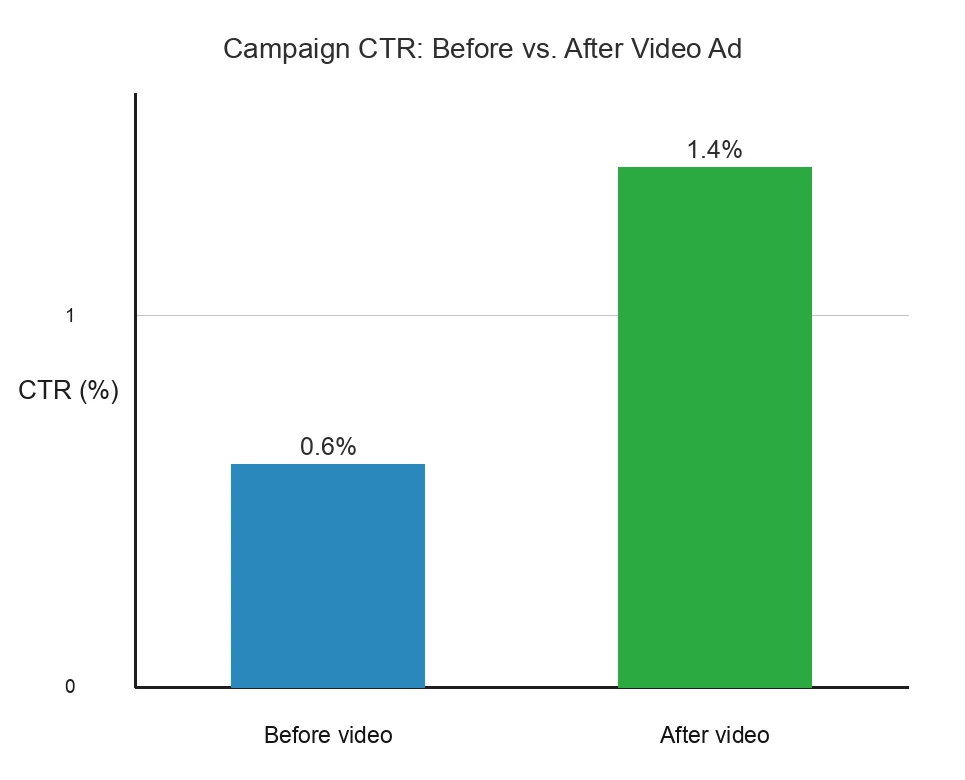
Click-through rate (CTR) before introducing video advertising (banner campaign) and after launching the YouTube video campaign. The improvement from 0.6% to 1.4% is clear, more than double the original rate.
It is important to note that the budget and target audience stayed the same. The only change was the ad format, static versus video. Of course, every campaign is different and results may vary, but this example shows the potential of video campaigns created on a lean budget. We gained more clicks and more conversions for less money.
The key was that the video captured the target audience’s attention more effectively. People spent more time with the ad. The average video watch time was 10 seconds, even though they could skip after 5 s, and the message about the value of the training reached them in a clearer format. The campaign also helped strengthen brand awareness: even people who skipped the ad still saw the logo and main slogan.
Our tip: Do not be afraid to experiment. As in this case study, you can launch a smaller test, for example with 10-20% of your budget, and compare the performance of video advertising with other formats. You will see whether the metrics improve. If they do, you can roll video out more broadly; if not, you will learn from it and try a different approach, or consult specialists. Working with experts can also speed up the whole process, so entrust your campaign management to professionals. Our PPC ONE team will be happy to help, while you focus on your business.
ROI calculator: is video advertising worth it for you?
Every business owner cares about one thing: return on investment (ROI). Let us show how ROI for a YouTube campaign, or a PPC campaign in general, can be roughly calculated. We will continue with our ABC B2B Services case study and plug specific numbers into a simplified model:
- Monthly investment in the YouTube campaign: CZK 50,000
- Conversions acquired (inquiries from companies): 100
- Cost per conversion: 50,000 / 100 = CZK 500 (which matches the result above)
- Let us assume that roughly 20% of inquiries are successfully closed as contracts (i.e. 20 clients)
- Average order value per client: CZK 50,000
- Total campaign revenue: 20 clients * CZK 50,000 = CZK 1,000,000
- Net profit attributed to the campaign: CZK 1,000,000 - CZK 50,000 = CZK 950,000
- ROI = (net profit / costs) * 100% = (950,000 / 50,000) * 100% = 1900%
For clarity, the table below summarizes it:
| Metric | Value |
|---|---|
| Campaign investment | CZK 50,000 |
| Number of acquired inquiries (conversions): | 100 |
| Cost per conversion: | CZK 500 |
| Inquiry -> client conversion rate: | 20% |
| Number of new clients from the campaign: | 20 |
| Average order value: | CZK 50,000 |
| Total campaign revenue: | CZK 1,000,000 |
| Net profit (revenue - investment) | CZK 950,000 |
| ROI (return on investment) | 1900% |
YouTube vs. Display vs. LinkedIn: Where will your video perform best?
Video is not limited to YouTube. If you are considering promotion based only on images and text, you can also use the clip elsewhere, for example as an MP4 video for LinkedIn or as a dynamic banner. Each platform, however, has its own specifics. Let us compare three popular channels for video and content advertising from the perspective of reach, targeting and suitability for B2B:
| Factor | YouTube video advertising | Display (banner) advertising | LinkedIn video advertising |
|---|---|---|---|
| Reach and audience | Huge global reach (YouTube = 2+ billion monthly users). Users spend hours watching videos across topics. | Broad reach across the display network (millions of websites and apps via Google Display Network). Suitable for mass awareness, less so for engagement. | A narrower professional audience (~900 million users on LinkedIn). Ideal for B2B, managers and decision-makers. |
| Targeting options | Detailed targeting by interests, demographics, keywords, topics, remarketing and lookalike audiences. Strong algorithmic targeting (Google AI). | Contextual targeting (based on the topic of page content), in-market audiences, demographics and remarketing. Less user interaction with the format. | Precise B2B targeting: by field, job title, company industry, company size, skills and more. Account-Based Marketing is possible (targeting specific companies). |
| Ad format | Video (sound + image). In-stream spots of 6-30 s (skippable after 5 s), 6 s bumpers, or video discovery previews. Can also be used in YouTube Shorts (vertical video). | Static image (banner) or responsive HTML5 (images + text). No sound, purely visual impression. Standard sizes or adaptive formats. | Video in the LinkedIn feed (auto-play, muted by default, users can turn sound on). Recommended length is 15 s; longer formats are also supported. |
| Payment model | Cost-per-view (CPV), you pay for a view, for example CZK 0.05-0.10 for a 30 s view. Alternatively CPM (~CZK 20-100 per 1000 impressions) for non-skippable formats. | Cost-per-mille (CPM), very low costs (even CZK 10-30 per 1000 banner impressions). Cost-per-click (CPC) is often in the single-digit CZK range, but the click-through rate is low. | More expensive format: CPC can easily be CZK 50-150, CPM in the hundreds of CZK. You pay for a premium audience and a professional context. LinkedIn usually has a higher cost per interaction than Google. |
| Strengths | High engagement thanks to the audiovisual format; ideal for storytelling and emotional impact. A huge user base and broad targeting options. Brand lift and impact on brand awareness are often substantial on YouTube. | Massive impression volume at a low price, suitable for broad awareness and retargeting. Simple production, because banners are enough. It can complement video campaigns through frequency capping across formats. | Precise targeting of a narrow B2B audience, reaching relevant people with purchasing authority. Lower competition within video content on LinkedIn (many companies still do not create videos), which can increase visibility. |
| Weaknesses | You need to create a video, although as we have seen, you can work around the camera. With skippable ads, part of the audience skips after 5 s, so you need to capture attention immediately. It is sometimes perceived more as a branding channel; direct performance may fluctuate. | Banner blindness, users often ignore display ads. Minimal engagement with the format and limited space for the message. As a standalone channel, it does not generate such high CTR or conversions, and works more as a supporting media type. | Very high costs for both reach and clicks, so a larger budget is needed to collect enough data. User behavior on LinkedIn is different: people do not primarily go there to watch videos and may skip them in a work environment. Lower reach in the Czech Republic, with a more limited audience than YouTube. |
| When to use | When you want to reach a massive audience with attractive content: brand building, launching a new service, educating the market through video. Also when you are targeting a younger audience or a visually oriented industry. | When you need to reach a broad group of users with awareness at a low cost, for example to complement a TV campaign with banners, or stay visible to former visitors (remarketing) at minimal cost. | When you target a narrowly defined group of professionals or companies and do not mind a higher cost per lead. Ideal for B2B lead generation, recruitment campaigns, and promotion of expert content (webinars, whitepapers) directly to a relevant audience. |
Frequently asked questions (FAQ) about YouTube ads without video
- Do I need a professionally filmed video for YouTube advertising?
-
No. For a basic video campaign, quality images (product, service, logo), short copy and music from a library are enough. Using templates, you can assemble a video in a few minutes that presents the problem, solution and a clear call to action. The first 5 seconds and readable captions have the biggest impact, because many people watch without sound.
- What is YouTube Video Builder and is it available in the Czech Republic?
-
It is a tool inside Google Ads that automatically creates a short video from your images, text and logo based on the template you choose. It is usually available in Czech accounts, sometimes under names such as "Create video", "Asset library / Video" and similar. If you do not see it in your account, use alternatives such as Canva, Adobe Express or Animoto, then upload the finished video to YouTube as Unlisted.
- How much does YouTube advertising cost, and do I pay anything to create the video?
-
You pay through the auction for views, impressions or conversions depending on the campaign goal you choose, for example CPV, tROAS/tCPA or "Maximize conversions". Creating the video itself in Google Ads templates or Canva is usually free of licensing fees; the main costs are your time or the work of a designer/copywriter. Start with a smaller test budget, evaluate performance, and increase the budget gradually.
- Is YouTube advertising suitable for B2B companies and the services sector?
-
Yes. Video quickly explains a complex offer, shows a case study and builds trust. Use remarketing (website visitors, leads), custom segments based on keywords and placements (expert channels, conferences, media). Short educational spots and testimonials work very well in B2B.
- Which video formats and lengths should I choose?
-
For broad reach and performance, combine In-stream (skippable/non-skippable) and In-feed (Video discovery). Prepare a 15-20 s version for a quick message and a longer variant for detail (30-60 s). At the same time, make a vertical 9:16 version for Shorts; keep horizontal 16:9 for YouTube and the web. Always test multiple previews and the first 5 seconds.
- Do I need my own YouTube channel for these ads?
-
Having your own channel is recommended because you need to upload the video to YouTube, where it can be Unlisted. That gives you control over the video library, previews, captions and statistics. Managing everything through your channel also makes remarketing and future publishing of content videos easier.
- Which metrics should I track, and how do I evaluate success?
-
Track view rate, average watch time, CTR on companion elements, CPV/CPC/CPA, conversions and engaged-view conversions, meaning a view followed by a conversion. Reach frequency, placements and audience segments are also important. Optimize creative (first 5 s, captions, CTA), targeting and the landing page at the same time.
- What if people skip my ad and do not watch it to the end?
-
With skippable formats, you primarily pay for views based on the goal you choose, so some skipping is fine. Reduce it with a strong hook in the first seconds, dynamic editing, captions and a clear offer. Narrow your targeting, test shorter versions and work with remarketing. Someone who skips today may convert after the next touchpoint.
In closing: try video advertising even without a camera
We hope you now see that YouTube advertising does not have to mean a large production or a large budget. If you have images, a presentation or a good idea in your head, nothing is stopping you from turning it into an engaging video and reaching your audience in a new way. The benefits of video advertising, higher engagement, better message recall and potentially lower conversion costs, are well worth testing.
Do not fall behind while your competitors experiment with video content. Try it too. And if you need advice or want the whole campaign set up for you turnkey, we are here for you.
The article was prepared by Bc. Petr Kučera, MSC., MBA, PPC specialist and strategist with 15 years of experience in online marketing, with overlap into business, startups, UX, UI and product creation. Take a look at more articles or write to us. We will be happy to hear from you.
Related Articles
- How to Approach PPC Management, a Marketing Tool That Saves Money and Makes Money
- PPC Specialist, the Key to a Successful Campaign and Maximum ROI
- PPC Campaigns from A to Z: How They Work and What to Expect from Them
CEO & Performance Strategist



 Fast
Fast  Effective
  Nonstop