

 November 4, 2025
 PPC campaigns from A to Z: how they work and what to expect
Read the complete guide to PPC campaigns, from A to Z. Learn how to increase return on investment (ROI) and generate qualified leads.
Article Contents
- What is PPC advertising and how do campaigns work?
- Why invest in PPC campaigns?
- How to manage PPC campaigns properly?
- How to measure PPC campaign success and which metrics to track?
- What does a successful PPC campaign look like in B2B practice?
- How to calculate ROI from PPC and which format should you choose?
- Frequently asked questions (FAQ)
- What to do tomorrow: recap and next steps
Do you want every CZK 1 you put into advertising to generate real enquiries? PPC campaigns, or performance advertising, are a core tool for companies in both B2B and B2C. This article takes you through the topic from A to Z: what PPC means, how to measure success and how to maximise return on investment (ROI). You will see specific numbers (CTR, conversions, CPL) from the Czech market, practical tips from a PPC specialist and a comparison of the most important formats (Google Ads, Sklik, YouTube, LinkedIn). At the end, you will also find a case study and a simple ROI calculator that make it easy to see whether your campaigns are truly profitable.
- PPC (pay-per-click) advertising lets you target relevant audiences and measure results clearly.
- Key campaign metrics: CTR around 5-6%, conversion rate 5-7%, average cost per lead (CPL) around CZK 1,500.
- Benefits of PPC: instant activation, flexible budget, precise targeting (including B2B decision-makers) and fast performance data.
- Google Ads holds around 80-90% share in the Czech Republic, Seznam Sklik around 10-18%. Google has greater reach, while Sklik offers lower CPC for local campaigns.
- A properly set up PPC campaign generates more leads than SEO and, with good optimisation, achieves ROI around 500-1000% (usually a target for services).
What is PPC advertising and how do campaigns work?
PPC (Pay-Per-Click) is a form of online advertising where you pay only when someone clicks your ad. The system runs as an auction: the advertiser sets a maximum cost per click (CPC), and the advertising platform (Google Ads or Sklik) decides which ad appears and in which position. In Google Ads, this can include text search ads, banner ads in the Display Network and video ads on YouTube. In the Czech market, Seznam’s Sklik offers similar formats (search, display network and Zboží.cz).
The strength of PPC lies in precise targeting. You can define keywords, demographics, interests and location, for example by targeting only Prague or commercial directors, then test which combinations deliver the best results. Real-time ad auctions show how much you will pay and what reach you can expect. This keeps every CZK 1 you allocate under control.
PPC specialist’s view: Measuring all conversions (for example, submitted enquiry forms or calls from the website) is critical for a successful campaign. Without conversion data, you are only guessing. Regularly test different headlines and landing pages (A/B tests), as different creative can often raise CTR and conversion rate noticeably. Do not underestimate Quality Score either: the higher your relevance, the cheaper your clicks will be at the same reach.
Summary: PPC advertising is a performance-based form of advertising where you pay for clicks. It helps you quickly reach specific prospects, including B2B managers, and monitor every campaign’s performance in real time.
Why invest in PPC campaigns?
PPC campaigns give companies fast, measurable results. Unlike long-term SEO, PPC can be switched on immediately and starts delivering traffic and conversion data right away. It is also an effective way to reach a tightly defined audience, especially in B2B, where PPC can target managers searching for a specific solution or product. Remarketing is another major advantage: banners or video help you reach users who have already shown interest, increasing the likelihood of conversion.
Before you launch PPC, set clear goals. Define what success means for you, for example how many qualified leads you want to acquire, what maximum cost per lead you accept (CPL) or what ROI (return) you are aiming for. Then set these goals as conversion actions in advertising systems (form submission, phone call, newsletter sign-up and so on). Without goals, you have no benchmark for optimising the campaign.
In the Czech market, Google Ads (around 80-90% search share) and Seznam Sklik (10-18%) dominate. Google Ads provides global reach and advanced AI targeting (demographics, interests), but CPC can be higher because competition is strong. Sklik is localised for the Czech Republic, usually offers a lower cost per click and benefits from less competition. In practice, it often pays to combine both platforms: Google captures most of the market, while Sklik helps with budget efficiency and local reach. The result is often a well-managed PPC strategy that brings in dozens of percent more leads than organic SEO.
Summary: PPC campaigns offer an immediate start and high flexibility. Thanks to precise data and targeting, you can reach the right customers, whether you need to generate more B2B opportunities or quickly capture attention in B2C. Set goals carefully and manage campaigns by performance so the investment pays back quickly.
How to manage PPC campaigns properly?
Managing PPC campaigns requires strategy and continuous tuning. Start with keywords: identify precise terms with strong commercial potential and set negative keywords to filter out unsuitable clicks. Build ad groups by topic (for example, “corporate training” vs. “courses for entrepreneurs”) and optimise ad copy. Every ad should have a relevant headline, an engaging description and a clear call to action.
Next, set your bidding strategy: you can begin with manual CPC to gain control, then switch to smart bidding (Target CPA, Max Conversions) once you have enough data. Regularly adjust the daily budget based on campaign performance, and do not exceed planned limits without a clear reason. It is also important to monitor Quality Score: the more relevant your ads and landing pages are, the lower their actual cost per click will be at the same price.
A good PPC specialist analyses data regularly. Track CTR, conversion rate, cost per click and cost per conversion. Remember that B2B marketing often has a longer buying cycle. That is why you should use longer remarketing lists (60-90 days) to keep your offer in front of potential customers even after more time has passed. Be ready to make quick changes: if some keywords generate few conversions, pause them; with the successful ones, you can increase the bid and scale the budget.
PPC specialist’s view: Integration with other systems makes a big difference. Connect your PPC campaign with a CRM or GA4 so you can also track offline conversions (a sale won from a lead). This lets the PPC platform optimise not just for lead volume, but for actual profit. Also, keep testing, as even a single A/B test in a campaign can significantly improve efficiency.
Summary: PPC campaign management consists of keyword research, creating high-quality ads and continuously optimising bids. Many companies rely on an experienced PPC agency, or an in-house specialist, to ensure efficient performance and cost savings.
How to measure PPC campaign success and which metrics should you track?
The success of PPC campaigns is measured through key performance indicators (KPIs). CTR (click-through rate) shows the ratio of clicks to ad impressions. In practice, it is often around 5-6%, although this depends on the industry and ad quality. Conversion rate expresses the share of clicks that lead to a conversion (for example, completing an enquiry form). In the Czech Republic, performance B2B/B2C campaigns commonly sit around 5-7%.
Also track CPC (average cost per click) and CPL (cost per lead), as these are direct indicators of cost efficiency. The higher the quality of your targeting and advertising, the lower these costs can be.
The most important metric, however, is ROI (Return on Investment), the return on your PPC investment. It is calculated using the formula ROI = (Revenue - Costs) / Costs x 100%. Practical example: you invest CZK 100,000 in a campaign and gain 5 new contracts from it with a total value of CZK 300,000. ROI = (300,000 - 100,000) / 100,000 = 200%. This means every CZK 1 invested brought back CZK 2. In services, the target is often ROI of at least 1000% (10x), but lower values can also be a good signal at the start.
Summary: The key PPC metrics are CTR, conversion rate, CPC/CPL and, of course, ROI. By monitoring these indicators in real time and evaluating them, you can gradually improve campaigns and increase return.
What does a successful PPC campaign look like in B2B practice?
One of our clients offered corporate training and had no previous online advertising. The client decided to invest CZK 30,000 per month in a Google Search campaign, and our PPC agency handled the preparation in detail.
- Starting point: Before optimisation, the company had low CTR (around 2.5%) and a conversion rate of around 3%. For CZK 30,000, it gained only a few non-binding enquiries, none of which were high quality.
- Intervention: Using keyword analysis, we narrowed the targeting (selecting specific phrases such as "corporate project management training"), adjusted ad copy, added negative keywords ("free", "combined study") and optimised the landing page (a clear form and client references). We also increased bids for the highest-value terms.
- Result (after 2 months): Campaign CTR rose to around 5%, and the conversion rate reached 6%. The company gained 20 high-quality leads per month, 3 of which turned into business. The average value of one contract was CZK 100,000, so total revenue was CZK 300,000. Campaign ROI (300,000 - 30,000) / 30,000 x 100% = 900%.
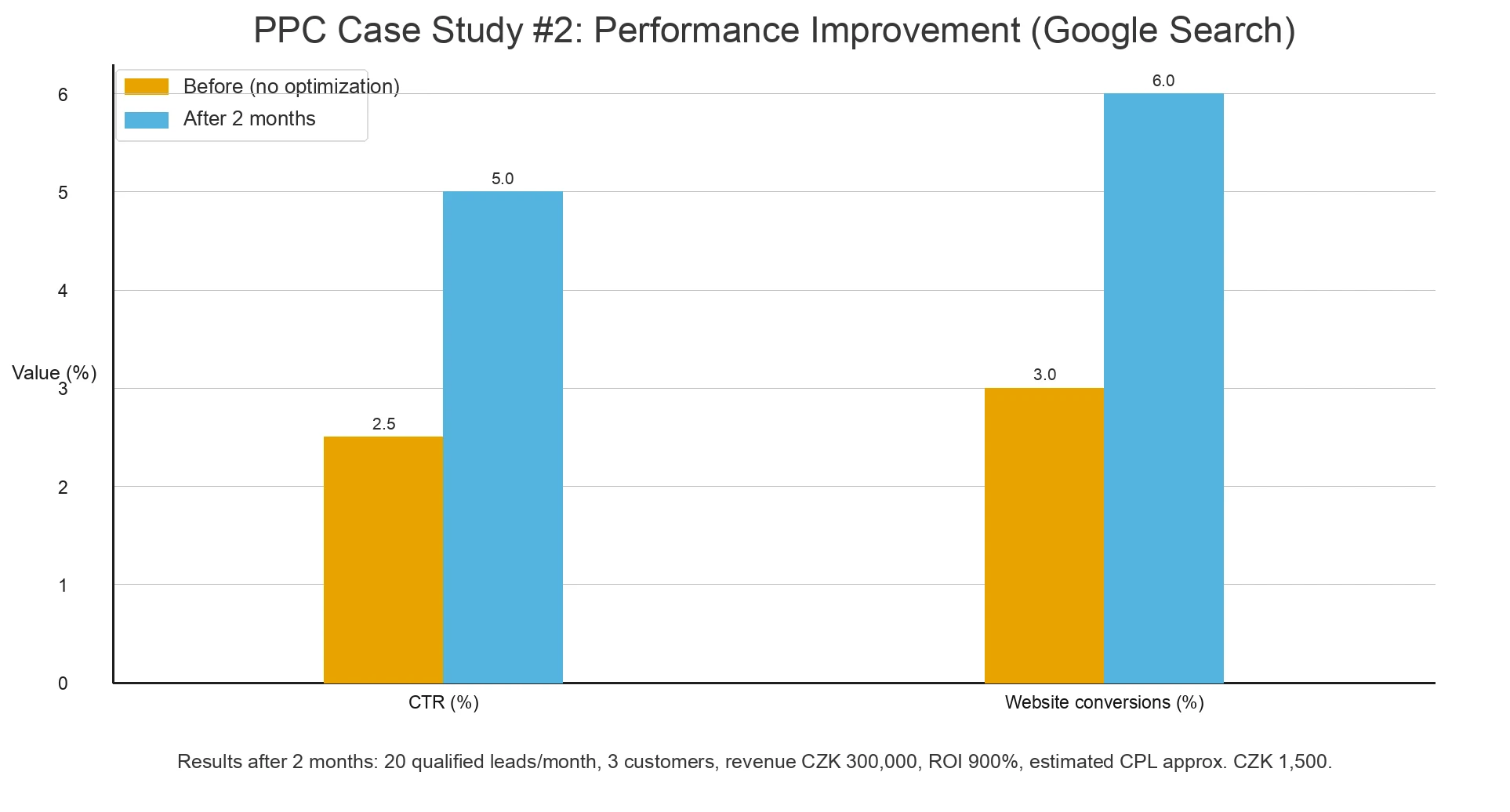
This example shows how the right optimisation and PPC strategy can dramatically improve advertising efficiency and generate qualified enquiries.
How to calculate ROI from PPC and which format should you choose?
ROI calculator (in text): For a quick overview of return on investment, use the formula ROI = (Revenue - Costs) / Costs x 100%. Enter your expected costs and revenue, and you immediately get the percentage return. For example, you invest CZK 50,000 in a campaign and win 3 contracts worth CZK 40,000 each (CZK 120,000 total). ROI = (120,000 - 50,000) / 50,000 = 140%.
| Campaign goal | Ad format | When to use it | Benefits | Risks | KPI |
|---|---|---|---|---|---|
| Lead generation | Google Search Ads | The user is actively searching for a specific solution | High enquiry quality; direct intent | High competition (CPC); less room to scale | CTR, conversions, CPL |
| Awareness building | Display and Video Ads | Start of the buying process, brand awareness | Large reach; visual format | Lower immediate conversions; remarketing required | Impressions, views, CTR |
| Professional targeting (B2B) | LinkedIn Ads | Targeting specific positions/industries | Precise B2B audience (managers, companies) | High CPC; smaller audience | CPL, number of MQLs |
| Local campaigns | Sklik (Search/Display) | Targeting Czech users and regions | Lower CPC than Google; local reach | More limited audience; less advanced targeting | CTR, CPL, reach |
| Video and views | YouTube Ads | Presenting a brand/product through video | High attention, emotional engagement | Ads can be skipped; more demanding production | View-through rate, engagement |
Frequently Asked Questions (FAQ)
- What is a PPC campaign?
-
A PPC (Pay-Per-Click) campaign is paid online advertising where the advertiser pays only when someone clicks the ad. Ads appear in search engines or on partner networks based on keywords or targeting. The advantage of PPC is immediate launch and easy results measurement.
- How do you pay for PPC advertising?
-
You pay for PPC advertising through CPC (Cost-Per-Click), meaning the price for each click. You set a budget (daily/monthly) and a maximum bid. The actual price depends on the auction; with high relevance and a good Quality Score, CPC can be lower.
- How quickly do PPC campaigns deliver results?
-
PPC advertising can start bringing in the first visitors on the day it launches. Stable conversions and optimal settings, however, usually take several weeks of testing. The first enquiries can arrive within days to weeks depending on the length of the sales cycle.
- When should you use Sklik instead of Google Ads?
-
Sklik targets Czech users exclusively and is suitable for local and medium-sized companies. Its advantage is lower competition (and therefore often lower CPC). The ideal approach is to combine both platforms for broader coverage.
- Who are PPC campaigns suitable for?
-
PPC is a universal tool for B2B and B2C. In B2B, expect a longer decision-making cycle and a focus on lead quality; in B2C, expect a faster conversion process and higher volumes. KPIs and optimisation principles are similar.
- What are the main differences between PPC B2B and B2C?
-
B2B targets a narrower audience, usually with higher CPL and a longer cycle, and requires more nurturing (emails, remarketing). B2C reaches a wider audience with faster conversion and higher volumes. In both cases, you track CTR, CPL and ROI.
- Do I need an in-house specialist or an agency for PPC?
-
It depends on scope and capacity. You can handle the basics internally, but a specialised agency will usually bring deeper know-how, better optimisation and budget savings, plus systematic reporting and planning.
What to do tomorrow: recap and next steps
The key to a successful PPC campaign is data and clear goals. Define your goals (number of leads, CPL, ROI), prepare a keyword list and set up conversion tracking in Google Ads/Sklik. Set the budget based on lead value.
Launch a test campaign and measure the results. Regularly evaluate CTR, cost per click and, most importantly, cost per lead. Strengthen what works (increase the bid) and switch off weak items. Add remarketing and consider an audit or management by an experienced PPC agency so every CZK 1 invested returns as quickly as possible. Wondering how much PPC campaign management costs? See our transparent pricing, or get in touch for a no-obligation consultation.
Related Articles
- PPC specialist, the key to a successful campaign and maximum ROI
- How to manage PPC: the marketing tool that saves and earns money
CEO & Performance Strategist


 Fast
Fast  Effective
  Nonstop