

 April 23, 2025
 The Benefits of Server-Side Tracking in PPC Advertising
Article Contents
- What is server-side tracking?
- Comparison of server-side and client-side tracking
- Benefits of server-side tracking for PPC campaigns
- Conversion loss rates with client-side tracking
- The advantage of server-side tracking: more recorded conversions
- Impact on campaign performance: higher ROAS, lower CPA
- Website speed and user experience
- Longer data lifespan and stronger resistance to blocking
- Case studies and statistics
- Examples of successful implementations
- How server-side tracking is implemented
- How we help clients with tracking and PPC campaigns
- Frequently asked questions
- Conclusion
In digital marketing, accurate tracking is the basis for effective optimization. Without reliable data, you cannot optimize PPC campaigns properly, which can waste budget and cost you potential customers. Server-side tracking is a modern way to collect more accurate data and improve the performance of your advertising campaigns.
What is server-side tracking?
Server-side tracking moves data collection from the user’s browser to the server. This helps bypass limitations caused by ad blockers and improves measurement accuracy. It also helps ensure that important data about user behavior is not lost and can be used effectively to optimize campaigns.
Comparison of server-side and client-side tracking
| Criterion | Client-side tracking | Server-side tracking |
|---|---|---|
| Data accuracy | Lower | Higher |
| Resistance to ad blockers | Low | High |
| Page load speed | Can slow it down | Faster |
| Control over data | Limited | High |
Benefits of server-side tracking for PPC campaigns
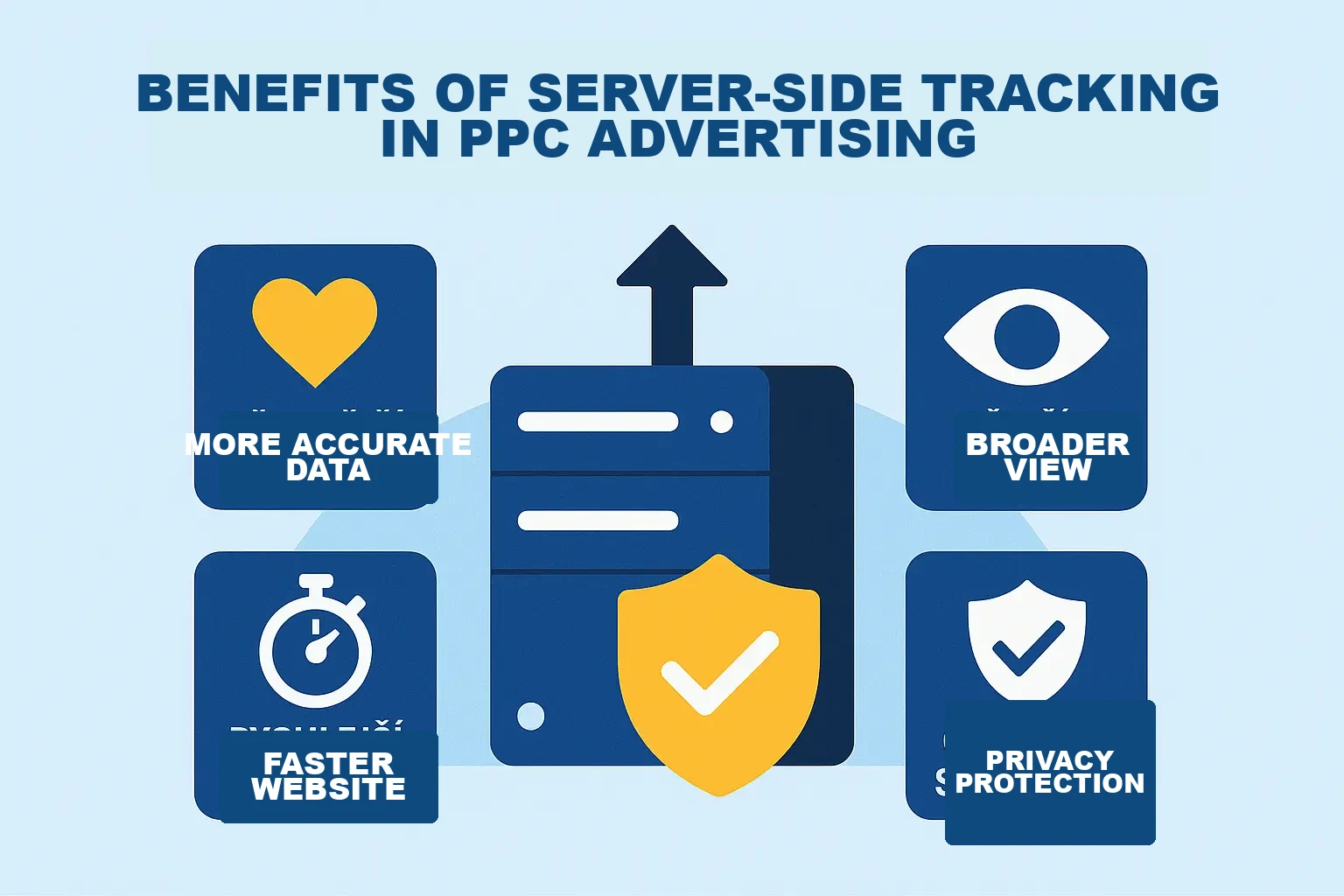
- More accurate data, with up to 40% more conversions captured
- Bypasses ad blockers
- Better campaign optimization
- Support for GDPR compliance
- Less dependence on browsers
- Integration with Google Analytics, Google Ads, Facebook Ads, TikTok Ads, and more
Conversion loss rates with client-side tracking
Client-side tracking, which relies on the browser and cookies, is losing more and more data. For example, Air France saw an immediate drop of roughly 20% in conversion visibility after introducing a stricter cookie policy. Similarly, the Elevar platform estimates that without server-side tracking, 20-25% of transactions and important events may be lost.
The benefit of server-side tracking: more recorded conversions
Switching to server-side tracking helps reduce these losses and improves the accuracy of data sent to advertising platforms. Square recorded 46% more conversions after deploying server-side tagging. Elevar clients commonly report 10-20% more purchases attributed in Facebook and Google Analytics.
Impact on campaign performance: higher ROAS, lower CPA
More accurate data gives advertising algorithms better input for optimization. A case study by the Stape platform shows that after implementing Facebook Conversions API, leads increased by 568% and registrations by 204%. Thanks to Meta CAPI, Ray-Ban recorded 36% broader reach and 10% more online sales.
Website speed and user experience
Server-side tracking reduces the number of scripts loaded in the browser, which helps websites load faster. After deploying server-side Google Tag Manager, the Danish e-shop Nemlig reduced page load time by 7%. A study of news portals reports that average load time dropped from 9.46 s to 2.69 s after client-side tags were removed.
Longer data lifespan and stronger resistance to blocking
Server-side tracking uses 1st-party cookies, which can be set with a longer validity period. For example, Facebook Conversion API makes it possible to extend cookie lifespan to up to 6 months, while Safari limits cookies to 7 days. Server-side tracking also bypasses ad blockers because data is sent from your own domain.
Case studies and statistics
Data accuracy is critical in digital marketing. But as expectations around user privacy grow, cookies are blocked more often and ad blocker use increases, so traditional client-side tracking fails more frequently. A modern server-side approach offers an effective solution: it removes these obstacles and provides more reliable data for campaign optimization. Let’s look at specific numbers and real-world examples.
Examples of successful implementations
- Square (USA), +46% more conversions after implementing server-side GTM
- Nemlig (Denmark), +40% new customer conversions in 90 days thanks to server-side tracking and Consent Mode
- Ray-Ban (globally), +36% greater reach and +10% more online sales thanks to Meta Conversions API
- Unieuro (Italy), +25% increase in e-commerce revenue thanks to TikTok Events API integration
Study by Elevar (2023): By switching to server-side tracking, e-commerce clients recorded an average 28-44% increase in additionally measured conversions in Facebook Ads.
| Tracking type | Additionally measured conversions | ROAS |
|---|---|---|
| Client-side only | 560 | 3.1 |
| Server-side only | 780 | 4.2 |
| Combined solution | 845 | 4.6 |
How server-side tracking is implemented
- Platform selection, Google Tag Manager Server-Side, Meta Conversions API
- Server container setup
- Connection to data sources
- Sending data to advertising systems
- Testing and debugging
How we help clients with tracking and PPC campaigns
We offer:
- An audit of your current tracking setup
- Implementation of server-side solutions
- Connection to advertising platforms
- Ongoing campaign management
Frequently asked questions
- Is server-side tracking legal and GDPR compliant?
-
Yes, it gives you better control over data and user consent.
- Is implementation complicated?
-
We offer server-side tracking free of charge as part of most plans. As a standalone service, however, it starts from CZK 2,900 per month.
- How much does server-side tracking cost?
-
It depends on the scope of implementation; we offer several packages.
- Can server-side and client-side tracking be combined?
-
Yes, combining them delivers the best results.
- Which platforms is server-side tracking suitable for?
-
Google Ads, Facebook, TikTok, Sklik, LinkedIn and others.
Conclusion
Data accuracy determines whether your PPC advertising makes money or simply burns through budget. Server-side tracking is the modern standard that helps you get the most out of every campaign.
Start improving campaign performance
CEO & Performance Strategist







 Fast
Fast  Effective
  Nonstop