

 October 24, 2025
 The secret to PPC advertising: how it works and how it can kick-start your business
Article Contents
- What PPC advertising is and how it works
- Why PPC advertising should matter to you
- PPC for B2B vs. B2C
- How to measure PPC campaign success
- Where to advertise: comparison of the main PPC platforms
- How to create a successful PPC strategy (step by step)
- Frequently asked questions (FAQ) about PPC
- Conclusion: summary and next steps
The Secret to PPC Advertising: What It Is and How It Can Change Your Business
PPC advertising (Pay-Per-Click) is an online advertising model where you pay only when someone clicks your ad. That makes it highly measurable and, when managed well, highly effective.
- Fast results and ROI: Well-built PPC campaigns deliver an average return on investment of around 200% (for every CZK 1, roughly CZK 2 comes back), and you can see that performance in the data almost immediately.
- Works for B2B and B2C: PPC can generate qualified leads for B2B companies and purchase-ready customers for B2C brands, with precise targeting across the Czech market (Google, Seznam and social networks).
- Precise targeting: You can reach the right audience by keyword, location, interest or company. Your ads are shown only to relevant audiences, which increases the chance of conversion.
- Scalability and control: A PPC budget can be scaled almost instantly. Start with a small campaign, then increase investment in what works while keeping cost per lead and return under constant control.
- Measurability: PPC campaigns can be measured in detail. Every click, conversion and CPL (cost per lead) is transparent, so you can see what is actually making money and scale only the campaigns that perform.
What PPC Advertising Is and How It Works
PPC advertising (pay-per-click) is a digital advertising model in which the advertiser pays only when a user clicks their ad. In simple terms, you pay only for the visitors your ad brings to your website. PPC most often appears in search engines (text ads on Google or Seznam), but it also includes banner ads in display networks, video ads on YouTube and promoted posts on social networks. PPC is a core pillar of performance marketing because it allows precise targeting, fast campaign launches and, most importantly, detailed real-time measurement.
Where PPC Ads Appear
The best-known platform is Google Ads, where your text ads appear above Google search results. In the Czech Republic, Google has around an 81% share of search, while Seznam.cz is around 13%, so Sklik (Seznam’s PPC platform) also deserves attention. PPC formats appear in many other places too: Google Ads also offers the display network (millions of websites that can show your banners), YouTube Ads (video spots) and the newer Demand Gen campaign type (the successor to Discovery Ads), which combines social-style formats across YouTube, Gmail and the Google Feed. Social networks also use the PPC principle, including Facebook/Instagram Ads and LinkedIn Ads, where you pay for clicks or impressions and can target precisely by demographics or job role.
How PPC Works
When a user searches for a phrase such as “PPC agency Prague”, the search engine runs an auction among advertisers targeting that phrase. Each advertiser sets a maximum cost per click (for example CZK 15) and combines it with a high-quality ad and a relevant landing page. The algorithm selects the winner based on a combination of the bid and the Quality Score. The winning ad appears in the top positions marked as “Ad”. The advertiser is charged only when someone actually clicks the link (for example CZK 14 per click). If the user sees the ad but does not click, it costs the advertiser nothing. This model means you pay only for visitors who have shown interest in what you offer.
Why PPC Is Popular
Because it is fast and effective. Unlike SEO, which can take months, PPC advertising can bring in the first customers within hours of launching a campaign. It is also used by the vast majority of companies, with up to 96% of brands investing in Google Ads. PPC advertising is everywhere, from search engines (where it occupies the top positions) and news websites to social networks. Up to 90% of internet users see some form of PPC ad during the day, often without even realizing it.
Summary: PPC advertising is paid online advertising where you pay for a click. It appears in search (Google, Seznam) and in other formats (banners, videos and social networks). Thanks to targeting and the auction model, you pay only for relevant visitors, making PPC one of the most effective tools in performance marketing.
Why PPC Advertising Should Matter to You
- An immediate flow of customers: As soon as you launch a PPC campaign, your offer starts appearing to potential clients. You can receive your first enquiries or orders within the first few days.
- PPC increases conversions: Visitors from PPC advertising convert around 50% better than organic traffic. With the same investment, PPC can bring up to twice as many visitors compared with SEO.
- High return on investment (ROI): On average, companies generate around CZK 2 in revenue for every CZK 1 invested in Google Ads. Many businesses report even higher returns; in B2B, ROI is often especially attractive.
- Precise targeting for your segment: Target by keywords, audiences, demographics and remarketing. Every CZK 1 goes toward a relevant audience.
- Building awareness and trust: PPC ads increase brand awareness and reinforce the perception of your company as a market leader.
- Measurability and data for decision-making: You can track impressions, clicks, CTR, conversions, CPA/CPL and ROAS/ROI, then optimize the budget based on facts.
Mini Case Study
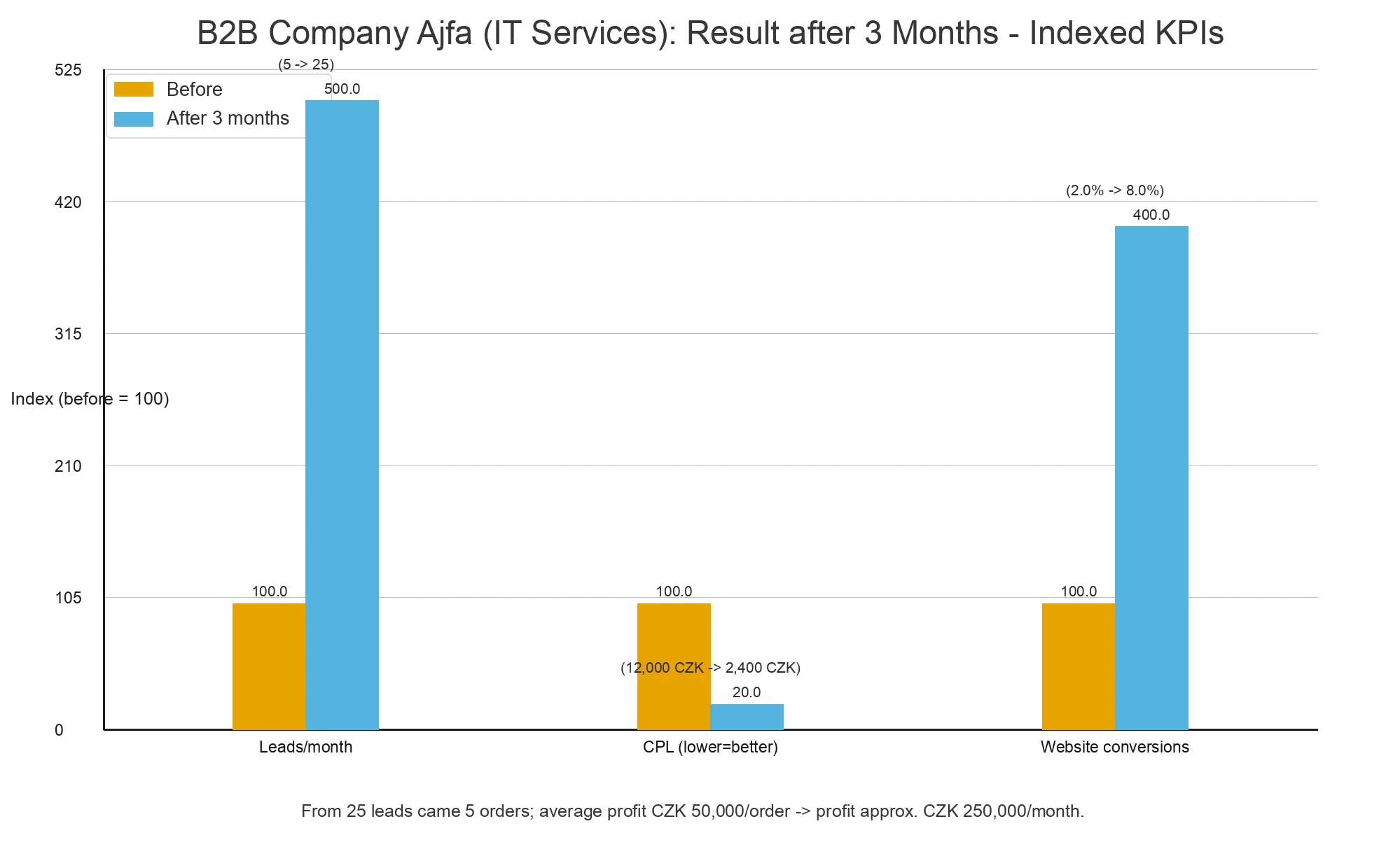
Our client in the IT services sector invested CZK 60,000 in PPC on Google and Sklik. After 3 months of optimization (keywords, negative queries, copy and landing page), enquiries rose from 5/month to 25/month. The conversion rate increased from 2% to 8%. CPL fell to CZK 2,400. Those 25 leads produced 5 contracts with an average profit of CZK 50,000, which meant roughly CZK 250,000 in profit per month. ROI exceeded 300%.
A PPC specialist’s view: “Many companies focus on clicks but forget to measure and optimize conversions. Without proper tracking, you may be quietly losing a substantial share of your campaigns’ value. One small landing page adjustment and an A/B test of the headline were enough for one client to increase the conversion rate from 3% to 5%, which meant 30% more leads from the same budget.” - Petr Kučera, PPC specialist (15 years’ experience)
PPC delivers fast results, above-average conversion performance and scalable ROI. It also builds your brand and gives you clear data for further optimization.
PPC for B2B vs. B2C
1) Target Audience and Targeting
B2B: Narrower, more specific audiences (decision-makers), often reached through LinkedIn Ads. Higher CPC, higher visitor value.
B2C: Broader audiences, demographics and interests (Meta Ads), usually with lower CPC and a stronger focus on volume.
2) Length of the Buying Cycle and Conversions
B2B: A longer cycle and more approvers, with lead generation as the goal (forms, demo, webinar). CPL may be higher, but client value can be higher too.
B2C: A shorter cycle, more often focused on direct sales or registrations, with remarketing (for example abandoned carts) playing a major role.
3) Ad Content and Message
B2B: Factual, rational messaging (efficiency, ROI, references). CTAs such as “Book a demo”.
B2C: More emotional, punchier offers (discount, free delivery), visuals and strong CTAs.
4) Platform Selection
B2B: Google Search + LinkedIn, with remarketing in the display network and on YouTube.
B2C: Google (Search, Display, YouTube) + Meta; Sklik for the Czech web; TikTok, Pinterest and others as additions.
Recap: B2B = precision, patience and lead quality. B2C = broad reach, fast action and conversion volume.
How to Measure PPC Campaign Success
Key Metrics
Impressions: Campaign reach. Low impressions may mean targeting is too narrow or bids are too low.
CTR: Clicks / impressions × 100. Shows how relevant and appealing the ad is.
CPC: Average cost per click. Depends on competition and quality.
Conversions & CVR: Desired actions and their ratio to clicks. Influenced by the landing page, offer and website speed.
CPA/CPL: Cost per action/lead. Critical for business return.
ROI/ROAS: Overall campaign profitability.
Quality Score & Ad Rank: These affect cost and position. Monitor and improve relevance.
Impression Share Lost: Lost impressions due to budget or rank, a useful guide for scaling.
Summary of the Main PPC Metrics
| Metric | What it measures | What is a good value? | How to improve it |
|---|---|---|---|
| CTR | Ad relevance and appeal | Varies by platform; in search approx. 3-8%, display network ~0.5-1% | Better headlines, keywords in copy, more precise targeting, variant testing |
| Conversion rate (CVR) | % of visitors who convert | Highly sector-dependent; e-shop 2-5%, lead gen 5-15% | Fine-tune the landing page (speed, UX), clear CTA, credibility, A/B tests |
| CPC | Cost per click | Varies; the key is the trend and the ratio to conversion | Improve Quality Score, long-tail, max CPC cap, smart bidding |
| CPL/CPA | Cost per action/lead | Below the profit/order break-even value | Refine targeting, reduce CPC, increase CVR, remove inefficiencies |
| ROI/ROAS | Overall campaign profitability | ROI > 0%, ROAS often 300-500% | Invest in the best channels, limit waste, work with LTV |
Summary: Track CTR, CVR, CPL/CPA and ROI/ROAS. Set target values and optimize so the campaign supports business goals over the long term.
Where to Advertise: Comparison of the Main PPC Platforms
| Platform / format | Main goal | Ad format | When to use it | Benefits | Risks / limits | Typical KPI |
|---|---|---|---|---|---|---|
| Google Ads - Search | Enquiries, sales | Text ads | When people are actively searching | Highest intent, broad reach | High competition, limited search volume | CTR, CPC, CVR, CPA/CPL, QS |
| Google Ads - Display Network (GDN) + remarketing | Brand, retargeting | Responsive banners, text | Interest-based reach and reminders | Huge reach, low CPC | Lower CVR, placements must be monitored | Impressions, CTR (~0.5%), frequency, conversions (assisted) |
| YouTube Ads (video) | Awareness, education | In-stream, bumpers, discovery | Storytelling, product demonstration | Large reach, low CPV | Harder to measure direct conversions, video requirements | View rate, CPV, engagement, conversions |
| Demand Gen (Google) | New demand | Large images + short videos | Expanding reach beyond search | AI optimization, attractive formats | Less control, requires assets | Engagement rate, CTR (~1%), conversions (often assisted) |
| Seznam Sklik - Search & content | Reach a Czech audience | Text + banners | Supplementing Google in the Czech Republic | Lower competition, strong Czech portals | Smaller reach, fewer features | CTR, CPC, conversions, CPL |
| Facebook/Instagram Ads (Meta) | Reach, acquisition, retargeting | Image/video, carousels, stories | B2C, lifestyle, mobile audience | Precise targeting, creative space | Lower purchase intent, weaker measurability | Reach, engagement, CTR, CPC, CPA |
Other platforms include LinkedIn Ads (B2B targeting by job title), Microsoft Ads (a global supplement), TikTok, Pinterest and X, depending on the target audience and goals.
How to Combine Platforms
Combine Search (capturing existing demand) with Meta/Display/YouTube (expanding reach), and run remarketing across channels. Keep messaging consistent and evaluate each channel’s role in the buying journey.
There is no single “best” channel. Build the mix around your target audience and goals, then keep testing.
How to Create a Successful PPC Strategy (Step by Step)
- Define goals and KPIs: SMART goals (for example 50 enquiries/month at a CPL of up to CZK 500).
- Understand your audience and keywords: Research queries, personas and companies; segment by purchase stage.
- Choose platforms and campaigns: Start with Search, then add remarketing and suitable social networks.
- Ads: Use keywords in headlines, add a clear USP and strong CTA; use extensions.
- Landing pages: Ensure relevance, a clear CTA, credibility, speed and mobile UX.
- Measurement and analytics: GA4, conversion codes, GTM and reports.
- Launch and testing: Check search queries, run A/B tests and tune bids.
- Ongoing management and scaling: Weekly management, budget shifts and QS monitoring.
- Learning and innovation: Regular tests (for example 10% of budget) and trend monitoring.
- Expert management: Consider an agency/freelancer for larger budgets.
Set goals, understand your audience, choose channels, prepare ads and landing pages, measure, optimize and scale.
Frequently Asked Questions (FAQ) About PPC
- What is PPC advertising?
-
PPC (Pay-Per-Click) advertising is an online advertising model where you pay for each click on your ad (search, banners, social networks). You pay only for visitors who show interest by clicking.
- How much does PPC advertising cost per month?
-
The price is flexible and depends on your budget and the CPC in your sector. Start with an amount that feels comfortable (for example CZK 10,000-30,000 in the first month) and increase it based on results. The key is to monitor return.
- How long before I see results?
-
First results can appear within days of launch, with optimization typically taking place over the following weeks. Compared with SEO, PPC is almost immediate.
- Which metrics should I track?
-
The basics: CTR, CPC, conversions, CVR, CPA/CPL and ROAS/ROI. Check performance daily/weekly and evaluate return monthly.
- Why are my ads not showing?
-
Most often: exhausted budget, low bid/Quality Score, targeting or timing that is too narrow, repeated searches without clicks, waiting for approval, or policy restrictions. Check the account and use Ad Preview.
- Does PPC work for B2B companies too?
-
Yes. B2B uses PPC to generate high-quality leads (Search, LinkedIn, remarketing). The click may be more expensive, but the contract value can be higher.
- What minimum budget makes sense?
-
It depends on CPC and CVR. For a smaller local company, at least CZK 5,000-10,000 per month is often needed to gather enough data for optimization.
- Should I manage it myself or use an agency?
-
Manage it yourself if you have the knowledge and time. An agency/freelancer pays off with larger budgets and advanced strategies.
- The most common PPC mistakes?
-
Poor keyword selection, weak landing pages, not tracking conversions, "set and forget", ignoring QS, spreading the budget too thin, missing negative keywords and placement checks, unrealistic expectations.
- PPC vs. SEO, which is better?
-
Ideally, a combination. PPC brings immediate traffic and conversions, while SEO builds long-term organic visibility. Mix them based on stage and goals.
Conclusion: Summary and Next Steps
PPC advertising can bring in customers immediately, measure every CZK 1 spent and help your business scale. The secret to success lies in smart targeting, high-quality landing pages, proper measurement and continuous optimization.
What can you do tomorrow? Draft your first campaign (5-10 keywords, a compelling ad and a suitable landing page) in Google Ads or Sklik, or have an audit done. Follow new developments and take inspiration from case studies. Test and learn from the data.
Related Articles
- PPC Specialist: The Key to a Successful Campaign and Maximum ROI
- How to Manage PPC: The Marketing Tool That Saves and Makes Money
CEO & Performance Strategist


 Fast
Fast  Effective
  Nonstop