

 June 9, 2025
 How to Get the Most from Performance Max: A Complete Guide for Czech B2B Companies
Article Contents
- Is Performance Max suitable for B2B lead generation?
- How do you set up a Performance Max campaign for lead generation?
- How do you optimize PMax campaigns and what should you avoid?
- How does Performance Max compare with other platforms?
- How do you calculate return on investment (ROI) in PPC campaigns?
- Frequently asked questions about Performance Max (FAQ)
- What are the key takeaways and recommendations? (Summary)
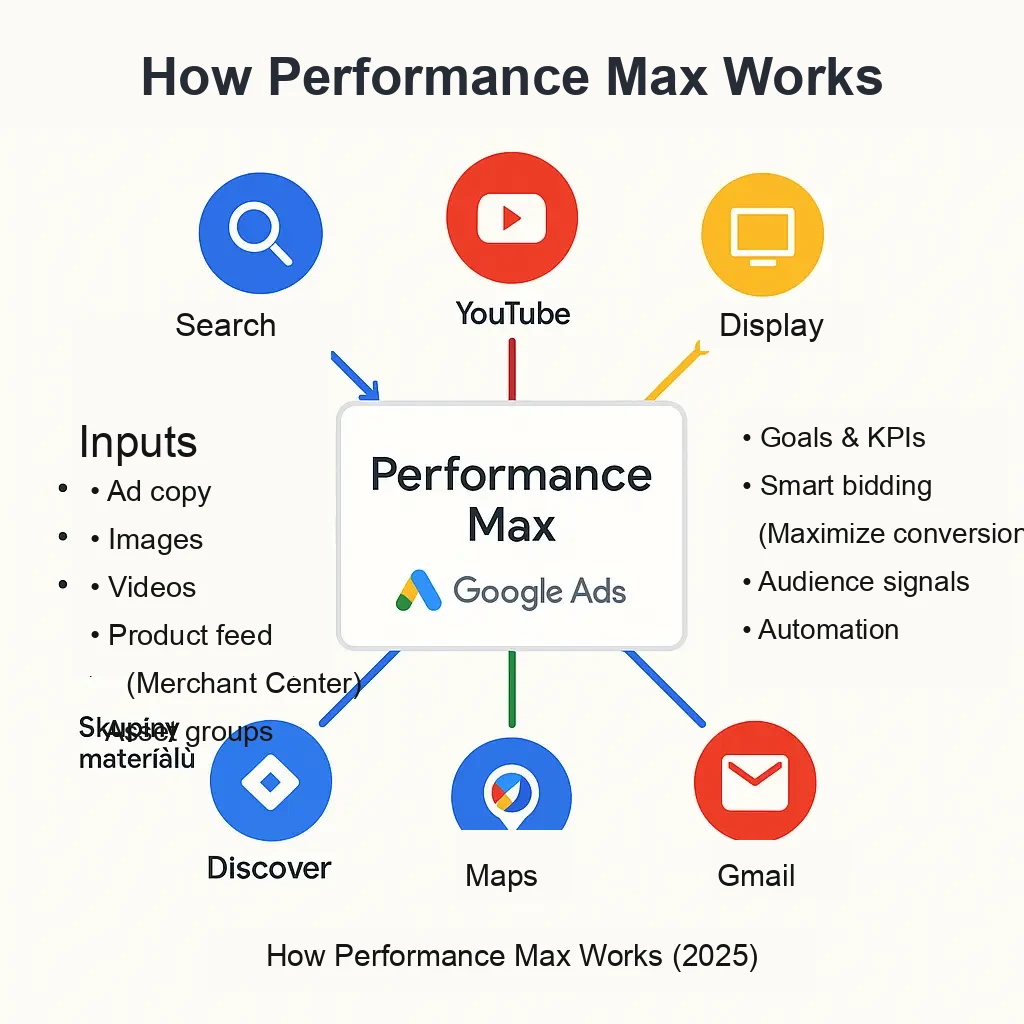
Performance Max (PMax) is a relatively new Google Ads campaign type, launched by Google in 2021. It uses machine learning to manage ads automatically across all Google channels. Unlike traditional campaigns, where you manage each network (Search, Display, YouTube and others) separately, Performance Max lets you cover the entire Google ecosystem from one campaign. Your ads can appear in Google Search, on YouTube, across the Google Display Network (GDN), in Gmail, Google Maps or Discovery, in short, wherever Google has ad inventory.
How does it work in practice? PMax is built around a conversion goal. When you create a campaign, you choose the goal that matters to your business, such as “Leads” or “Sales”, and where relevant you set a target cost per action (tCPA) or target return (tROAS). Google then uses AI to optimize bids and placements automatically in real time, with the aim of reaching that goal as efficiently as possible. It uses Smart Bidding strategies and evaluates a wide range of signals, including audience, context, device, time and more. Ads are assembled from the assets you provide, such as text, images and videos, in a similar way to responsive ads.
The advantage is that you do not have to decide manually where your ads should appear. Google handles that for you and finds customers across channels you might otherwise miss. Performance Max can uncover additional conversions beyond your standard search campaigns. That is why Google positions it as a complement to search campaigns, helping you acquire new customers your keywords would not otherwise reach.
The downside is that you give up some control. With PMax, you do not manage individual keywords, because it works more with broader “search themes”. You cannot fine-tune bids for specific queries, and you cannot manually select exact placements. Performance is largely in the hands of the algorithm, which can be a major advantage, but also a risk if you do not know how to steer Google AI properly.
Google is constantly improving PMax. In 2024, it added more than 90 new features and improvements to the system, which led to measurable growth in conversions and conversion value. For example, it introduced channel-level reporting, more detailed search term insights and asset performance reporting, all designed to provide greater transparency and make campaigns easier to manage. It is no surprise that advertisers worldwide have adopted Performance Max quickly. According to Google, more than a million advertisers already use it. PMax is becoming the new standard in Google advertising, so knowing how to get the most from it matters.
Is Performance Max suitable for B2B lead generation?
Short answer: yes, but with the right setup. Performance Max can be highly useful for B2B companies, but it needs a different approach from e-commerce. In B2B, a conversion, or lead, is where the sales process begins. In an e-shop, the purchase is where it ends. Your “product” is often a complex service with a long sales cycle, so the goal is not to collect hundreds of generic leads. It is to generate a smaller number of genuinely valuable business opportunities.
At a basic level, PMax can bring you a high volume of conversions: form inquiries, offer downloads, registrations and more. But quantity is not the same as quality. Many B2B advertisers have found that PMax generated conversions, but those conversions did not become real customers. The reason is simple: the algorithm optimizes for the metric it can see, for example the number of forms submitted. If it does not receive any additional signals, it will maximize volume. It can therefore start prioritizing channels and tactics that bring cheap conversions, but not necessarily good ones, such as users who fill out a form out of curiosity or by mistake.
The solution is to give Google quality signals as well. One proven method is Offline Conversion Tracking (OCT), which means uploading information back into Google Ads about which leads actually became deals, or which leads have value for you through lead scoring. Google Ads allows you to import conversions from a CRM, for example by marking leads that passed qualification or generated revenue. This tells the algorithm: these conversions were valuable, find more like them. PMax can then stop blindly chasing volume and learn to recognize quality.
Another recommendation is to track the full funnel. Do not optimize only for the number of leads acquired. Track follow-up micro-conversions too: how many booked a meeting, how many accepted an offer, how many signed a contract. Either import this data into the system, or at least use it in your internal campaign evaluation. PMax can bring you prospects, but closing the deal is up to you. If you see that certain campaigns generate leads that do not move any further through the funnel, that is a warning sign that you need to adjust your targeting, message or filtering.
Current trends: AI in search and high-quality content
It is worth noting that search and online marketing are changing quickly. Google is gradually adding artificial intelligence elements to search results (AI Overviews, SGE), giving users direct summaries of information. That may mean fewer clicks to organic results. Companies therefore have to compete harder for visibility, and PPC advertising is one way to stay visible when traditional SEO loses some of its space. Performance Max has a role here because it lets you cover the maximum amount of inventory Google offers.
At the same time, Google is placing more emphasis on content quality and user experience. Its algorithms, for example Helpful Content System 2.0, are getting better at recognizing content written primarily for users, not SEO spam or low-value AI-generated text. For advertisers, the lesson is clear: focus on the quality of the content on your landing pages. The more useful and persuasive the page is that you send a PMax visitor to, the greater the chance that the lead becomes a customer. Google can use AI to bring people to your website, but turning a visitor into a client is your job, through strong content, a strong offer and good follow-up.
How do you set up a Performance Max campaign for lead generation?
If you are clear that you want to try Performance Max for B2B lead acquisition, let us walk through the setup and best practices step by step:
1. Define conversion goals and measurement. In the Google Ads interface, create a new Performance Max campaign. Choose “Leads” as the goal, or Sales if you track revenue. Make sure conversions are set up, typically form submissions, clicks on an email address or phone calls. Without proper conversion tracking, this will not work. If one lead is more valuable to you than another, for example an enquiry for a more expensive service, consider setting conversion values or different goals. Ideally, use conversion values to signal quality. For instance, a lead that passed qualification can have a higher value in the system.
2. Prepare high-quality assets. Performance Max automatically builds ads from your assets. Prepare strong copy, including headlines and descriptions. Highlight your unique customer offer, add a clear call to action and address the customer’s problem. You will also need images in multiple dimensions, such as company photos, product images and illustrative graphics, and if possible, video. Video is not mandatory, but it is strongly recommended. If you do not provide it, Google may try to generate a video automatically from your images and text. It is better to use your own short promo video than to rely on automation. For B2B services, a video might include a product demo, client references, a team introduction and so on.
3. Set audiences (Audience Signals). Even though PMax targets broadly, you can, and should, give Google clues about who to look for. In the Audience Signals section, add relevant groups:
- Custom segments based on keywords your customers search for (for example "ERP system for manufacturing"), or on competitor website URLs they might visit.
- Your customer data (Customer Match), if you have a database of existing client or lead email addresses, upload it. Google will use it to create similar user groups.
- Demographic and interest groups, if they make sense (for example targeting only certain sectors or job functions, although Google tends to handle this through its own algorithms rather than manually).
These audience signals do not restrict impressions only to that audience, but they help Google find the right people faster. They are input data for the algorithm and help shorten the campaign’s learning phase.
4. Split the campaign into meaningful parts. Performance Max does not use ad groups. It uses asset groups. If you offer several different services or target different customer segments, create a separate Asset Group for each area with matching assets. For example, one group for “IT outsourcing” and another for “Custom software development”, each with its own copy and images. This helps ensure each audience sees ads that are as relevant as possible. At the same time, there is no value in over-fragmenting campaigns. If you are targeting the same service and the same audience, keep it in one campaign so the algorithm has enough data.
5. Set the budget and bidding. Decide how much you want to invest in the campaign daily or monthly. For B2B lead gen campaigns, it may make sense to start with a reasonable budget, for example the equivalent of 1 to 2 times the price of your product per month, and then adjust gradually. Choose a bid strategy: Maximize conversions, with the option to set tCPA, or Maximize conversion value, with tROAS, if you work with values. For lead generation, target CPA is usually chosen. For example, if you want a lead for CZK 200, set tCPA = CZK 200. But be careful. If you set the target cost too low and PMax cannot acquire leads that cheaply, delivery will be limited. Sometimes it is better to start with a looser strategy, just maximize conversions without limits, and apply tCPA based on reality once you have data.
6. Use extensions and additional settings. As with other campaigns, you can add ad assets such as sitelinks, callouts, phone numbers, lead forms and so on. Make sure your geographic targeting is set correctly, for example the whole Czech Republic or specific regions if you operate locally, as well as location exclusions, such as foreign countries if you do not offer services there. PMax campaigns also now allow negative keywords at account level. Use this to exclude completely irrelevant queries or your own brand queries if you do not want PMax to target them.
7. Final URL expansion. One specific PMax feature is Final URL Expansion. By default, Google can choose a different landing page from your website if it decides that page is a better match for the user’s search query than the URL you entered. It can also dynamically generate headlines based on page content. This feature can help capture additional conversions, but in B2B it can also create problems, for example by sending users to a general page instead of a specific landing page. Recommendation: if you have well-built landing pages for your services, consider turning Final URL Expansion off so Google does not accidentally send visitors somewhere else. Alternatively, use the option to exclude pages you definitely do not want PMax to use.
After launching the campaign, give the data time to build. Allow the system at least 1 to 2 weeks, or a few dozen conversions, to get moving. During that period, do not interfere with the campaign too much. Let the algorithm learn. Then comes the next phase: ongoing optimization.
How do you optimize PMax campaigns and what should you avoid?
Performance Max is not a “set it and forget it” method. To deliver strong results over the long term, it needs continuous management and tuning. Here are proven practices, plus common mistakes and pitfalls worth avoiding:
Evaluate performance regularly: Track campaign metrics such as CPA (cost per acquisition), number of conversions and conversion rate, but also qualitative indicators. If you import offline data, for example how many campaign leads became customers, also track the so-called Conversion Rate to Opportunity/Customer. New PMax reports, if you have them available, also allow you to see performance by channel. For example, you may find that most conversions come from Search and Display, while YouTube brings nothing. You can then consider whether to create a separate video campaign or adjust the creative.
Creative and copy updates: Every few weeks, check how your ad assets are performing. Google Ads provides ratings (low, good, best) for text, images and videos. Replace or adjust anything rated “Low”. Test new copy variants, for example a different USP or a different call-to-action style. For images, try different visuals, infographics, or add references, such as client logos and awards, directly into the graphic to increase trust. Remember that PMax relies heavily on your assets. If they are not compelling enough, performance will be limited.
Audience Signals, adjustments: Look at the “Search terms” report. It is already available for newer PMax campaigns. You will see which queries are bringing visits. If you see irrelevant queries, add them as negative keywords at account level. That tells PMax where not to go. Conversely, if you discover new relevant queries, try incorporating them into custom audience segments or ad copy. Also monitor the Placement report, which shows where your ads appeared in the Display Network and on YouTube. You may discover that you are appearing on websites or videos that are not suitable. In that case, use placement exclusions in Google Ads.
The most common mistakes to watch out for:
- Missing feedback on lead quality: As already mentioned, if PMax optimizes only for the number of forms, it can create a flood of cheap but low-quality inquiries. Many companies fail to connect their CRM with Google Ads and lose the opportunity to train the algorithm on high-quality leads. Do not underestimate this. Set up offline conversions or at least manually evaluate quality and adjust campaigns accordingly.
- Ignoring the whole funnel: PMax may appear to be hitting the target beautifully, for example bringing leads at CZK 150, but what happens next? Track follow-up metrics too: % of meetings booked, % offer to order, etc. If these numbers lag, the problem may not only be in the sales team. It can mean the campaign is targeting the wrong audience or promising something the offer does not then deliver.
- Over-reliance on automation: Do not assume that Google will do everything for you. Check the campaign at least once a week. Even advanced AI sometimes struggles and needs strategic human intervention. For example, if you know your budget is running out or the market is changing, you may need to intervene manually, such as temporarily lowering bids, pausing the campaign, etc. Google AI is a powerful tool, but company strategy and expert oversight are irreplaceable.
- Weak or repetitive creative: If you provide only the bare minimum of assets, for example one image, no video and 3 short sentences, you cannot expect miracles. PMax needs something to work with. Underinvesting in creative production does not pay off. Invest time in preparing high-quality banners and test different messages for different audiences. Creative is often what decides whether a user converts or ignores the ad.
- Short time horizon and frequent interventions: Sometimes the mistake is impatience. PMax may need several weeks to fully ramp up and optimize. If you intervene every other day, changing goals and budgets, adding and removing assets, the algorithm will keep resetting and never mature. Give changes time to show results. Google recommends evaluating performance over a horizon of at least 4 weeks after a major change.
How does Performance Max compare with other platforms?
For B2B lead gen, Google Ads campaigns are far from the only option. Platforms such as LinkedIn Ads, Facebook/Instagram, the Czech Seznam Sklik and Bing (Microsoft Advertising) often come into play too. Each has pros and cons. Performance Max essentially combines most Google inventory (Search + partner websites + YouTube + Gmail, etc.), so its competitors are usually other ecosystems rather than individual ad formats. Let us briefly look at which platform is suited to what, and how they differ:
- Google Ads (Search + PMax): Google is the pioneer of PPC advertising and the foundation of most online strategies. In Search, it reaches users with active intent. They are looking for your solution, so the conversion rate is usually excellent. The downside is heavy competition for lucrative keywords. Click prices can be higher in sectors where several companies are competing for demand. Performance Max then allows you to expand reach beyond Search without having to manage Display or YouTube separately. Overall, Google reaches more than 90% of internet users globally, and in the Czech Republic, thanks to the dominant share of its search engine, it also reaches the vast majority of the online population.
- LinkedIn Ads: LinkedIn's advertising platform is unique in its ability to target professional audiences precisely, by field, position, industry, company size, seniority and so on. For B2B, this is often a goldmine, especially when you are targeting a narrow group of decision-makers. An example could be a campaign targeting "CTOs in engineering companies with 50+ employees in the Czech Republic", something only LinkedIn can do. The disadvantage is cost: CPC on LinkedIn is usually an order of magnitude higher than on Google. It typically ranges around $5 to 15 (i.e. CZK 100 to 300) per click, sometimes more. According to some data, however, cost per lead on LinkedIn is 28% lower than in Google Ads for B2B campaigns, suggesting that although clicks are expensive, high-quality conversions can compensate. LinkedIn has limited reach in the Czech Republic, with profiles in the low millions, but it is a very high-quality audience in a work mindset.
- Facebook/Instagram (Meta Ads): Meta platforms (Facebook, Instagram) offer massive reach across the population and relatively low click prices. They are ideal for promoting products and services people are not actively searching for, or for building awareness in the early stages of demand. With attractive, original creative, advertising on Facebook or Instagram can even outperform Google Search campaigns, especially when the content grabs attention and prompts users to respond. In B2B, Facebook is used, for example, to target specific interests or roles, although not as directly as LinkedIn, and for remarketing to website visitors. Click costs often range from single-digit CZK amounts to tens of CZK, but conversion rates tend to be lower than in Search because the user is not primarily looking for anything on a social network. Lead gen campaigns on FB, for example using Lead Forms directly on Facebook, can work, but you need to expect lead quality to fluctuate. People sometimes fill out forms more out of curiosity. Even so, it is a strong channel for filling the top of the funnel (TOFU) and subsequent nurturing.
- Seznam Sklik: A Czech PPC platform on the Seznam.cz search engine and its content network. Today, Sklik functions more like a media house than a pure search engine. In addition to advertising in search results, where Seznam has roughly a 10 to 20% market share in the Czech Republic depending on the segment, it offers broad banner and native advertising options on Seznam websites and partner media. The advantage of Sklik is often lower competition in many industries and therefore cheaper clicks compared with Google Ads. The disadvantage is limited reach, only Seznam users, and somewhat less advanced targeting and optimization options. For B2B companies targeting the Czech market only, however, Sklik can be an interesting complement. It reaches users Google may not have reached, often at a good price. For example, in some B2B sectors, your CPC in Sklik can easily be 30 to 50% cheaper than in Google, even if search volume is lower.
- YouTube and other Google channels: These channels actually fall under Google Ads/PMax, but they are worth mentioning separately. YouTube is the world's second-largest search engine after Google. For B2B, it is interesting if you have content, meaning video ads, that can engage your target audience. Its advantage is very precise targeting by video topics, keywords or specific channels. With B2B videos, you might target channels about industry, conferences, interviews with leaders and so on. We will mention TikTok and other platforms only in passing here. TikTok has low ad costs and is growing, but in Czech B2B it is not yet used at scale, more often for HR marketing or highly innovative campaigns. Microsoft Ads (Bing) can bring an additional 5 to 20% reach in global markets, depending on the segment, but in the Czech Republic Bing's share is only a few percent. Its importance may grow with the rise of AI (Bing chat integration), but for now it remains marginal.
For clarity, I will summarize the key platform differences in a table:
| Platform | Strengths and advantages | Weaknesses and limitations |
|---|---|---|
| Google Ads (Search & PMax) | Huge reach (practically the whole internet in the Czech Republic), high intent (users actively search for solutions), excellent lead conversion. PMax expands reach beyond Search. | High competition for attractive queries leads to higher CPC. Limited detailed control in PMax (Google automates). |
| LinkedIn Ads | Precise B2B targeting by professional data (position, field, company). High-quality leads, audience in a professional mode. | Very high cost per click/lead. Limited reach (users must be on LinkedIn, low millions in the Czech Republic). |
| Facebook/Instagram Ads | Mass reach, low CPC. Good for awareness-building and reaching latent demand. Ability to scale campaigns quickly. | Weaker targeting for professional segments (cannot target job title directly). Leads may be less qualified and need filtering. Conversions are often lower than with Search. |
| Seznam Sklik | Reach among Czech audiences not using Google. Lower competition leads to cheaper clicks. Strong Czech content websites within the network. | Small search market share. Less advanced automation and formats than Google. Some specific B2B audiences may not be active on Seznam. |
As you can see, there is no single best platform in general. It always depends on your product, target audience and budget. For most Czech B2B companies, a mix makes sense: Google Ads (Search + PMax) as the foundation for capturing active demand, LinkedIn for targeted reach among company decision-makers if the budget allows, and Facebook/Instagram for brand building and retargeting. You can add Sklik if you also want to capture the rest of the Czech audience. The key is to measure results, including cost per lead, cost per qualified lead and cost per sale, for each channel and compare the cost/performance ratio.
For example, you may get 10 leads from LinkedIn for CZK 20,000 (CZK 2,000/lead) and 50 leads from Google for CZK 25,000 (CZK 500/lead). At first glance, Google looks clearly cheaper. But if those 10 LinkedIn leads bring you 5 clients and the 50 Google leads bring only 2 clients, the economics suddenly flip in LinkedIn’s favor. That is why you should always track costs all the way down to customer acquisition level, or ROI.
How do you calculate return on investment (ROI) in PPC campaigns?
When you invest in advertising, you want to know whether it paid off. ROI (Return on Investment) gives you the answer. The calculation is fairly straightforward: ROI = (Campaign revenue - Campaign costs) / Campaign costs x 100%. The result is the percentage return on the money you invested. A positive number means the campaign earns more than it costs. A negative number means the opposite.
In e-commerce, ROI is easy to calculate because revenue equals order revenue from the campaign. In B2B lead gen, it is more complicated because revenue comes from deals closed months after the lead was acquired, and not every lead becomes an order. Even so, ROI can be estimated if you know customer value and conversion rates in your sales funnel.
Let us consider a simple model example for a B2B service:
- Monthly campaign budget: CZK 50,000
- Average cost per click (CPC): CZK 50
- Visitor to lead conversion rate: 5% (50 out of 1000 visitors convert)
- Number of leads acquired: 50
- Lead success rate (lead to paying customer): 10% (5 deals closed from 50 leads)
- Number of new customers: 5
- Average order value: CZK 100,000 (revenue per customer)
- Total revenue attributed to the campaign: 5 x 100,000 = CZK 500,000
- Profit (revenue - costs): 500,000 - 50,000 = CZK 450,000
So ROI = (450,000 / 50,000) x 100% = 900%.
This 9x return looks excellent. You invested CZK 50,000 and generated half a million in revenue. Of course, ROI will not always be this high. Everything depends on your conversion capability and customer value. If, in the same example, the deal close rate were only 2% (1 customer from 50 leads), revenue would be CZK 100,000 and ROI would be only 100%, meaning you earned zero profit and just about broke even.
ROI calculator: We recommend doing a similar calculation for your specific case. If you plug in realistic numbers, for example what % of leads you turn into deals and what they are worth, you will get the target cost per lead at which you break even. That helps you determine what CPA you can afford. For example, if you know the average order is worth CZK 50,000 and 1 out of 10 leads becomes a deal, one lead is worth CZK 5,000 to you. Anything under CZK 5,000 per lead is ROI-positive. If a lead costs you CZK 2,000, you are still in profit, with a decent ROI of around 150%. Conversely, a lead for CZK 10,000 would be loss-making.
When evaluating campaigns, therefore, look beyond cost per lead. Track cost per acquisition, meaning the cost of acquiring a customer, and overall return too. Sometimes a campaign with a higher CPA can have better ROI because it brings in very solvent clients. Other times, it pays to acquire cheap leads at scale and rely on at least a few of them working out. That falls under your sales strategy.
Tip: In Google Ads, you can set a so-called conversion value and enter it as the expected value of a lead, for example that CZK 5,000 average. You can then optimize for tROAS (target return on ad spend). For example, tROAS = 500% in our example would mean that for CZK 1 in advertising, we want CZK 5 in revenue. Google will then try to adapt the strategy accordingly. It is not as precise as e-commerce, but it is better than nothing. If you value leads correctly, it can help prioritize higher-quality conversions.
Decrease in cost per conversion after campaign optimization, internal case study (illustrative data).
The chart shows a 95% reduction in average cost per lead over 6 weeks of optimization. Thanks to a combination of better targeting, creative adjustments and use of first-party data, the campaign dramatically improved efficiency.
Increase in the number of conversions thanks to campaign optimization, case study.
After adjusting the strategy and deploying a Performance Max campaign, the number of leads acquired increased by +560% (compared with the previous state). This kind of growth leads to a significant reduction in cost per conversion and, while maintaining lead quality, to higher ROI.
Frequently asked questions about Performance Max (FAQ)
- Is Performance Max suitable for smaller companies too, or only for large advertisers?
-
In principle, it is suitable for anyone with a clearly defined conversion goal. Smaller companies can use it, for example, for local targeting and basic lead acquisition. The important thing is to have enough data. If your campaign generates only a handful of conversions per month, PMax will not have much to learn from. With smaller budgets and few conversions, it may be better to start with a classic search campaign and deploy PMax once you have more conversion data for the algorithm.
- How many conversions do I need for PMax to "learn" to work effectively?
-
Google does not give a strict number, but as a rule, the more, the better. In any case, you want at least 15 to 20 conversions per month so that a Smart Bidding strategy (tCPA/tROAS) can optimize reasonably. Dozens of conversions per month are ideal. If you have fewer, do not despair. PMax can work with a smaller volume of data too, but results may fluctuate and take longer to stabilize. In that case, seriously consider using audience signals and other inputs that give Google useful hints.
- What if I do not have any video for the campaign?
-
Video is recommended, but not mandatory. If you do not have one, Google will try to create a simple "slideshow" video from your images and text. The quality of this automated output is limited. Consider whether you can produce at least a short video, perhaps a presentation animation, a cut of testimonials or a spoken invitation. Video can significantly increase reach because it opens YouTube and video inventory in the Display Network. If it really is not possible, you can run PMax without videos too. But make sure you have "Auto-generated video" turned off if you do not like the automated creations.
- Will Performance Max cannibalize my existing search campaigns?
-
PMax is designed to complement your Search campaigns, not replace them. If a user enters a query that matches your exact match keyword in another campaign, that search campaign gets priority. PMax mainly comes into play for queries you do not cover in Search campaigns, or when your search campaigns are exhausted and limited by budget. It can happen that PMax sometimes shows an ad on a keyword you have in Search, for example because of budget limits, but if you want to prevent that, you can add negative keywords to PMax or use brand exclusions for your own brand queries. In general, PMax and standard campaigns can coexist and jointly cover more space.
- On which platforms do ads from PMax actually appear?
-
Performance Max covers all Google channels: Search (Google Search), including Maps, the Display Network (banners on websites and in apps), YouTube video ads, Gmail (ads in the Promotions tab) and the Discover feed on mobile. In other words, your ads can reach users while they search on Google, read news, watch videos or check email. However, PMax does not include social networks outside Google. For those, you need to use other platforms, such as Facebook, LinkedIn, Twitter and so on.
- Can I exclude audiences or placements where I do not want to appear in a PMax campaign?
-
Targeting and exclusion options are more limited in PMax than in other campaigns, but some things are possible. Negative audiences cannot be set as such, so you cannot say "do not target these users", but you can exclude locations, such as countries and regions, and keywords at account level. Google also allows brand keyword exceptions, so you will not appear for queries containing, for example, your name or specific words you enter. You can also use Content suitability settings for content, for example unsuitable content where you do not want to appear. Since May 2025, Google has been rolling out placement and channel reports, so you can see where you appeared and react if needed, for example by blocking some placements in the Display Network. However, it is not as straightforward as in classic Display campaigns.
- How quickly do changes in a PMax campaign take effect?
-
Every change to bidding strategy, ad assets or budget triggers new algorithm learning. Usually, PMax needs several days to a week to fully adapt. The first 1 to 2 weeks of a new campaign tend to be weaker because the campaign is still in its learning phase. If you make a minor change, such as adding a new ad, it does not matter as much. But major changes, for example reducing tCPA by 50% or completely replacing creative, can temporarily disrupt performance. Google recommends evaluating roughly 4 weeks after larger interventions. So be patient. Give it time and do not panic if performance fluctuates for a few days.
- Do I have to keep checking PMax, or can I set it up and let it run?
-
You definitely need to check it. Although PMax is highly automated, it still needs human oversight and strategy. We recommend reviewing results at least once a week, looking at new statistics, such as search queries and performance by channel, and checking competitors. Occasionally refresh banners, add new references and test a different offer. Competitors are not standing still, and while AI optimizes, it does not have creativity or business instinct. You will get the best results when you combine the power of automation, meaning speed and big data, with the human factor: ideas, experience and customer knowledge.
What are the key takeaways and recommendations? (Summary)
- Performance Max can be a powerful engine for lead-gen campaigns, if you feed it the right data and guide it properly. When deploying PMax, always think about conversion quality. Measure which leads are valuable and use that to teach the algorithm through offline conversion imports, values and lead scoring.
- B2B companies should see PMax as part of a broader strategy. It can cover the Google ecosystem very well and bring in additional inquiries, but do not rely on it alone. Combine it with LinkedIn for targeting specific companies and roles, and with other marketing such as content and emailing, so the customer is guided through the full buying cycle.
- Test and optimize: PMax saves you a lot of manual work, but do not give it completely free rein in everything. Evaluate campaigns regularly, run experiments (Google also offers A/B testing for different campaigns or asset groups), and look for creative ways to engage the customer. Even a small reduction in CPA or increase in conversion rate multiplies into total profit.
- Watch the trends: Online advertising is evolving. Google is introducing new features (SGE, AI assistant in search, GA4, etc.) that will change user behavior. Stay one step ahead. For example, if Google increasingly answers users directly with AI answers, fewer users may click through to organic results. This is where PPC campaigns can capture what would otherwise be lost. At the same time, website quality and trustworthiness, the E-E-A-T principle, will also play a role in campaign success, because users are more demanding and Google considers content as part of page evaluation (Quality Score).
- Do not be afraid to ask an expert for help: Managing PMax and PPC in general can be time-consuming for busy company directors or junior marketers. If you are not sure whether everything is set up optimally, a consultation with an experienced PPC specialist can save you hundreds of thousands of CZK. As we saw in the examples, proper optimization can reduce cost per lead by as much as 95% and multiply your revenue. Investment in expert PPC management therefore often pays for itself many times over.
CEO & Performance Strategist




 Fast
Fast  Effective
  Nonstop