
 June 9, 2025
 PPC Advertising 2025: 7 Tactics to Push Your Campaigns to the Top of Google Search
Article Contents
- Quality content and credibility (E-E-A-T) as the foundation of PPC success
- Make full use of AI and automation in Google Ads
- First-party data and personalization in the privacy era
- Prepare for voice search and AI Overviews (SGE)
- Let ROI lead: the right metrics and evaluation
- Scale campaigns gradually and sustainably
- Combine automation with human creativity and expertise
- Conclusion
- Frequently Asked Questions About PPC Advertising (FAQ)
Google advertising is changing quickly in 2025. Google has rolled out new algorithms, including Helpful Content System 2.0 and the March 2024 Core Update, placing even greater emphasis on content quality and user satisfaction. At the same time, AI Overviews (Search Generative Experience, SGE) are appearing in search results, and voice search is becoming more important. Both trends are changing user behavior and reshaping the search results page. For businesses, success with PPC now requires a smarter strategy than ever. In this article, we share 7 practical PPC advertising tactics for 2025 that can help move your campaigns toward the top of search results. The tips focus on business impact, a high return on investment (ROI), and sustainable campaign scaling. Instead of repeating generic advice, we offer an original perspective that connects current SEO trends with PPC and draws on real case studies. Let us look at the specific strategies that will help you get more from Google Ads and move ahead of the competition.
1. Quality content and credibility (E-E-A-T) as the foundation of PPC success
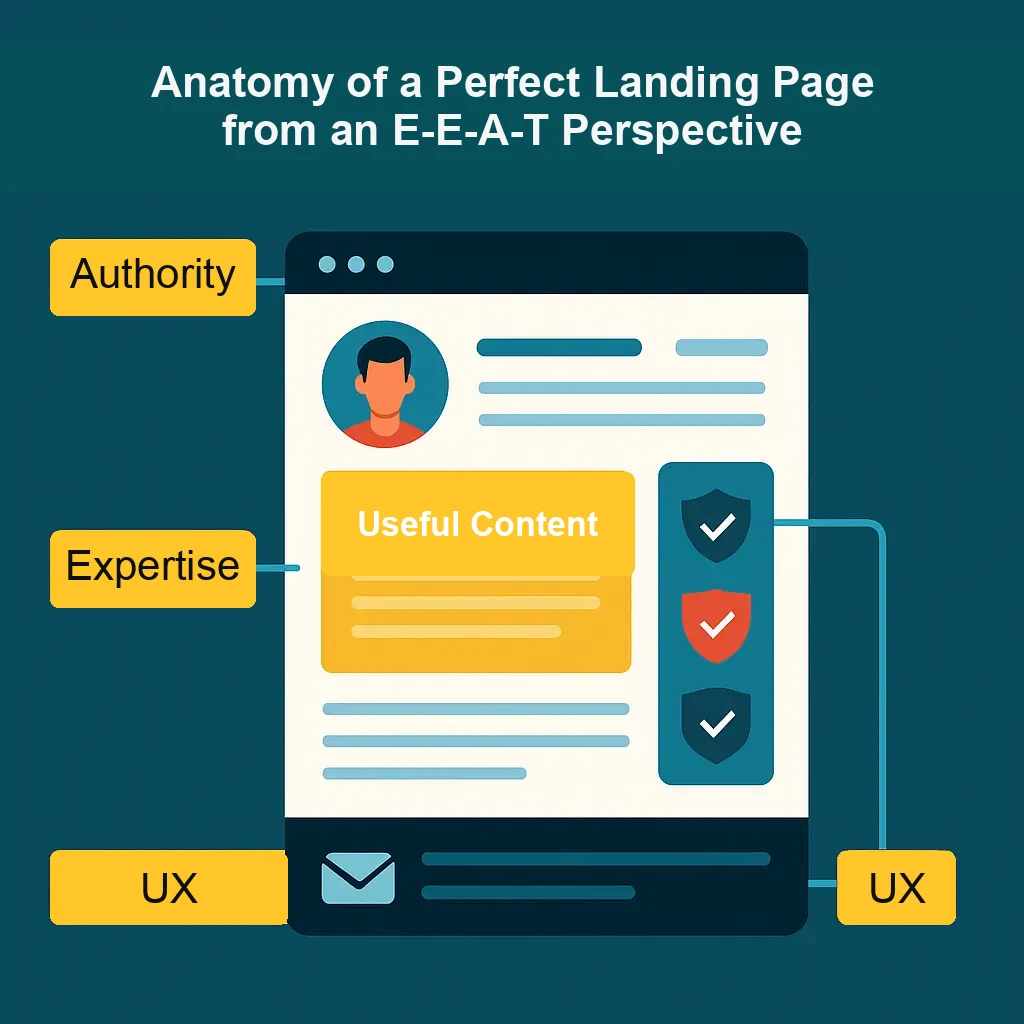
The first tactic is to focus on the quality of the content and website your PPC ads lead to. In the era of Helpful Content System 2.0, Google favors sites with original, useful content. Although this mainly affects organic search, it also has a clear impact on PPC. Ad Quality Score takes landing page relevance and quality into account. The more valuable the content on that page is, the better your score can be and the lower your cost per click. Make sure the pages your PPC campaigns send traffic to are clear, useful, and trustworthy. Apply the principles of E-E-A-T and show your company’s expertise, authority, and credibility:
- Relevant and useful content: Answer the visitor's needs directly on the landing page. For example, if the ad promises to solve a problem, the landing page should explain the process in detail and offer valuable information, not just a thin sales pitch.
- Credibility and authority: Highlight references, certifications, case studies, and industry experience. Add customer reviews, partner logos, or media mentions to your site. All of this builds trust with new visitors who arrived through an ad.
- Technical quality of the website: Do not underestimate user experience, including fast page loading, responsive design, and a clear content structure. Core Web Vitals (metrics for website speed and interactivity) do not directly control PPC, but they do affect bounce rate and conversion rate.
2. Make full use of AI and automation in Google Ads
2025 favors advertisers who can use automation and artificial intelligence in Google Ads effectively. Google continues to improve its smart algorithms, from Smart Bidding strategies to automated ad creation. Performance Max campaigns, responsive search ads (RSA), and Dynamic Search Ads (DSA) use AI to maximize reach and performance while reducing time spent on manual management. The key is to configure automation properly and give it the right inputs:
- Smart Bidding: Let Google optimize bids toward your chosen goal (CPA, ROAS, and so on). In 2025, thanks to AI, Google can better predict when to raise a bid to win a conversion and when to save budget. But remember to set realistic goals, such as a target CPA based on your required return.
- Automated ad creation: Use RSA ads, which combine headlines and descriptions with AI so each user sees the most relevant possible combination. New tools are also appearing for generating ad copy and creative with AI. They can inspire you or quickly create variants for testing.
- Dynamic Search Ads (DSA) for website content coverage: DSA campaigns automatically match search queries with your website content. This is a strong way to uncover new keywords and bring visitors to pages you might not otherwise think to target. In 2025, DSA are becoming even better at understanding website content, so use them for market research as well as greater reach. For example, according to PPC experts, DSA can also be used to "spy" on competitors by creating DSA campaigns aimed at competitors' websites and seeing which queries trigger them.
Important: Automation does not mean putting campaigns completely on autopilot. Google is introducing a range of features that automatically pull advertisers into broader targeting, for example broad keyword matching and showing ads for more general queries. Less control for advertisers is becoming a clear trend. We are seeing limited search query reports and the removal of some manual features. That is why you should continuously monitor and evaluate campaigns, exclude unsuitable queries, and adjust targeting so automation does not spend money on irrelevant clicks. Those who learn to work with AI, however, will save time and often achieve better results than with purely manual management.
(A real-world example: A service-sector company moved from manual bidding to smart Target CPA strategies and launched Performance Max. Within 3 months, conversions increased by 30% while the original CPA was maintained. Automation found new customers the ads had not previously reached.)
3. First-party data and personalization in the privacy era
The world of online advertising is facing the challenge of privacy protection. Stricter regulation and the end of third-party cookie support are changing how ads are targeted. In 2025, it is therefore essential to use first-party data and build personalization around your own customer information. This tactic is about using the data you already have intelligently while respecting user privacy:
- Use customer lists and CRM data: Import your customer or lead lists into Google Ads using Customer Match. Google can use them to target ads more effectively to similar audiences (lookalikes) or remind existing customers of your brand and new products. For example, e-shops can upload buyers' emails and create an audience for cross-selling.
- Segmentation and personalized messaging: Divide your audience by behavior (website visitors, abandoned carts, loyal customers) and tailor the advertising message to each segment. Personalized ads tend to have higher click-through and conversion rates. Customers appreciate offers that match their needs. In practice, this may mean having different ad groups for different personas or stages of the buying cycle.
- Respecting GDPR and privacy: If you use remarketing and advanced tracking, make sure you set up Consent Mode correctly and clearly communicate what data you collect. Customer trust is crucial for long-term business. Do not buy questionable mailing lists. Work instead with your own data collected with consent.
From a business perspective, first-party data increases ROI because it lets you target ads where the chance of conversion is highest, instead of spending budget broadly. In addition, cookie restrictions mean that whoever starts building alternatives in time (their own database, community, logged-in users) gains a head start over competitors still relying on old targeting methods. Campaign personalization based on first-party data will therefore be one of the engines of sustainable PPC campaign growth in 2025.
4. Prepare for voice search and AI Overviews (SGE)
Voice search and AI-generated answers in search results (SGE) are changing how people look for information, and therefore how paid results appear. More and more users ask Google questions by voice through mobile devices or smart assistants. These queries tend to be longer and phrased as natural questions (conversational keywords). For example, instead of the blunt query “hotel Prague”, someone might ask, “Ok Google, what is the best hotel in Prague for families with children?” Tactic 4 is therefore to adapt your PPC campaigns to this trend and use it to your advantage:
- Include long and question-based keywords in campaigns: Research the questions people ask by voice in your industry. You can use tools such as AnswerThePublic or Google Suggest directly. These long-tail phrases usually have less competition and often reveal a specific intent. In our campaigns, we can add these queries as keywords or cover them with DSA campaigns so your ad appears even for these specific questions.
- Adapt ad copy to natural language: When users search by voice, Google may show ads that closely match the form of the query. Try working your customers' frequent questions into your ad copy. For example, an ad headline such as "How to improve home security? Try smart cameras from XYZ" may resonate better with the voice query "How do I secure my home?" than a generic advertising slogan.
Alongside voice search, there is Search Generative Experience (AI Overviews). Google has started deploying AI in the United States and gradually elsewhere, summarizing answers to users' queries directly in search results. For advertisers, this has a major impact: the AI answer often appears above paid results, so ads may become less visible. Studies show that in some cases the click-through rate for PPC ads drops when an SGE result with an immediate answer appears at the top. How should you respond?
- Focus on queries with commercial intent: AI Overviews have the greatest impact on general or informational queries, where users can read the answer directly on Google. By contrast, for queries such as "buy ...", "price ...", or "best product ...", Google still often shows paid results, such as Google Shopping or text ads, above or next to the AI answer. Direct your budgets and attention mainly toward keywords where there is a chance your ad will appear at the top, typically queries with purchase intent or localized queries such as "service in city".
- Use every possible extension and format to make your ad stand out: If SGE pushes text ads down, help them stand out. Use ad extensions (sitelinks, callouts, structured snippets, phone contact, and so on) that increase the ad's footprint and make it hard to miss. Also test image extensions in search campaigns if they are available. A visual element can capture attention even below the AI panel.
- Monitor developments and new advertising options in SGE: Google is testing ways to integrate ads directly into AI answers. Even in SGE previews from 2023, concepts appeared where sponsored links were incorporated directly into the generated answer. Be ready to use these formats as soon as they become available. They may be an opportunity to get back to the top even in an environment dominated by AI answers.
Summary: Voice search and SGE are two major trends reducing the share of classic clicks. If you want to keep PPC campaigns at the front of the pack in 2025, adapt: target natural queries, optimize ads for spoken language, and focus your budget where paid advertising still plays an irreplaceable role (commercial queries). This will help you minimize negative effects and use new ways to reach users.
5. Let ROI lead: the right metrics and evaluation
For many company directors, the only question about PPC is this: does it pay off? That is why the fifth tactic emphasizes rigorous campaign measurement and evaluation using the right metrics. Google Ads offers dozens of numbers, but not all of them matter to the business. Focus on ROI and related indicators that reflect the real impact of advertising:
- Set up conversion tracking and monitor real goals: The foundation is to have conversions properly set up in Google Ads (or Google Analytics 4), whether that means submitted inquiries, orders, calls, or other actions that have value for your business. Do not measure only clicks and impressions. What matters is how much revenue the ad generates. If you run an e-shop, track revenue from PPC directly. If you generate leads, assign them a point value or track the closed deals that follow.
- Calculate return on investment (ROI / ROAS / PNO): ROAS (Return on Ad Spend) = revenue divided by advertising costs, PNO (share of advertising costs in revenue) = the inverse of ROAS expressed as a percentage. These metrics tell you how many CZK in revenue were generated by every CZK 1 invested in advertising. Set target values. For example, if you want a 20% margin, your PNO must be max 80% (or ROAS at least 1.25). Monitor these indicators continuously and pause or adjust campaigns that fail to achieve the required return over the long term.
- Use attribution models and look at the entire customer cycle: Do not judge the impact of ads only by the last click. In 2025, Google Ads uses a data-driven attribution model by default, which distributes credit more effectively between campaigns at the beginning and end of the purchase journey. For strategic decision-making, pay attention to assisted conversions as well. For example, the first click from a generic search campaign may introduce the customer to your brand, even if they ultimately convert through remarketing. Analytics data, for example a Return by source/medium report, will help you determine where PPC contributes most to customer acquisition.
Careful evaluation allows you to optimize budget. You can strengthen campaigns and channels that generate profit and limit those with weaker performance. Be prepared to make strategic decisions based on data: for example, increase investment in campaigns where you see ROAS of 500% or more, or experimentally pause campaigns with ROAS below the profitability threshold and monitor the impact. These decisions are essential for sustainable growth. PPC advertising can scale your revenue only if you constantly make sure costs do not outgrow returns.
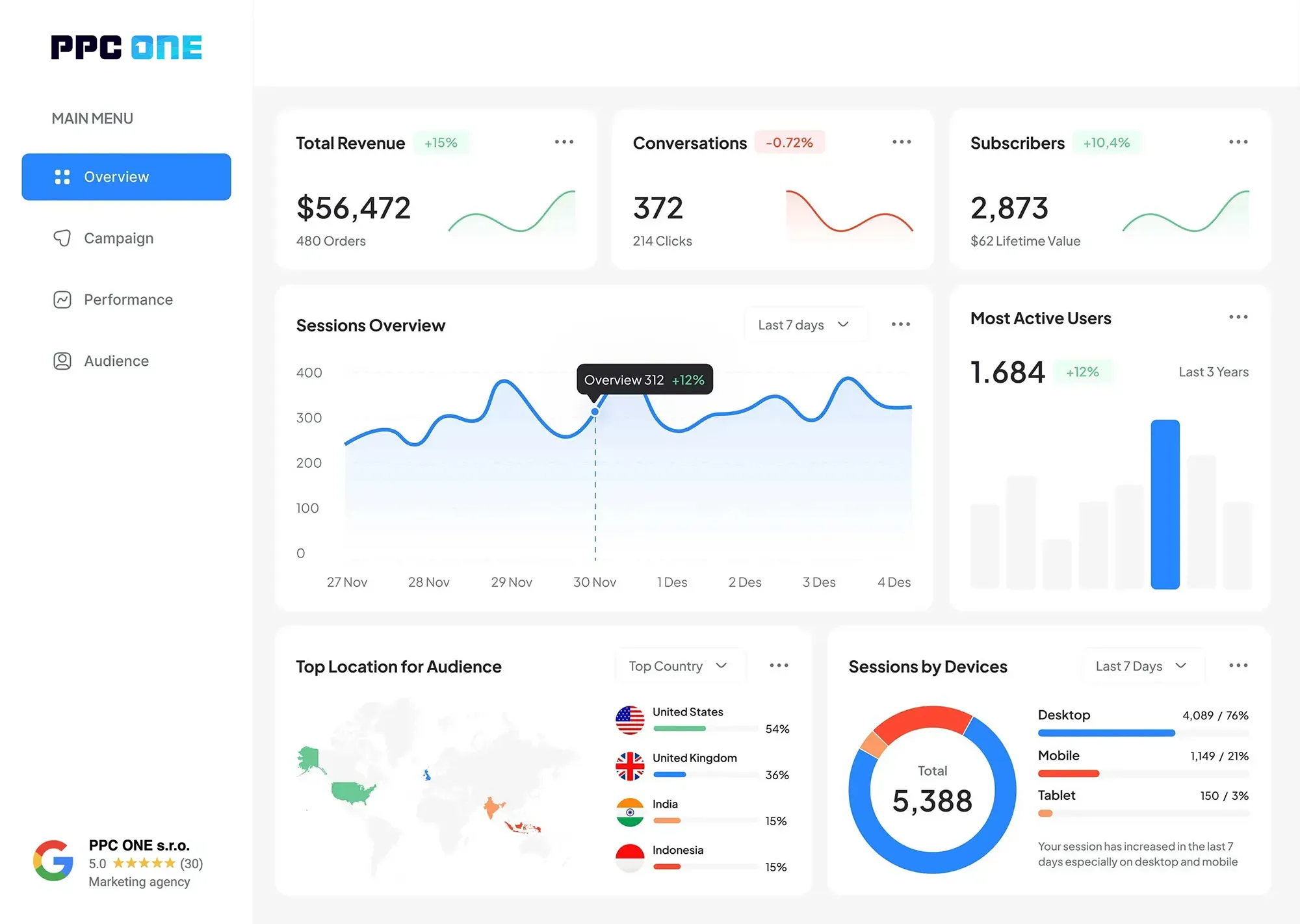
(Tip: Consider creating a dashboard or interactive table in Data Studio (formerly Looker Studio) where you can see the main KPIs in real time: spend, conversions, cost per conversion, PNO/ROAS. For company leadership, this kind of overview is easy to understand and can be used for regular budget decisions.)
6. Scale campaigns gradually and sustainably
Every business wants to grow. PPC advertising is an excellent scaling tool because, in theory, you only need to increase the budget to reach more people. In practice, however, rapidly increasing spend often leads to a higher cost per conversion and declining efficiency. Tactic 6 is therefore to scale campaigns smartly, gradually, and strategically so growth is sustainable and you do not sacrifice ROI. How do you do it?
- Gradual budget increases ("step scaling"): Instead of suddenly doubling the budget, increase campaign daily budgets by ~20%, then let the Google algorithm adapt to the new spending level for several days to a week. Only then take another 20% step. This gradual approach gives smart bidding time to re-optimize, so it can keep CPA stable even at higher volume. Experience from PPC experts shows that this method can make it possible to grow monthly spend from, for example, CZK 100,000 to CZK 500,000 without significantly worsening return.
- Horizontal scaling (diversification): Scaling does not have to mean pouring money into a single campaign. Create new campaigns or ad groups targeted at additional segments, keywords, or audiences. For example, if you sell software, do not limit yourself to one general campaign. You can launch separate campaigns targeted at different use cases or industries. This lets you cover a broader market and lower average CPA by spreading the budget. Similarly, you can expand into new geographic markets or try other platforms (YouTube, Display) as supporting channels.
- Optimization and increasing LTV: Sustainable growth is not only about acquiring new customers, but also about maximizing customer lifetime value (LTV). Reflect LTV in your campaigns. For example, you can upload offline data on actual revenue or customer value into Google Ads (enhanced conversions, CRM conversion imports). If Google learns which customers brought you the highest value, it will prioritize similar profiles in automated bidding. This means that as the budget grows, the smart algorithm will look for quality conversions, not just cheap clicks, making your scaling more profitable.
Sustainable scaling requires patience and planning. Do not try to grow quickly at any cost. If you see CPA or PNO worsening at a certain investment level, you may have hit a ceiling and it is time to slow down. It is better to temporarily stay at the level you have reached, focus on optimizing the conversion rate on your website or developing new creative, and only then try the next wave of growth. By proceeding in stages, you can increase budgets and revenue over the long term without ruining efficiency.
Real-world example: A startup in SaaS services applied a gradual scaling methodology. It increased budget by 15-20% per month while expanding the number of campaigns targeting new segments in parallel. Within a year, it increased Google Ads spend by 300% and gained 280% more conversions, while CPA remained almost unchanged. That kind of growth would not have been possible with sudden scaling.
7. Combine automation with human creativity and expertise
Automation in PPC is powerful, but it is not enough on its own. The final tactic therefore highlights the importance of human creativity, strategic thinking, and expert campaign oversight. Google Ads can optimize bids and generate ad variants, but what it promotes and how it captures customers’ attention is something you (or your marketing team) have to come up with. Here are several areas where the human factor creates a competitive advantage:
- Creative advertising concepts: A machine cannot replace an original idea. Think about advertising campaigns as a whole: what story they tell, what emotion you use to address the customer, and how you stand apart from other ads. In 2025, when many advertisers rely on the same automated templates, human creativity can make sure your ads are memorable. For example, in ad copy you can use an unusual question, a joke, or offer an unconventional benefit that competitors do not mention.
- A/B testing and experiments: Let automation run, but keep testing new ideas continuously. Set up Experiments in Google Ads. For example, test a different landing page, new ad creatives, or a different bidding strategy in parallel with the existing campaign. Human intuition can propose a bold experiment, such as targeting an untested audience or adjusting the pricing strategy, and the data will then show whether it works. Regular experimentation is a source of learning and competitive advantage. You will stay one step ahead of those who rely only on safe automatic approaches.
- Expert interventions and strategy: Experienced PPC specialists know when to let AI work and when to intervene. For example, they can recognize that a certain trend (seasonality, a new competitor in the market) has confused the automation and that the strategy or budgets need to be adjusted manually. They can also come up with a new strategy that is not in any handbook, such as combining PPC and SEO content strategy: using data from PPC campaigns to create content that later attracts visitors organically (and reduces acquisition costs in the future). E-E-A-T applies not only to content, but also to you as an advertiser. Show expertise in your field and in your advertising messages. The more your ads and website feel like they come from an industry leader, the more customers will trust you and convert.
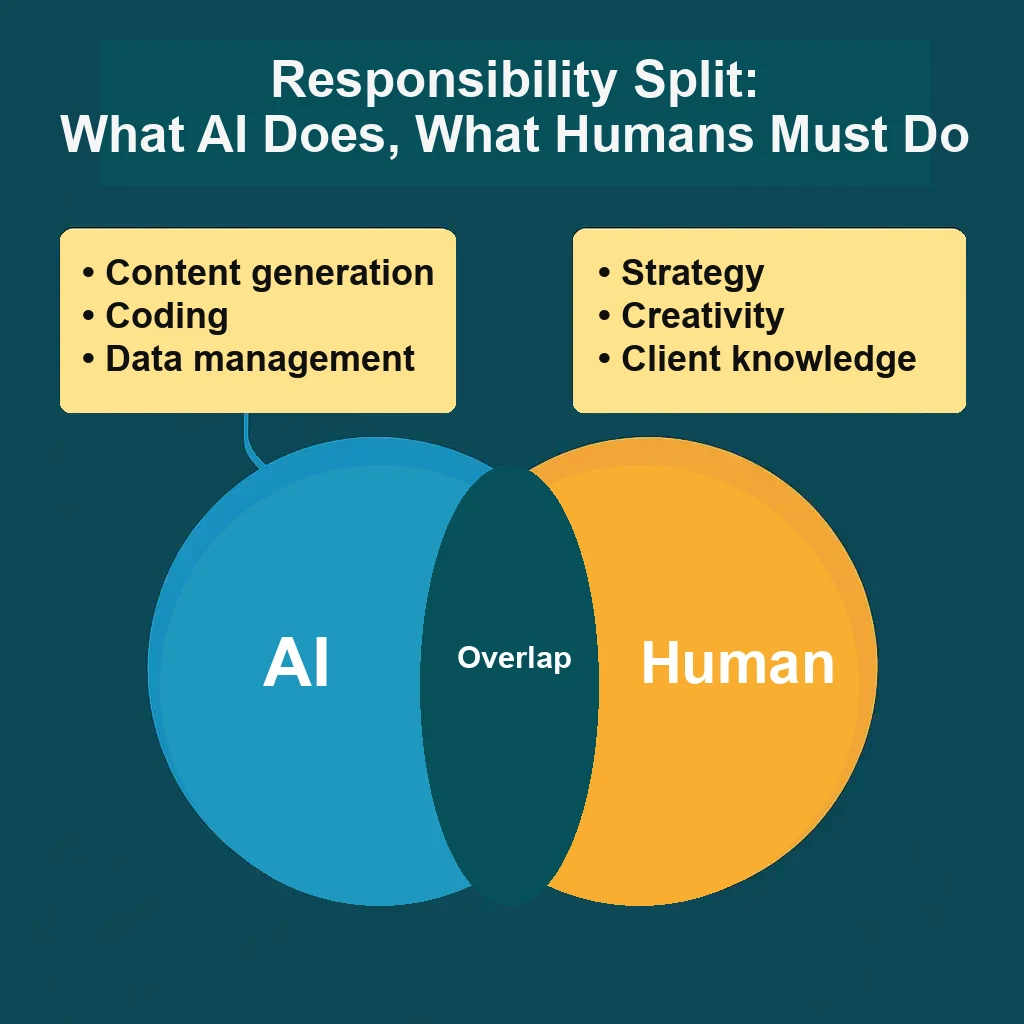
Division of responsibility: human vs AI
In short, the best PPC results come from combining automation with the human factor. Let machines handle the heavy lifting with data and real-time optimization, but keep overall strategy, creativity, and decision-making firmly in your hands. For business owners, this also means not being afraid to invest in experts, whether in the form of an in-house specialist or an experienced PPC agency. One current trend is even increased demand for PPC experts who know how to rein in automation and give campaigns a human dimension. This confirms that human intelligence is just as important in marketing in 2025 as artificial intelligence.
Conclusion
2025 brings new challenges and opportunities for PPC advertising. We have covered 7 tactics, from emphasizing quality content and E-E-A-T, through making full use of AI in ads, working with first-party data and voice search, to constant ROI monitoring, smart scaling, and combining automation with human creativity. All these strategies share one goal: to maximize the contribution of PPC campaigns to your business and maintain a competitive edge. Google Ads can still be a goldmine of customers in 2025 if you approach it strategically, as an investment that must be optimized and developed. Use our tips as a framework for your advertising investment decisions. Watch the trends (AI, algorithm changes, new formats), stay one step ahead with original ideas, and do not be afraid to innovate. When you run your PPC campaigns with an emphasis on return and long-term growth, you can look forward to your ads consistently occupying leading positions in Google Search and, most importantly, bringing you new customers and profitable business.
Frequently Asked Questions About PPC Advertising (FAQ)
- Is investing in Google advertising worth it in 2025?
-
Yes, Google advertising can still be highly profitable in 2025 if it is done correctly. Although competition is growing and the environment is changing, for example because of AI results, Google Ads offers immediate reach to the target audience and measurable results. The key is to set up campaigns so they deliver a positive return on investment (ROI), meaning every CZK 1 invested generates more CZK in revenue. If you proceed strategically (see the 7 tactics above) and keep an eye on costs vs. revenue, PPC advertising will almost certainly pay off. For many companies, it is even the most effective customer acquisition channel.
- How much should I invest in PPC campaigns?
-
The amount you invest in PPC depends on several factors: your industry, keyword competitiveness, margins, and goals. In general, you should invest as much as still delivers a positive return. Start with a smaller budget, for example, to test campaign performance (such as a few thousand CZK per month). Once you see that every CZK 1 spent generates corresponding revenue, for example PNO is below your margin threshold, you can gradually increase the budget. Some companies invest a few thousand CZK a month in Google Ads, others hundreds of thousands. What matters is regularly evaluating whether the investment is returning and then adjusting spend flexibly. You will find guidance on sustainable budget scaling in tactic 6 above.
- How long does it take to see results from PPC advertising?
-
One advantage of PPC is that you can see results very quickly. Unlike SEO, where you wait months for the effect, with Google Ads your ads start running and bringing in visitors almost immediately after the campaign launches. You will get the first data (clicks and possibly conversions) within a few days. However, optimal campaign performance can take some time. The algorithms learn, you fine-tune keywords, exclude irrelevant queries, and test different ads. Campaigns usually mature and stabilize within the first 2-4 weeks. During this time, they need active management. So you may see the first tangible business results, such as new inquiries or sales, in the first month, but real scaling and optimization are ongoing. The best results often come after 2-3 months, when the campaign is fine-tuned.
- How should PPC campaign success be measured?
-
You should measure PPC campaign success with specific metrics that reflect your business goals. The foundation is conversions, meaning the actions you want from users (purchase, form submission, phone call, and so on). You should also track cost per conversion (CPA), meaning how much one acquired conversion costs on average. Return on investment is very important: either ROAS (how much revenue every CZK 1 in advertising brings you) or PNO (the percentage of costs in revenue). These metrics show whether you are making money on advertising. Of course, you can also track CTR (ad click-through rate), bounce rate on the website, or Quality Score, but treat those more as diagnostic indicators. The final judge of success is always the ratio of money spent to profit gained. Use Google Ads (or Google Analytics) for measurement and create clear reports that tell you how campaigns are performing and where there is room for improvement.
- Should I manage PPC campaigns myself or use an agency?
-
That depends on your knowledge, capacity, and budget. PPC campaign management requires time and expertise. You need to monitor developments, optimize continuously, and respond to algorithm changes. If you are a small business with a limited budget, you can try managing campaigns yourself, especially if you are willing to learn the field. Google Ads also offers simple modes and recommendations that may be enough for the basics. On the other hand, an experienced PPC specialist or agency can give your campaigns professional care. They often achieve better results, know the tricks and advanced strategies (like those described in the article), and can save you money by increasing efficiency. For a business owner or director, the return on investing in an expert can therefore be very high. A compromise may be to have a specialist set up the strategy and campaigns, then maintain them internally, or conversely to start independently and bring in a specialist as the campaigns grow and management becomes too complex.
- What are the latest PPC advertising trends in 2025?
-
The main PPC trends in 2025 include growing automation and the use of AI in every direction. Google is taking more and more control (smart bidding, automated Performance Max campaigns, AI ad generation). Connected with this is less control for advertisers, so they need to adapt and look for new ways to use data for campaigns, such as scripts or custom automation. Another trend is voice search and the rise of AI answers (SGE) in results. PPC strategy must be adapted to changed user behavior and a different SERP layout. There is also growing emphasis on privacy and first-party data, with advertisers using their own customer databases more for targeting because third-party cookies are losing importance. The integration of different channels continues as well. Video campaigns (YouTube) and visual formats in general are popular, and PPC is being connected with social networks. Last but not least, both Google and companies are emphasizing measurement of the real contribution of campaigns. Attributed value, customer LTV, and overall business impact are tracked, not just superficial metrics. These trends mean successful advertisers will be those who stay flexible, adopt new tools (AI), and at the same time manage campaigns intelligently from the perspective of business goals.
- How does PPC advertising work with an SEO strategy?
-
PPC (paid results) and SEO (organic results) are two different search channels, but ideally they should work hand in hand. Together, they can occupy a larger part of search results. For example, if your page appears organically and you also have a PPC ad at the top, it increases the chance that the user will click your link, whether paid or unpaid. PPC also makes it possible to get immediate traffic for keywords that SEO may only be trying to reach (new content, competitive queries). Conversely, SEO can cover broad informational content and build brand awareness, which supports PPC effectiveness when people later know your brand. In addition, data from PPC campaigns is valuable for SEO strategy. You can see exactly which queries convert, which copy attracts clicks, and use those findings when creating content and meta tags for organic search. The result of strong PPC + SEO synergy is usually dominance in results (you occupy more positions) and higher overall traffic and conversions. The important thing is to coordinate strategies. For example, keywords with extremely expensive CPC may be better covered with an SEO article, while PPC is used where SEO is not enough or where you need results quickly.
- What mistakes do companies most often make in PPC advertising?
-
The most common mistakes include poor targeting and keywords. Companies sometimes choose keywords that are too general or irrelevant, so they pay for visits from people who are not interested in their product. Related to this is failure to exclude unsuitable queries. Negative keywords must be added continuously, otherwise campaigns spend money on irrelevant clicks. Another mistake is underestimating the landing page. If users do not find what they were looking for after clicking, or the page is slow and confusing, conversions will not come, no matter how good the ad is. Many companies also fail to measure conversions correctly. Without outcome data, they spend blindly and cannot optimize. Lack of strategy is also common: instead of clear goals and processes, they randomly raise or lower budgets, react hastily to short-term fluctuations, and fail to use trends, for example ignoring automation or new formats. Finally, it is a mistake to let campaigns run unsupervised. PPC requires ongoing care, evaluation, and testing. Companies that remove these mistakes gain a major advantage over many competitors, and their campaigns become significantly more effective.
CEO & Performance Strategist


 Fast
Fast  Effective
  Nonstop